
Title
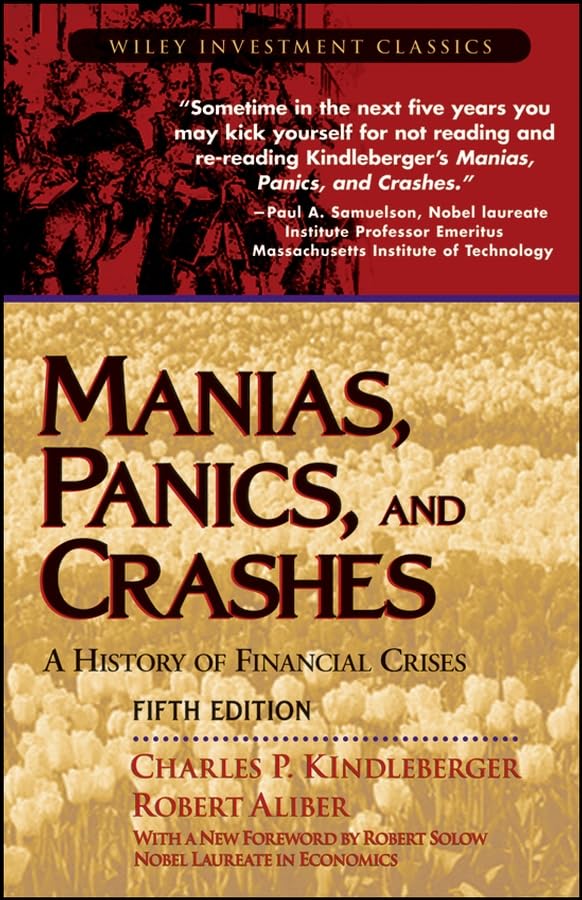
Manias, Panics, And Crashes: A History Of Financial Crises (Wiley Investment Classics),New
Sold by Ergodebooks, an authorized reseller.
Returns accepted within 30 days | support@ergodebooks.com
Shipping Information
- Free Standard Shipping — United States only
- Processing Time: 3–5 business days
- Estimated Delivery: 6–10 business days after dispatch
- Double-boxed, fully insured & discreetly packaged
- Tracking number sent via email once dispatched
Returns & Refund
Returns accepted within 30 days of delivery.
Damaged or Defective Item
Free return shipping + replacement or full refund
Wrong Item Received
Free return shipping + replacement or full refund
Change of Mind
Return shipping at customer's expense · 25% restocking fee applies
Payment Option

Manias, Panics, And Crashes, Fifth Edition Is An Engaging And Entertaining Account Of The Way That Mismanagement Of Money And Credit Has Led To Financial Explosions Over The Centuries. Covering Such Topics As The History And Anatomy Of Crises, Speculative Manias, And The Lender Of Last Resort, This Book Puts The Turbulence Of The Financial World In Perspective. The Updated Fifth Edition Expands Upon Each Chapter, And Includes Two New Chapters Focusing On Significant Financial Crises Of The Last Fifteen Years.
⚠️ WARNING (California Proposition 65):
This product may contain chemicals known to the State of California to cause cancer, birth defects, or other reproductive harm.
For more information, please visit www.P65Warnings.ca.gov.
- Q: How many pages does this book have? A: This book has three hundred fifty-five pages. It provides a comprehensive exploration of financial crises throughout history.
- Q: What is the binding type of this book? A: The binding type is paperback. This makes it lightweight and easy to handle for reading.
- Q: What are the dimensions of this book? A: The book measures five point forty-five inches in length, point ninety-eight inches in width, and eight point forty-four inches in height. These dimensions make it a convenient size for bookshelves or carrying.
- Q: Who is the author of this book? A: The author is Charles P. Kindleberger. He is known for his influential work in economic history and financial crises.
- Q: What topics does this book cover? A: This book covers the history and anatomy of financial crises. It also discusses speculative manias and the role of lenders of last resort.
- Q: Is this book suitable for beginners in finance? A: Yes, this book is suitable for beginners. It presents complex financial concepts in an engaging and accessible manner.
- Q: What is the reading level for this book? A: The reading level is appropriate for adults and older teens. It assumes some basic understanding of economic principles.
- Q: Can this book be used as a reference for academic studies? A: Yes, this book can be used as a reference. It provides valuable insights and historical context for academic research in economic history.
- Q: How should I store this book to keep it in good condition? A: Store this book upright on a shelf away from direct sunlight. This helps preserve the cover and pages for long-term use.
- Q: Are there any special care instructions for this book? A: No special care instructions are needed. Just avoid exposing it to moisture or extreme temperatures.
- Q: What if the book arrives damaged? A: If the book arrives damaged, contact customer support for a return. They will assist you in processing a replacement or refund.
- Q: What is the return policy for this book? A: The return policy typically allows returns within thirty days of purchase. Ensure the book is in good condition for a full refund.
- Q: Is this book a good choice for someone interested in economic history? A: Yes, this book is an excellent choice for anyone interested in economic history. It provides a detailed examination of financial crises.
- Q: Does this book include recent financial crises? A: Yes, the updated fifth edition includes two new chapters focusing on significant financial crises from the last fifteen years.
- Q: What is the genre of this book? A: The genre of this book is economic history. It combines historical analysis with economic theory.