
Title

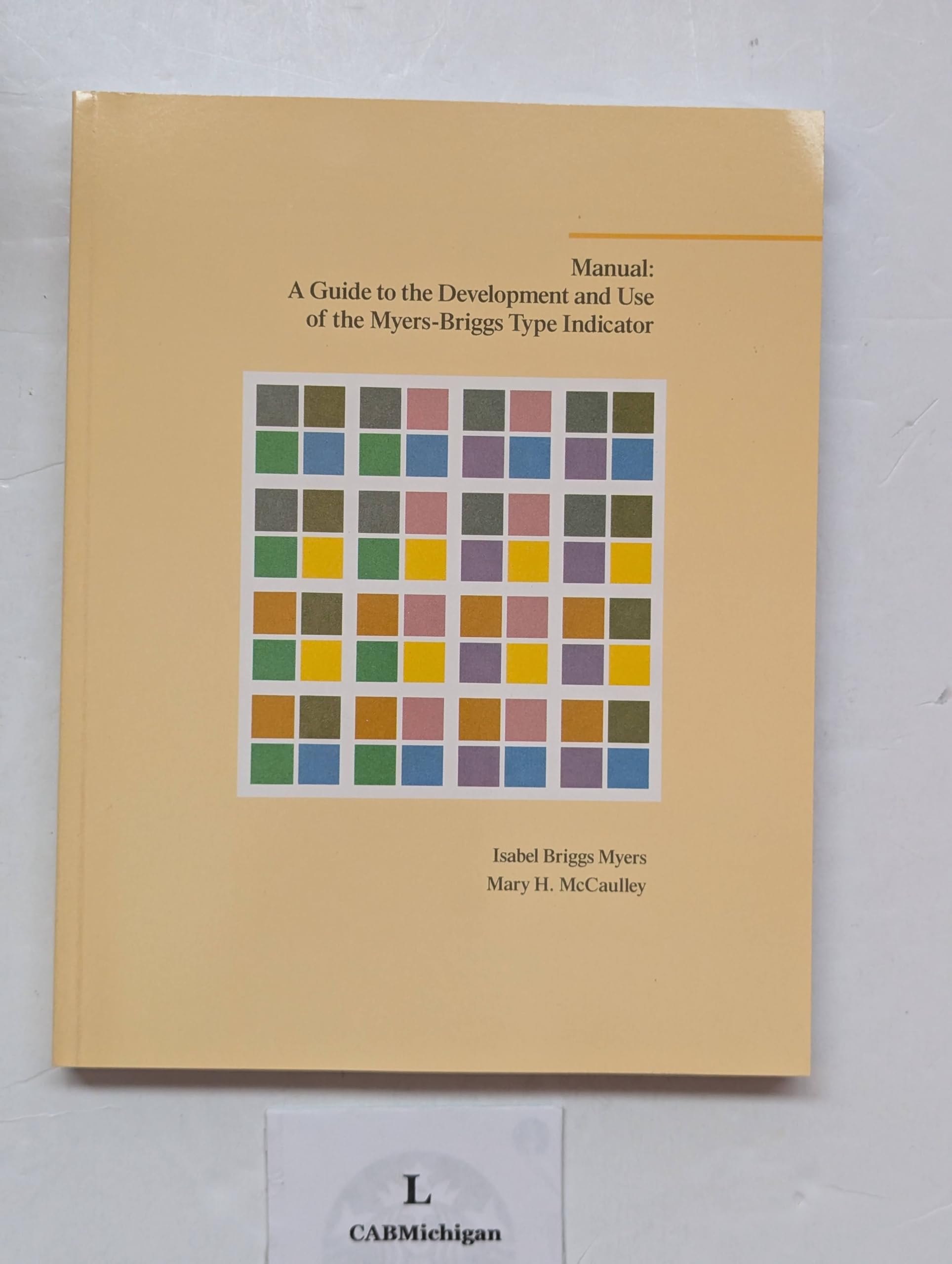
Manual: A Guide to the Development and Use of the MyersBriggs Type Indicator,New
Sold by Ergodebooks, an authorized reseller.
Returns accepted within 30 days | support@ergodebooks.com
Shipping Information
- Free Standard Shipping — United States only
- Processing Time: 3–5 business days
- Estimated Delivery: 6–10 business days after dispatch
- Double-boxed, fully insured & discreetly packaged
- Tracking number sent via email once dispatched
Returns & Refund
Returns accepted within 30 days of delivery.
Damaged or Defective Item
Free return shipping + replacement or full refund
Wrong Item Received
Free return shipping + replacement or full refund
Change of Mind
Return shipping at customer's expense · 25% restocking fee applies
Payment Option

The purpose of the MyersBriggs Type Indicator (MBTI) is to make the theory of psychological types described by C.G. Jung understandable and useful in people's lives. The essence of the theory is that much seemingly random variation in behavior is actually quite orderly and consistent, being due to basic differences in the way individuals prefer to use their perception and judgment. Perception involves all the ways of becoming aware of things, people, happenings, or ideas. Judgment involves all the ways to coming to conclusions about what has been perceived. If people differ systematically in what they perceive and in how they reach conclusions, then it is only reasonable for them to differ correspondingly in their reactions, interests, values, motivations, skills, and interests. The early chapters in this Manual describe the adminstration and scoring of the MBTI, Jung's theory of psychological types, and applications of the MBTI in various settings. Later chapters describe the construction and psychometric properties of the MBTI, discuss evidence for reliability and validity, and offer comments about research strategies.
⚠️ WARNING (California Proposition 65):
This product may contain chemicals known to the State of California to cause cancer, birth defects, or other reproductive harm.
For more information, please visit www.P65Warnings.ca.gov.
- Q: What is the Myers-Briggs Type Indicator (MBTI)? A: The Myers-Briggs Type Indicator (MBTI) is a psychological assessment tool designed to help individuals understand their personality types based on C.G. Jung's theory of psychological types.
- Q: How does the MBTI help in personal development? A: The MBTI helps individuals identify their strengths, preferences, and areas for growth, facilitating better self-awareness and personal development.
- Q: What are the key features of the MBTI? A: The MBTI assesses personality based on four dichotomies: Introversion/Extraversion, Sensing/Intuition, Thinking/Feeling, and Judging/Perceiving, providing a comprehensive understanding of personality.
- Q: Is the MBTI scientifically validated? A: The MBTI has been subject to extensive research regarding its reliability and validity, making it a widely recognized tool in psychology, although it has its critics.
- Q: What is included in the manual for the MBTI? A: The manual includes administration and scoring guidelines, a detailed explanation of Jung's theory, applications of the MBTI, and discussions on its psychometric properties.
- Q: Can the MBTI be used in professional settings? A: Yes, the MBTI is often used in professional environments for team building, leadership development, and improving workplace communication.
- Q: How long is the book and what is its binding type? A: The book has 309 pages and is available in paperback binding.
- Q: Who is the author of this manual? A: The manual is authored by Isabel Briggs Myers, who co-developed the MBTI alongside her mother, Katharine Cook Briggs.
- Q: What year was the MBTI manual published? A: The MBTI manual was published on January 1, 1985.
- Q: In what category is the MBTI manual listed? A: The MBTI manual is categorized under Psychology & Counseling.