
Title
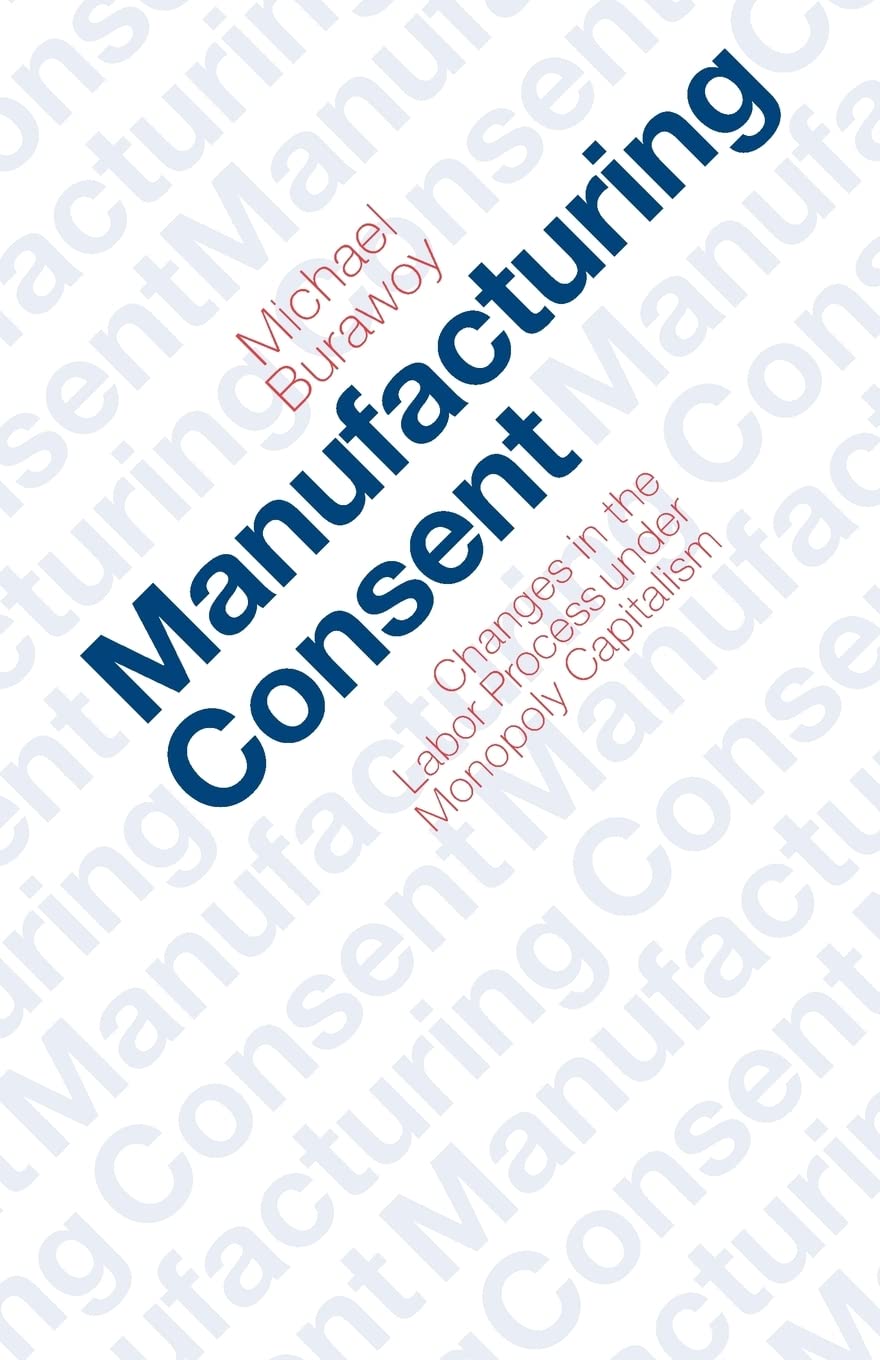
Manufacturing Consent: Changes In The Labor Process Under Monopoly Capitalism-used
Sold by Ergodebooks, an authorized reseller.
Returns accepted within 30 days | support@ergodebooks.com
Shipping Information
- Free Standard Shipping — United States only
- Processing Time: 3–5 business days
- Estimated Delivery: 6–10 business days after dispatch
- Double-boxed, fully insured & discreetly packaged
- Tracking number sent via email once dispatched
Returns & Refund
Returns accepted within 30 days of delivery.
Damaged or Defective Item
Free return shipping + replacement or full refund
Wrong Item Received
Free return shipping + replacement or full refund
Change of Mind
Return shipping at customer's expense · 25% restocking fee applies
Payment Option

Since The 1930S, Industrial Sociologists Have Tried To Answer The Question, Why Do Workers Not Work Harder? Michael Burawoy Spent Ten Months As A Machine Operator In A Chicago Factory Trying To Answer Different But Equally Important Questions: Why Do Workers Work As Hard As They Do? Why Do Workers Routinely Consent To Their Own Exploitation?Manufacturing Consent, The Result Of Burawoy'S Research, Combines Rich Ethnographical Description With An Original Marxist Theory Of The Capitalist Labor Process. Manufacturing Consent Is Unique Among Studies Of This Kind Because Burawoy Has Been Able To Analyze His Own Experiences In Relation To Those Of Donald Roy, Who Studied The Same Factory Thirty Years Earlier. Burawoy Traces The Technical, Political, And Ideological Changes In Factory Life To The Transformations Of The Market Relations Of The Plant (It Is Now Part Of A Multinational Corporation) And To Broader Movements, Since World War Ii, In Industrial Relations.
⚠️ WARNING (California Proposition 65):
This product may contain chemicals known to the State of California to cause cancer, birth defects, or other reproductive harm.
For more information, please visit www.P65Warnings.ca.gov.
- Q: What is the page count of this book? A: This book has two hundred eighty-six pages. It provides a comprehensive analysis of labor processes under capitalism.
- Q: What binding type is used for this book? A: This book is paperback bound. The paperback format makes it lightweight and portable.
- Q: Who is the author of 'Manufacturing Consent'? A: The author is Michael Burawoy. He conducted extensive research in a Chicago factory to explore labor dynamics.
- Q: How do I read this book? A: To read this book, simply open it and start from the first page. It explores complex themes in industrial sociology.
- Q: Is this book suitable for beginners in sociology? A: Yes, this book is suitable for beginners. It provides a clear exploration of labor processes and consent in industrial settings.
- Q: What themes are covered in 'Manufacturing Consent'? A: The book covers themes of labor processes, worker consent, and exploitation under capitalism. It combines ethnographic research with theory.
- Q: How should I store this book? A: Store this book in a cool, dry place, away from direct sunlight. This helps preserve its condition over time.
- Q: Is this book safe for all ages? A: Yes, the book is generally safe for all ages. However, it discusses complex labor issues that may require adult guidance.
- Q: Can I highlight or annotate this book? A: Yes, you can highlight or annotate this paperback book. Many readers find it helpful for studying and retaining key concepts.
- Q: What if the book arrives damaged? A: If the book arrives damaged, contact customer support for a replacement. Most retailers offer a return or exchange policy.
- Q: Does this book include any illustrations or images? A: No, this book does not include illustrations or images. It primarily consists of text and analysis.
- Q: How can I find similar books to this one? A: To find similar books, look for titles in industrial sociology or labor studies. Check recommendations from academic sources.
- Q: Is this book part of a series? A: No, 'Manufacturing Consent' is not part of a series. It stands alone as an in-depth study of labor processes.
- Q: Where can I buy this book? A: You can buy this book from various online retailers or bookstores. It is published by the University of Chicago Press.
- Q: What is the main argument of the book? A: The main argument is that workers consent to their exploitation through various social and economic mechanisms. Burawoy explores this in detail.
- Q: Does this book discuss historical context? A: Yes, the book discusses historical context, particularly changes in labor processes since World War II. It ties historical events to current practices.