
Title
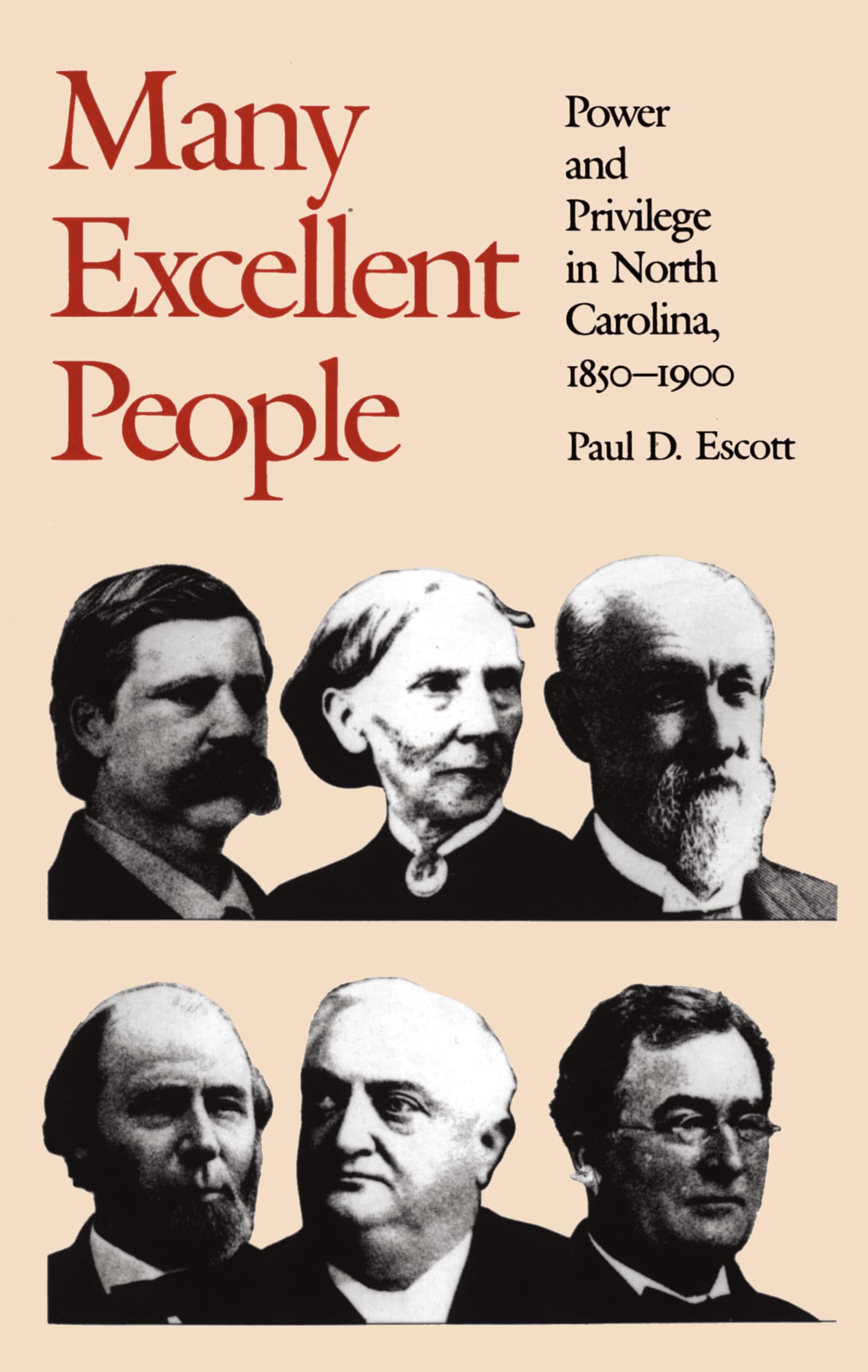
Many Excellent People: Power and Privilege in North Carolina, 18501900 (Fred W. Morrison Series in Southern Studies),Used
Sold by Ergodebooks, an authorized reseller.
Returns accepted within 30 days | support@ergodebooks.com
Shipping Information
- Free Standard Shipping — United States only
- Processing Time: 3–5 business days
- Estimated Delivery: 6–10 business days after dispatch
- Double-boxed, fully insured & discreetly packaged
- Tracking number sent via email once dispatched
Returns & Refund
Returns accepted within 30 days of delivery.
Damaged or Defective Item
Free return shipping + replacement or full refund
Wrong Item Received
Free return shipping + replacement or full refund
Change of Mind
Return shipping at customer's expense · 25% restocking fee applies
Payment Option

Many Excellent People examines the nature of North Carolina's social system, particularly race and class relations, power, and inequality, during the last half of the nineteenth century. Paul Escott portrays North Carolina's major social groups, focusing on the elite, the ordinary white farmers or workers, and the blacks, and analyzes their attitudes, social structure, and power relationships. Quoting frequently from a remarkable array of letters, journals, diaries, and other primary sources, he shows vividly the impact of the Civil War, Emancipation, Reconstruction, Populism, and the rise of the New South industrialism on southern society.Working within the new social history and using detailed analyses of five representative counties, wartime violence, Ku Klux Klan membership, stocklaw legislation, and textile mill records, Escott reaches telling conclusions on the interplay of race, class, and politics. Despite fundamental political and economic reforms, Escott argues, North Carolina's social system remained as hierarchical and undemocratic in 1900 as it had been in 1850.
⚠️ WARNING (California Proposition 65):
This product may contain chemicals known to the State of California to cause cancer, birth defects, or other reproductive harm.
For more information, please visit www.P65Warnings.ca.gov.
- Q: How many pages does this book have? A: This book has three hundred forty-four pages. It provides an in-depth examination of North Carolina's social system from 1850 to 1900.
- Q: What is the binding type of this book? A: This book is paperback. The paperback format makes it lightweight and easy to handle for reading.
- Q: Who is the author of this book? A: The author is Paul D. Escott. He focuses on race and class relations in North Carolina during a pivotal historical period.
- Q: What is the genre of 'Many Excellent People'? A: The genre is historical non-fiction. It explores social dynamics in North Carolina through detailed historical analysis.
- Q: What are the dimensions of this book? A: The dimensions are six point twelve inches long, zero point eighty-three inches wide, and nine point twenty-five inches high. These dimensions make it a convenient size for reading.
- Q: Is this book suitable for academic research? A: Yes, this book is suitable for academic research. It includes primary sources like letters and diaries, making it valuable for scholars.
- Q: What themes does this book explore? A: This book explores themes of power, privilege, race, and class relations. It provides insights into historical inequalities in the South.
- Q: Is this book appropriate for young readers? A: No, this book is not specifically geared towards young readers. It discusses complex social issues and historical events that may require mature understanding.
- Q: How should I store this book to maintain its condition? A: Store this book in a cool, dry place. Keeping it away from direct sunlight will help preserve the cover and pages.
- Q: Can I clean the book cover if it gets dirty? A: Yes, you can gently wipe the book cover with a dry cloth. Avoid using water or cleaning solutions to prevent damage.
- Q: What should I do if the book arrives damaged? A: If the book arrives damaged, contact the seller for a return or exchange. Most sellers will have a policy in place for such issues.
- Q: Is this book part of a series? A: Yes, this book is part of the Fred W. Morrison Series in Southern Studies. The series focuses on important themes in Southern history.
- Q: How does this book compare to others in its genre? A: This book is unique in its detailed analysis of North Carolina during a transformative period. It stands out for its use of primary sources.
- Q: Does this book include illustrations or photographs? A: No, this book does not include illustrations or photographs. It relies on text and primary sources to convey its message.
- Q: Is there a digital version of this book available? A: Yes, a digital version may be available through various platforms. Check with your preferred eBook retailer for options.
- Q: What is the publication year of this book? A: The publication year of this book is not specified in the details provided. Please check the publisher's website for accurate information.