
Title
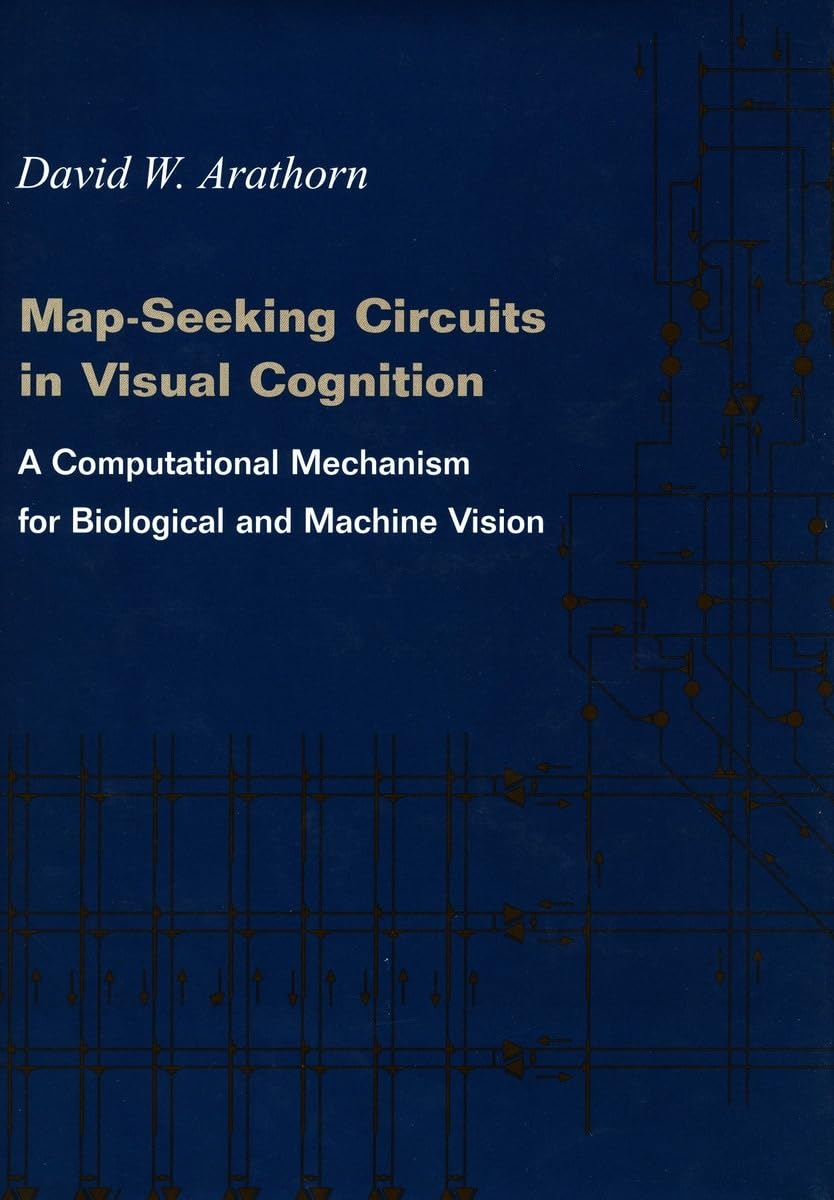
Mapseeking Circuits In Visual Cognition: A Computational Mechanism For Biological And Machine Vision,Used
Sold by Ergodebooks, an authorized reseller.
Returns accepted within 30 days | support@ergodebooks.com
Shipping Information
- Free Standard Shipping — United States only
- Processing Time: 3–5 business days
- Estimated Delivery: 6–10 business days after dispatch
- Double-boxed, fully insured & discreetly packaged
- Tracking number sent via email once dispatched
Returns & Refund
Returns accepted within 30 days of delivery.
Damaged or Defective Item
Free return shipping + replacement or full refund
Wrong Item Received
Free return shipping + replacement or full refund
Change of Mind
Return shipping at customer's expense · 25% restocking fee applies
Payment Option

This work presents a bold new theory of the cognitive circuitry of the brain, with emphasis on the functioning of human vision. Departing from conventional precepts in the fields of artificial intelligence, neuroscience, and visual psychophysics, the author has developed a computational theory that provides a unitary explanation for a wide range of visual capabilities and behaviors, most of which have no accepted theoretical explanation. He describes a cortical mechanism termed mapseeking and demonstrates its explanatory power in areas as diverse as limbmotion planning and perceptual deficits associated with schizophrenia.The author argues that mapseeking is a fundamental, broadly applicable computational operation with algorithmic, neuronal, and analog electronic implementations, and that its generality makes it suitable as the core of a computational explanation for several cognitive functions. Variations of this mapseeking circuit perform recognition under visual transformations, tracking, scene segmentation, and determination of shape from view displacement.The mathematical principle on which mapseeking depends, a superposition ordering property, solves the combinatorial explosion problem that has plagued all other approaches to visual computation. The author demonstrates that mapseeking is capable of realistic performances in neuronal form and in many current technological procedures. Because of its breadth of application, it is a plausible cortical theory. Because it can be implemented electronically, it forms the basis for a computational technology highly suited for visual, and other perceptual, cognitive, and motor applications.
⚠️ WARNING (California Proposition 65):
This product may contain chemicals known to the State of California to cause cancer, birth defects, or other reproductive harm.
For more information, please visit www.P65Warnings.ca.gov.