
Title

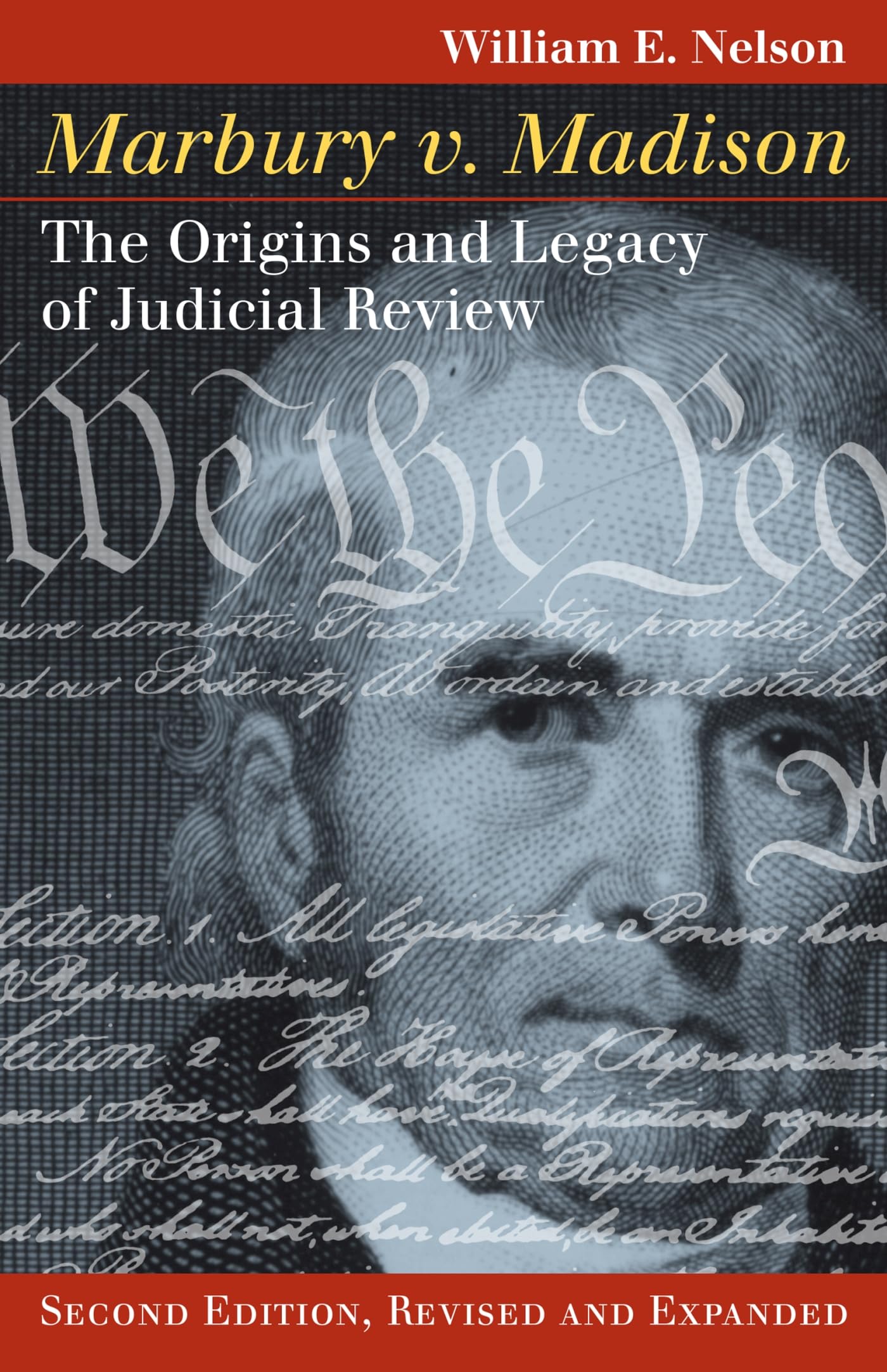
Marbury v. Madison : The Origins and Legacy of Judicial Review,Used
Sold by Ergodebooks, an authorized reseller.
Returns accepted within 30 days | support@ergodebooks.com
Shipping Information
- Free Standard Shipping — United States only
- Processing Time: 3–5 business days
- Estimated Delivery: 6–10 business days after dispatch
- Double-boxed, fully insured & discreetly packaged
- Tracking number sent via email once dispatched
Returns & Refund
Returns accepted within 30 days of delivery.
Damaged or Defective Item
Free return shipping + replacement or full refund
Wrong Item Received
Free return shipping + replacement or full refund
Change of Mind
Return shipping at customer's expense · 25% restocking fee applies
Payment Option

We take for granted today the tremendous power of the Supreme Court to interpret our laws and overrule any found in conflict with the Constitution. Yet our nation was a quartercentury old before that power of 'judicial review' was fully articulated by the Court itself in Marbury v. Madison (1803). William Nelson's concise study of that landmark case provides an insightful and readable guide for students and general readers alike.On the surface, the case itself seems a minor one at best. William Marbury, a lastminute judicial appointee of outgoing Federalist president John Adams, demanded redress from the Supreme Court when his commission was not delivered. But Chief Justice John Marshall could clearly see the danger his demand posed for a weak court filled with Federalist judges. Wary of the Court's standing with the new Republican administration of Thomas Jefferson, Marshall hit upon a solution that was both principled and pragmatic. He determined that while Marbury was justified in his suit, the law on which his claim was based was in conflict with the Constitution. It was the first time that the Court struck down an act of Congress as unconstitutional, thus establishing the doctrine of judicial review, which designates the Court as chief interpreter of the Constitution.Nelson relates the story behind Marbury and explains why it is a foundational case for understanding the Supreme Court. He reveals how Marshall deftly avoided a dangerous political confrontation between the executive and judicial branches by upholding the rule of law. He also shows how Marshall managed to shore up the Court's prestige and power rather than have it serve partisan political agendas.Nelson clarifies how the Marshall court sought to preserve what was best in eighteenthcentury constitutionalism while accommodating nineteenthcentury political realities and also traces the gradual transformation of Marburystyle judicial review since Marshall's time.Although the Supreme Court did not assert its power of judicial review for another fiftyfour years after Marbury, it has since then invalidated numerous acts of Congress. From Marshall's modest bid for consensus to what some consider the modern Court's 'activist' excesses, judicial review has been a cornerstone in the edifice of the federal judiciary. Nelson's analysis helps us better understand how this fundamental principle emerged and why it still matters.
⚠️ WARNING (California Proposition 65):
This product may contain chemicals known to the State of California to cause cancer, birth defects, or other reproductive harm.
For more information, please visit www.P65Warnings.ca.gov.