
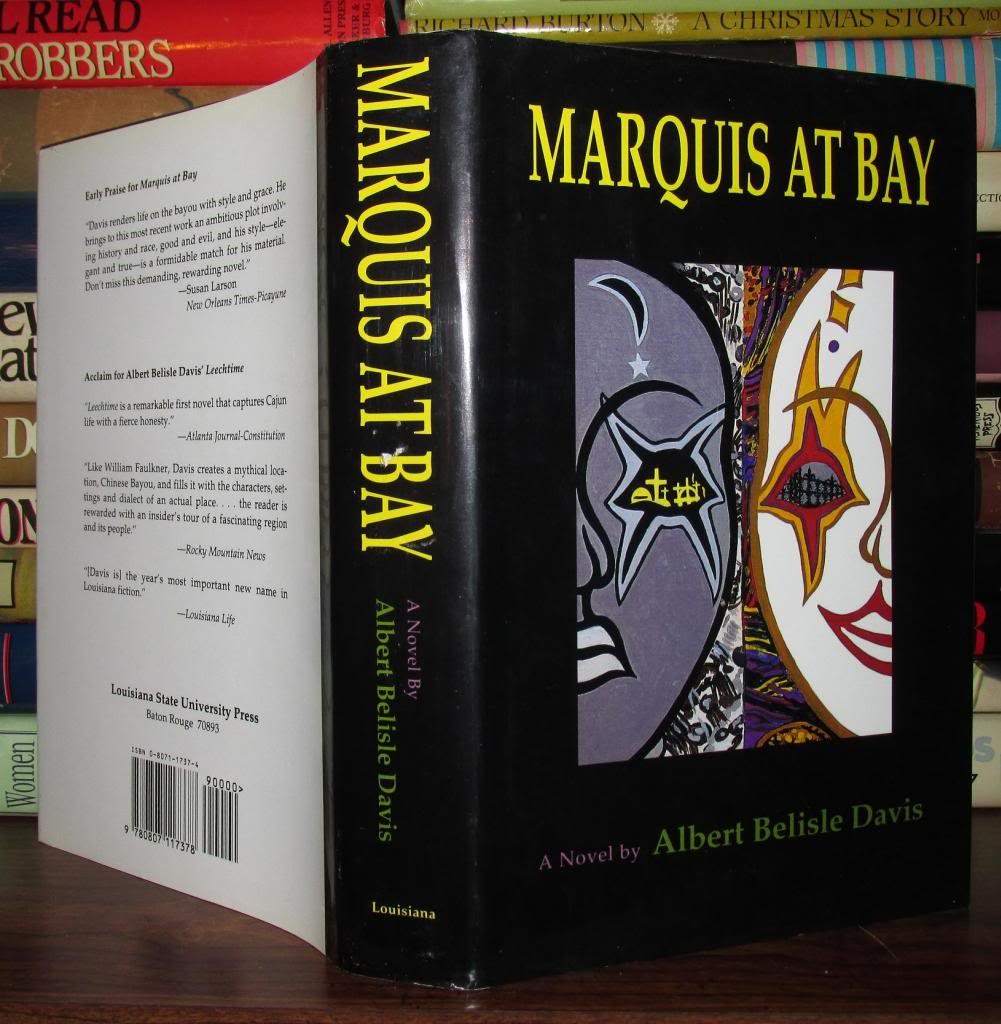
Title
Marquis at Bay: A Novel,Used
Sold by Ergodebooks, an authorized reseller.
Returns accepted within 30 days | support@ergodebooks.com
Shipping Information
- Free Standard Shipping — United States only
- Processing Time: 3–5 business days
- Estimated Delivery: 6–10 business days after dispatch
- Double-boxed, fully insured & discreetly packaged
- Tracking number sent via email once dispatched
Returns & Refund
Returns accepted within 30 days of delivery.
Damaged or Defective Item
Free return shipping + replacement or full refund
Wrong Item Received
Free return shipping + replacement or full refund
Change of Mind
Return shipping at customer's expense · 25% restocking fee applies
Payment Option

From Library JournalBelieving they will someday "happen into a significant event that is destined to be recorded in every school child's history book," attorney James Peter Marquis's Old New Orleans family faithfully records their experiences. Historically, Marquis witnesses the arrival of the civil rights era in a Louisiana bayou town. On a personal level, he records his struggle with tragedy and memory. Marquis gives his notes and taped interviews to his wife Molly, a historian, to compile into a "Marquis chronicle." The chronicle begins with a secret burial in 1944, traces years of blackmailing, and ends with a death at a 1963 Mardi Gras. Unfortunately, the tedious, slowlypaced narration drags on and on, long after suspense and interest have waned. Joanne Snapp, Virginia Commonwealth Univ., RichmondCopyright 1992 Reed Business Information, Inc.Product DescriptionJames Peter Marquis, an outcast attorney and son of an old New Orleans family, becomes the catalyst for a new tragedy when he searches for the truth behind a mysterious death and burial that occurred in a bayou town southwest of New Orleans in the mid1940sFrom Kirkus ReviewsDavis's second novel (Leechtime, 1989) is another Faulknerian effort, convoluted and tortured, that again uses mockoral history to tell the story of smalltime intriguethis time in a bayou town southwest of New Orleans. An outcast attorney from an old New Orleans family tries to find redemption amid characters who are by turns grotesque and Rabelaisian. James Marquis, the lawyer, comes to the bayou town and, representing indigents, meets Lineman, a black determined to succeed at whatever the cost, and Zeema, a local singer. Marquis gets drawn into the town's bestkept secret: Lineman's father, years ago doing some underhanded work for Roussell, the town's powerbroker, caused a baby to be killed, and Roussell secretly replaced the baby with an adoption. Forever after, Lineman, unscrupulous, has had leverage on Roussell. (Much of this narrative is pieced together after the fact by Molly, Marquis's wife, mostly from tapes her husband recorded.) Roussell's idea to import Zulu, a Mardi Gras club and celebration, to the bayou town serves as catalyst for much of the byzantine plotting that follows. That plotting involves elements from the Chronicles, a bizarre series of published histories of the Marquis family; the civilrights movement; and a conversation with Albert Einstein. Roussell and Lineman reach an understanding, divide the town into separate kingdoms,'' and the book finally becomes mainly a series of transcriptions of interviews. Davis creates a unique world here, not easily penetrable but not like any other, either, and the reader is willing to forgive some murkiness and loose ends in return for originality: Just as in sleep [Marquis writes to Molly], one finds that any nightmare worth its name is in control throughout....'' Hard going, but the odd intricate contours of Davis's southern Louisiana world can be found nowhere else. Copyright 1992, Kirkus Associates, LP. All rights reserved.
⚠️ WARNING (California Proposition 65):
This product may contain chemicals known to the State of California to cause cancer, birth defects, or other reproductive harm.
For more information, please visit www.P65Warnings.ca.gov.