
Title
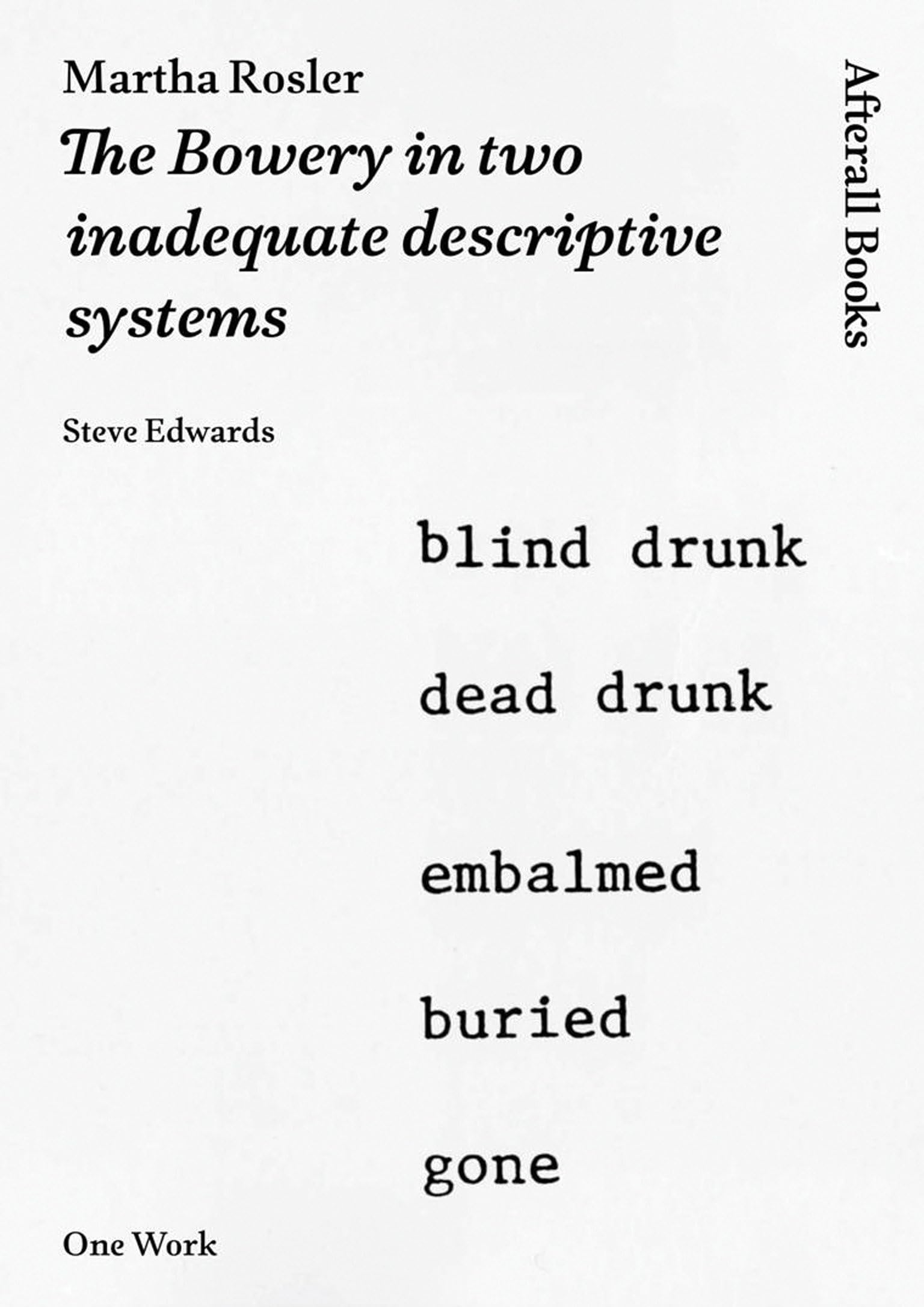
Martha Rosler: The Bowery in two inadequate descriptive systems (Afterall Books / One Work),Used
Sold by Ergodebooks, an authorized reseller.
Returns accepted within 30 days | support@ergodebooks.com
Shipping Information
- Free Standard Shipping — United States only
- Processing Time: 3–5 business days
- Estimated Delivery: 6–10 business days after dispatch
- Double-boxed, fully insured & discreetly packaged
- Tracking number sent via email once dispatched
Returns & Refund
Returns accepted within 30 days of delivery.
Damaged or Defective Item
Free return shipping + replacement or full refund
Wrong Item Received
Free return shipping + replacement or full refund
Change of Mind
Return shipping at customer's expense · 25% restocking fee applies
Payment Option

The first sustained critical examination of a work by Martha Rosler that bridged the concerns of conceptual art with those of political documentary.In The Bowery in two inadequate descriptive systems (19741975) Martha Rosler bridged the concerns of conceptual art with those of political documentary. The work, a series of twentyone blackandwhite photographs, twentyfour text panels and three blank panels, embraces the codes of the phototext experiments of the late 1960s and applies them to the social reality of New York's Lower East Side. The prevailing critical view of The Bowery focuses on its implicit rejection, or critique, of established modes of documentary. In this illustrated, extended essay on the work by Rosler, Steve Edwards argues that although the critical attitude towards documentary is an important dimension of the piece, it does not exhaust the meaning of the project.Edwards situates the work in relation to debates and practices of the period, especially conceptual art and the emergence of the phototext paradigm exemplified by the work of Robert Smithson, Bernd and Hilla Becher, Hans Haacke, Victor Burgin, and the Women and Work group. In particular, he contextualizes Rosler's work of this period within the politicized San Diego group (which included, in addition to Rosler, Allan Sekula, Fred Lonidier, and Philip Steinmetz). Comparing The Bowery to Rosler's later video vital statistics of a citizen, simply obtained (1977) and the films of the DzigaVertov Group (formed by JeanLuc Godard and JeanPierre Gorin), Edwards shows how the work engages with conceptual art and the neoavantgarde of the 1960s and 1970s.
⚠️ WARNING (California Proposition 65):
This product may contain chemicals known to the State of California to cause cancer, birth defects, or other reproductive harm.
For more information, please visit www.P65Warnings.ca.gov.