
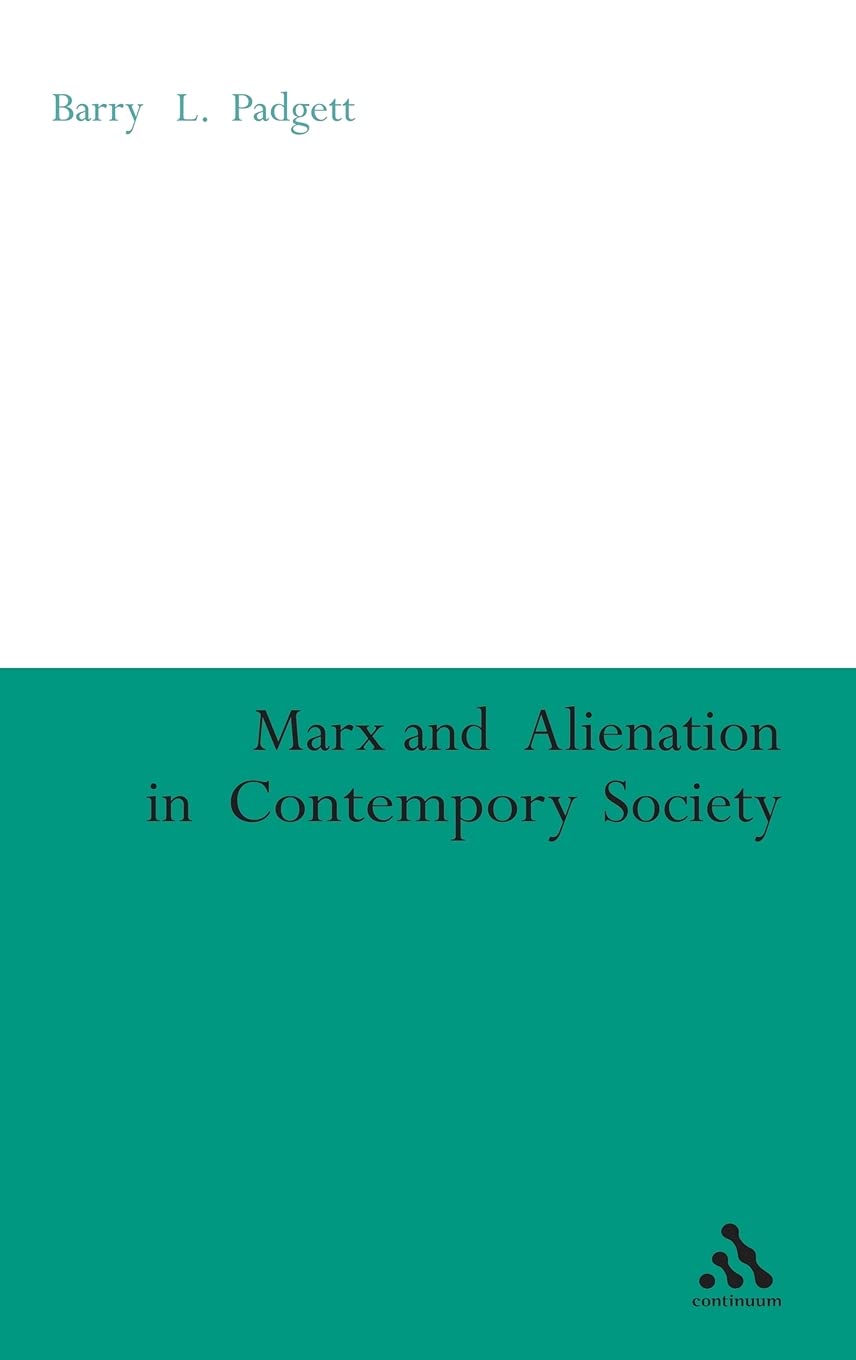
Title
Marx and Alienation in Contemporary Society,Used
Sold by Ergodebooks, an authorized reseller.
Returns accepted within 30 days | support@ergodebooks.com
Shipping Information
- Free Standard Shipping — United States only
- Processing Time: 3–5 business days
- Estimated Delivery: 6–10 business days after dispatch
- Double-boxed, fully insured & discreetly packaged
- Tracking number sent via email once dispatched
Returns & Refund
Returns accepted within 30 days of delivery.
Damaged or Defective Item
Free return shipping + replacement or full refund
Wrong Item Received
Free return shipping + replacement or full refund
Change of Mind
Return shipping at customer's expense · 25% restocking fee applies
Payment Option

In light of the events of the late 1980's and early 1990's, one might naively suppose that capitalism has emerged entirely victorious over communism, and hence that the former is practically and philosophically justified by its historical dominance. Even socalled "analytical Marxists" argue that in his later works Marx abandons his earlier "humanistic" perspective and with it his conception of "alienation."So then, is Francis Fukuyama correct to assert that we now have a glimpse of "the end of history," given that capitalism has seemingly triumphed over its alternatives? Some authors, such as David Schweickart, answer with a resounding, no. He is adamant that, "getting beyond capitalism is the best hope for our species," and although he does his best to offer an alternative to contemporary capitalism, his model is fraught with difficulties and still does not answer the question of the application of Marx's theory of alienation to contemporary society.This book argues that, to the contrary, Marx does not abandon the concept of alienation, and (contrary to the analytical Marxists and procapitalists) that its application is still relevant to today's economy and world. This account analyses at least four fundamental manifestations of the corrosive nature of Americanstyle capitalism: excessive consumerism, negative effects of globalization, cruel economic inequalities between persons, and a deep "irrational exuberance" intensifying our interaction in the material world (from the pace of our worklives to our relation to the environment). Padgett argues that new forms of these four traditional aspects of alienation outlined by Marx are still present in our world, and hence that Marx's analyses of negative aspects of capitalism are still widely relevant today.In light of the events of the late 1980's and early 1990's, one might naively suppose that capitalism has emerged entirely victorious over communism, and hence that the former is practically and philosophically justified by its historical dominance. Even socalled "analytical Marxists" argue that in his later works Marx abandons his earlier "humanistic" perspective and with it his conception of "alienation."So then, is Francis Fukuyama correct to assert that we now have a glimpse of "the end of history," given that capitalism has seemingly triumphed over its alternatives? Some authors, such as David Schweickart, answer with a resounding, no. He is adamant that, "getting beyond capitalism is the best hope for our species," and although he does his best to offer an alternative to contemporary capitalism, his model is fraught with difficulties and still does not answer the question of the application of Marx's theory of alienation to contemporary society.This book argues that, to the contrary, Marx does not abandon the concept of alienation, and (contrary to the analytical Marxists and procapitalists) that its application is still relevant to today's economy and world. This account analyses at least four fundamental manifestations of the corrosive nature of Americanstyle capitalism: excessive consumerism, negative effects of globalization, cruel economic inequalities between persons, and a deep "irrational exuberance" intensifying our interaction in the material world (from the pace of our worklives to our relation to the environment). Padgett argues that new forms of these four traditional aspects of alienation outlined by Marx are still present in our world, and hence that Marx's analyses of negative aspects of capitalism are still widely relevant today.
⚠️ WARNING (California Proposition 65):
This product may contain chemicals known to the State of California to cause cancer, birth defects, or other reproductive harm.
For more information, please visit www.P65Warnings.ca.gov.