If you have any questions, you are always welcome to contact us. We'll get back to you as soon as possible, withing 24 hours on weekdays.
Customer service
All questions about your order, return and delivery must be sent to our customer service team by e-mail at yourstore@yourdomain.com
Sale & Press
If you are interested in selling our products, need more information about our brand or wish to make a collaboration, please contact us at press@yourdomain.com
Help
If you have any questions, you are always welcome to contact us. We'll get back to you as soon as possible, withing 24 hours on weekdays.
Customer service
All questions about your order, return and delivery must be sent to our customer service team by e-mail at yourstore@yourdomain.com
Sale & Press
If you are interested in selling our products, need more information about our brand or wish to make a collaboration, please contact us at press@yourdomain.com
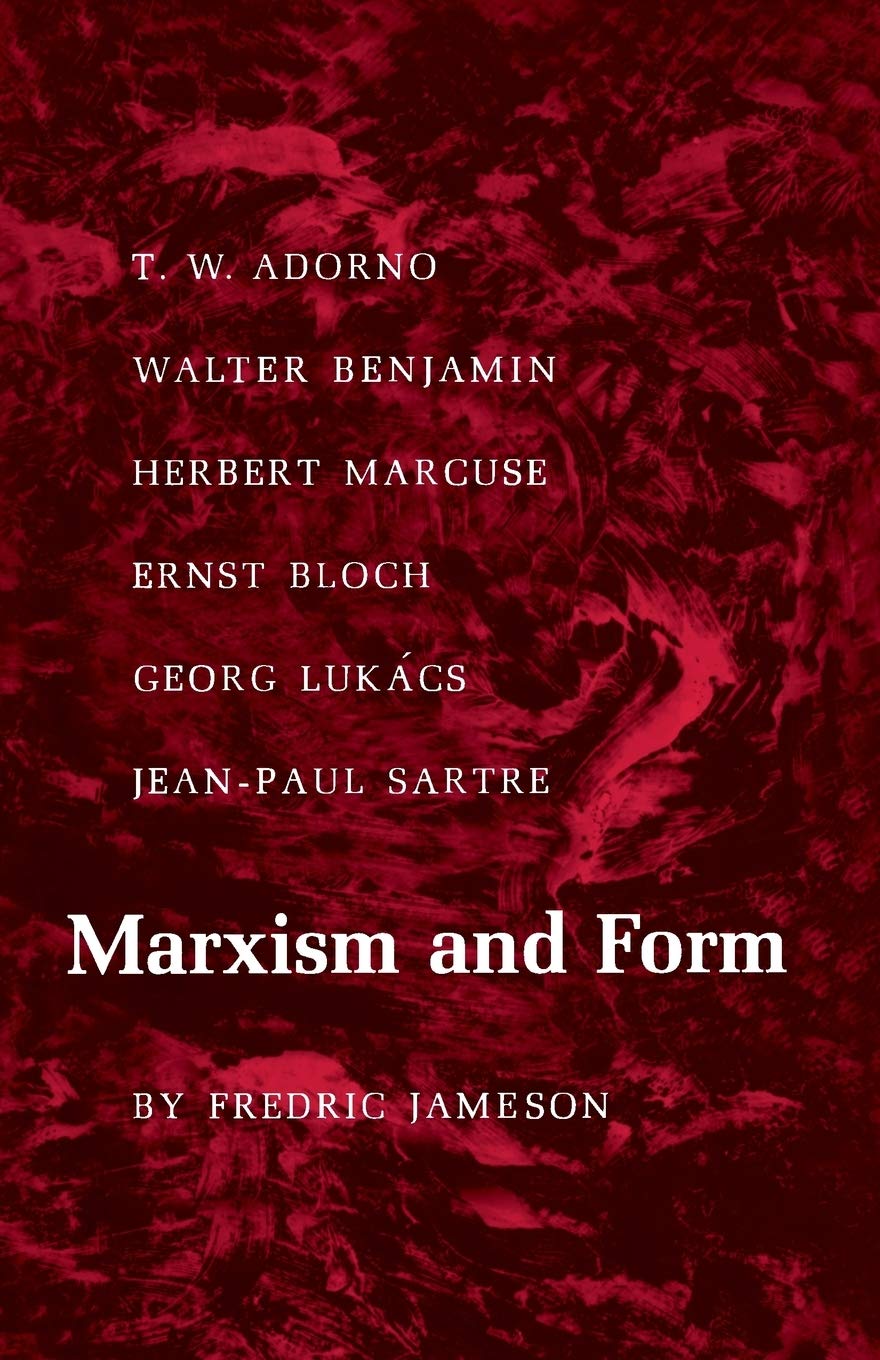
For more than thirty years, Fredric Jameson has been one of the most productive, wideranging, and distinctive literary theorists in the United States and the Anglophone world. Marxism and Form provided a pioneering account of the work of the major European Marxist theoristsT. W. Adorno, Walter Benjamin, Herbert Marcuse, Ernst Bloch, Georg Lukcs, and JeanPaul Sartrework that was, at the time, largely neglected in the Englishspeaking world. Through penetrating readings of each theorist, Jameson developed a critical mode of engagement that has had tremendous in.uence. He provided a framework for analyzing the connection between art and the historical circumstances of its makingin particular, how cultural artifacts distort, repress, or transform their circumstances through the abstractions of aesthetic form.Jameson's presentation of the critical thought of this Hegelian Marxism provided a stark alternative to the AngloAmerican tradition of empiricism and humanism. It would later provide a compelling alternative to poststructuralism and deconstruction as they became dominant methodologies in aesthetic criticism.One year after Marxism and Form, Princeton published Jameson's The PrisonHouse of Language (1972), which provided a thorough historical and philosophical description of formalism and structuralism. Both books remain central to Jameson's main intellectual legacy: describing and extending a tradition of Western Marxism in cultural theory and literary interpretation.
⚠️ WARNING (California Proposition 65):
This product may contain chemicals known to the State of California to cause cancer,
birth defects, or other reproductive harm.
For MAP (Minimum Advertised Price) violations and Intellectual Property (IP) or Trademark concerns, please contact:
support@ergodebooks.com
⚠️ California Proposition 65 Warning: Some products sold on this website may expose you to chemicals known to the State of California to cause cancer, birth defects, or other reproductive harm. For more information, visit www.P65Warnings.ca.gov.