
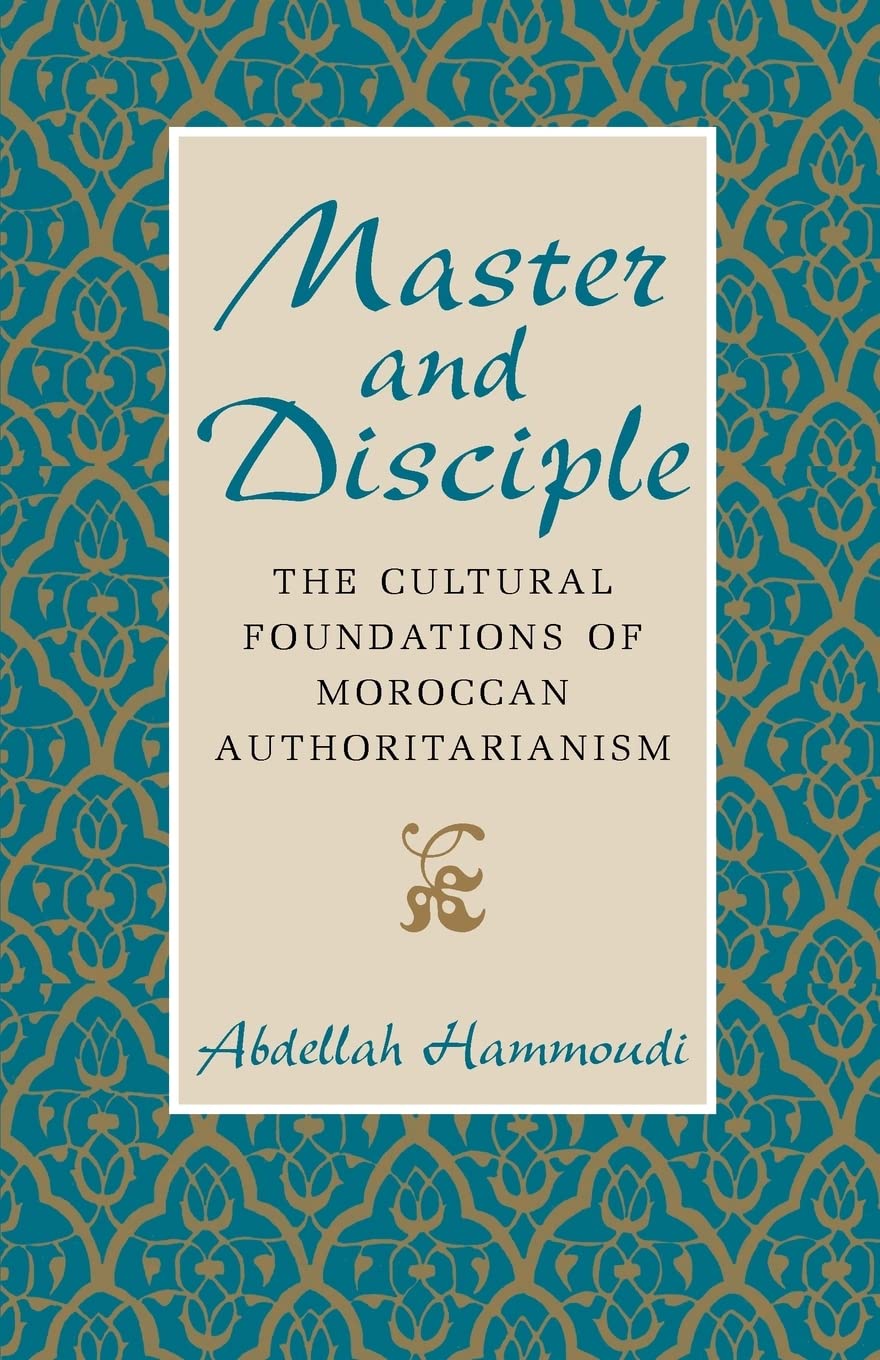
Title
Master And Disciple: The Cultural Foundations Of Moroccan Authoritarianism,Used
Sold by Ergodebooks, an authorized reseller.
Returns accepted within 30 days | support@ergodebooks.com
Shipping Information
- Free Standard Shipping — United States only
- Processing Time: 3–5 business days
- Estimated Delivery: 6–10 business days after dispatch
- Double-boxed, fully insured & discreetly packaged
- Tracking number sent via email once dispatched
Returns & Refund
Returns accepted within 30 days of delivery.
Damaged or Defective Item
Free return shipping + replacement or full refund
Wrong Item Received
Free return shipping + replacement or full refund
Change of Mind
Return shipping at customer's expense · 25% restocking fee applies
Payment Option

In The Postcolonial Era, Arab Societies Have Been Ruled By A Variety Of Authoritarian Regimes. Focusing On His Native Morocco, Abdellah Hammoudi Explores The Ideological And Cultural Foundations Of This Persistent Authoritarianism.Building On The Work Of Foucault, Hammoudi Argues That At The Heart Of Moroccan Culture Lies A Paradigm Of Authority That Juxtaposes Absolute Authority Against Absolute Submission. Rooted In Islamic Mysticism, This Paradigm Can Be Observed In The Drama Of Mystic Initiation, With Its Fundamental Dialectic Between Master And Disciple; In Conflict With Other Cultural Forms, And Reelaborated In Colonial And Postcolonial Circumstances, It Informs All Major Aspects Of Moroccan Personal, Political, And Gender Relations. Its Influence Is So Pervasive And So Firmly Embedded That It Ultimately Legitimizes The Authoritarian Structure Of Power. Hammoudi Contends That As Long As The Masterdisciple Dialectic Remains The Dominant Paradigm Of Power Relations, Male Authoritarianism Will Prevail As The Dominant Political Form.'Connecting Political Domination To Gift Exchange, Ritual Initiation, Social Loyalty, And Gender Reversals, Master And Disciple Is Nothing Less Than A Thoroughgoing Revision Of Our Understanding Of Authoritarian Rule In Morocco And In The Arab World In General.'Clifford Geertz, Institute For Advanced Study
⚠️ WARNING (California Proposition 65):
This product may contain chemicals known to the State of California to cause cancer, birth defects, or other reproductive harm.
For more information, please visit www.P65Warnings.ca.gov.
- Q: What is the main theme of 'Master and Disciple'? A: 'Master and Disciple' explores the cultural and ideological foundations of authoritarianism in Morocco, particularly the dynamic between authority and submission within Moroccan society.
- Q: Who is the author of this book? A: The author of 'Master and Disciple' is Abdellah Hammoudi, a scholar focusing on Moroccan culture and politics.
- Q: What is the publication date of this book? A: 'Master and Disciple' was published on October 1, 1997.
- Q: How many pages does this book have? A: 'Master and Disciple' contains 222 pages.
- Q: What is the binding type of this book? A: This edition of 'Master and Disciple' is available in paperback binding.
- Q: What kind of insights does the book provide about Moroccan culture? A: The book provides insights into the pervasive influence of the Master-Disciple dialectic on political, personal, and gender relations in Moroccan culture.
- Q: Is this book suitable for academic study? A: 'Master and Disciple' is suitable for academic study, particularly for those interested in Middle Eastern studies, political science, and cultural studies.
- Q: What are the critical reviews of this book? A: Critics have praised 'Master and Disciple' for its thorough analysis of authoritarianism and its connections to cultural practices, with notable endorsements from scholars like Clifford Geertz.
- Q: Does the book discuss gender relations within Moroccan society? A: Yes, the book discusses how the Master-Disciple dynamic influences gender relations in Morocco, highlighting the complexities of male authoritarianism.
- Q: What makes this book unique compared to other studies on authoritarianism? A: 'Master and Disciple' is unique in its focus on the cultural and ideological underpinnings of authoritarianism, using the lens of Islamic mysticism and social dynamics.