If you have any questions, you are always welcome to contact us. We'll get back to you as soon as possible, withing 24 hours on weekdays.
Customer service
All questions about your order, return and delivery must be sent to our customer service team by e-mail at yourstore@yourdomain.com
Sale & Press
If you are interested in selling our products, need more information about our brand or wish to make a collaboration, please contact us at press@yourdomain.com
Help
If you have any questions, you are always welcome to contact us. We'll get back to you as soon as possible, withing 24 hours on weekdays.
Customer service
All questions about your order, return and delivery must be sent to our customer service team by e-mail at yourstore@yourdomain.com
Sale & Press
If you are interested in selling our products, need more information about our brand or wish to make a collaboration, please contact us at press@yourdomain.com
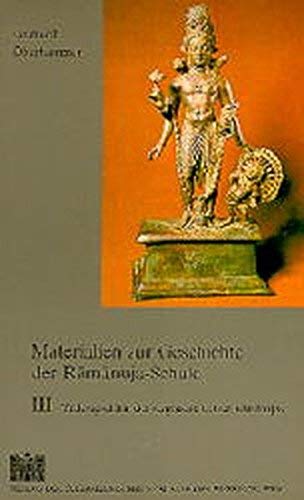
The ninth volume of the "Materialien zur Geschichte der RamanujaSchule" tries for the first time to systematically investigate Ramanuja's philosophicaltheological teaching on the Atma as a sentient subject, which in his work is dealt with in various places and in the context of various issues. The investigation has revealed that Ramanuja adopts the reflections on the Atma as are taught by Yamunamuni in his Atmasiddhih, although these teachings have not been fully worked out. However, in integrating the Atma into his theological view of the Brahma, Ramanuja considers the Atma mainly as a relational prinicple in human beings that, in the end, becomes the "place" of possible revelation and thus the "place" of human "religion." It is noteworthy that the Atma thus becomes ontologicallyy a relational unit with the divine Atma, in which monism is avoided due to an "ontological difference" between the divine and human beings. The second section of the volume is devoted to the reception of Ramanuja's philosophicaltheological reflections on the human subject. This section offers a translation of and commentary on the chapter about the Atma in Narayanarya's Nitimala (12th cent.) as well as portions of Meghanadarisuri's portrayal of the Atma in his Nayadyumanih. A paradigm shift can be seen thereby, due to their falling back on Yamunamuni's Atmasiddhih: a scholastic "treatise on the soul" was developed out of Ramanuja's philosophicaltheological reflections on this subject.
⚠️ WARNING (California Proposition 65):
This product may contain chemicals known to the State of California to cause cancer,
birth defects, or other reproductive harm.
For MAP (Minimum Advertised Price) violations and Intellectual Property (IP) or Trademark concerns, please contact:
support@ergodebooks.com
⚠️ California Proposition 65 Warning: Some products sold on this website may expose you to chemicals known to the State of California to cause cancer, birth defects, or other reproductive harm. For more information, visit www.P65Warnings.ca.gov.