
Title

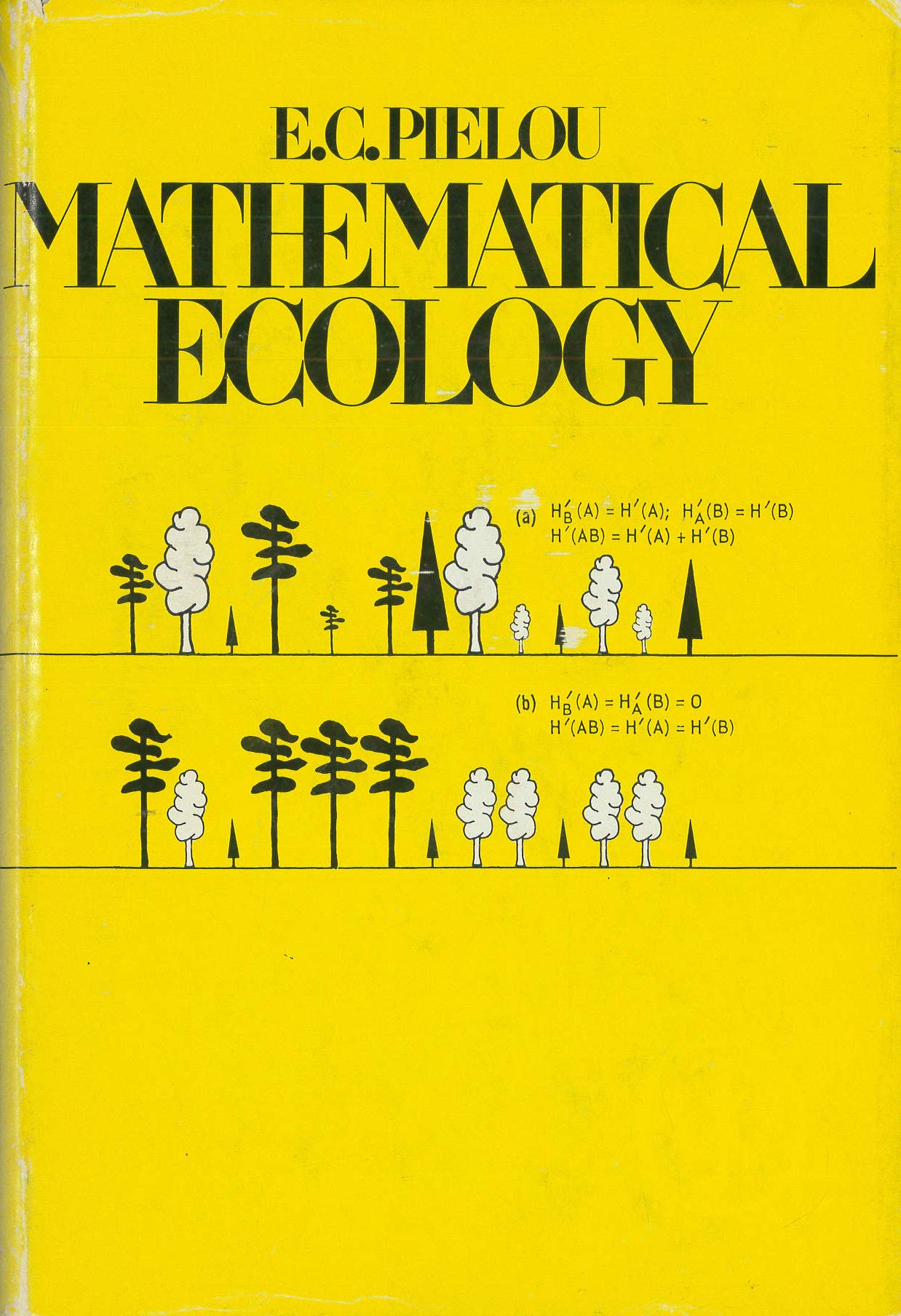
Mathematical Ecology
Sold by Ergodebooks, an authorized reseller.
Returns accepted within 30 days | support@ergodebooks.com
Shipping Information
- Free Standard Shipping — United States only
- Processing Time: 3–5 business days
- Estimated Delivery: 6–10 business days after dispatch
- Double-boxed, fully insured & discreetly packaged
- Tracking number sent via email once dispatched
Returns & Refund
Returns accepted within 30 days of delivery.
Damaged or Defective Item
Free return shipping + replacement or full refund
Wrong Item Received
Free return shipping + replacement or full refund
Change of Mind
Return shipping at customer's expense · 25% restocking fee applies
Payment Option

Pielou'S Approach Added Mathematical Modeling To Ecology. Quantifiable Analyses Could Be Done With Theoretical Ecology In Areas Like Population And Community Ecology. Mathematics Would Provide Insight Into, For Example, Which Factors Are Most Significant To Ecosystem Stability And By How Much Compared To Others. One Of Pielou'S Papers Mentioned The Importance And Uses Of Mathematical Modeling In Ecology As Well As Their Limitations. Population Dynamics Were Better Explained As To Why They Behaved In The Ways That They Did Through Modeling. Predictions To An Ecosystem'S Behavior And Its Outcomes Became More Of An Explanation As To Why, Rather Than Simply A Forecast, Through The Use Of Such Models. If A Model Was Unrealistic, It Did Not Mean That It Was Wrong. Mathematical Modeling Allowed The Creation Of New Hypotheses Looking Into Why The Model Did Not Match Observations. An Outcome Was Not Always One Or The Other, As It Might Have Been Different Due To Unforeseen Circumstances Or Conditions Initially Thought As Unimportant. This Allowed Mathematical Models In Ecology To Be Used As A Standard For Comparisons With Other Systems. No Two Ecosystems Are Identical, And The Significant Differences Between Them Could Be More Easily Identified.
⚠️ WARNING (California Proposition 65):
This product may contain chemicals known to the State of California to cause cancer, birth defects, or other reproductive harm.
For more information, please visit www.P65Warnings.ca.gov.
- Q: What are the dimensions of the book 'Mathematical Ecology'? A: The book measures one point eighteen inches in length, six point three inches in width, and nine point forty-five inches in height.
- Q: How many pages does 'Mathematical Ecology' have? A: The book contains four hundred pages, providing an extensive exploration of mathematical modeling in ecology.
- Q: What type of binding does 'Mathematical Ecology' have? A: This book is bound in hardcover, ensuring durability and a long-lasting addition to your library.
- Q: Who is the author of 'Mathematical Ecology'? A: The author of this book is E. C. Pielou, known for her contributions to the field of ecology through mathematical modeling.
- Q: What category does 'Mathematical Ecology' fall under? A: This book is categorized under Biology, focusing on ecological theories and mathematical applications.
- Q: How should I read 'Mathematical Ecology' for the best understanding? A: To fully grasp the concepts, it's recommended to read it thoughtfully, taking notes on key mathematical models and their ecological implications.
- Q: Is 'Mathematical Ecology' suitable for beginners in ecology? A: Yes, the book is approachable for beginners, although a basic understanding of ecology and mathematics will enhance comprehension.
- Q: What is the primary focus of 'Mathematical Ecology'? A: The book focuses on the integration of mathematical modeling with ecological studies to explain population dynamics and ecosystem behaviors.
- Q: Can I use 'Mathematical Ecology' as a textbook for a course? A: Yes, it can be used as a textbook for courses in ecology, particularly those emphasizing quantitative methods and modeling.
- Q: How should I care for 'Mathematical Ecology' to keep it in good condition? A: To maintain the book's condition, store it upright in a dry place away from direct sunlight and handle it with clean hands.
- Q: Does 'Mathematical Ecology' contain any illustrations or graphs? A: Yes, the book includes various illustrations and graphs that help visualize complex mathematical concepts in ecology.
- Q: What is the best way to store 'Mathematical Ecology'? A: Store the book vertically on a shelf to prevent warping, and avoid stacking heavy items on top of it.
- Q: Is there any specific care needed for the hardcover of 'Mathematical Ecology'? A: The hardcover is durable, but avoid exposure to moisture and extreme temperatures to prevent damage.
- Q: What should I do if my copy of 'Mathematical Ecology' arrives damaged? A: If your copy arrives damaged, contact the retailer's customer service for a return or exchange.
- Q: Are there any warranties available for 'Mathematical Ecology'? A: Typically, books do not come with warranties, but check with the retailer for their specific return policy.