If you have any questions, you are always welcome to contact us. We'll get back to you as soon as possible, withing 24 hours on weekdays.
Customer service
All questions about your order, return and delivery must be sent to our customer service team by e-mail at yourstore@yourdomain.com
Sale & Press
If you are interested in selling our products, need more information about our brand or wish to make a collaboration, please contact us at press@yourdomain.com
Help
If you have any questions, you are always welcome to contact us. We'll get back to you as soon as possible, withing 24 hours on weekdays.
Customer service
All questions about your order, return and delivery must be sent to our customer service team by e-mail at yourstore@yourdomain.com
Sale & Press
If you are interested in selling our products, need more information about our brand or wish to make a collaboration, please contact us at press@yourdomain.com
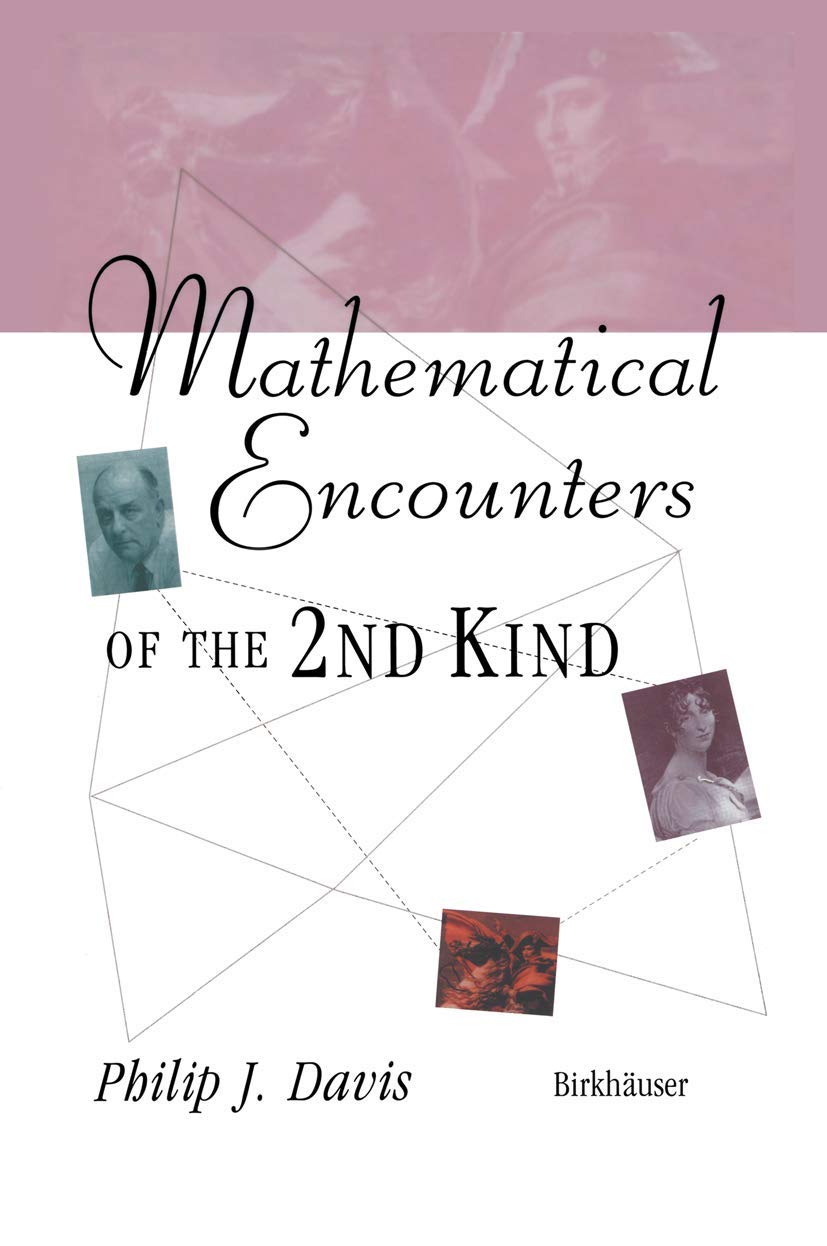
A number of years ago, Harriet Sheridan, then Dean of Brown University, organized a series oflectures in which individual faculty members described how it came about that they entered their various fields. I was invited to participate in this series and found in the invitation an opportunity to recall events going back to my early teens. The lecture was well received and its reception encouraged me to work up an expanded version. My manuscript lay dormant all these years. In the meanwhile, sufficiently many other mathematical experiences and encounters accumulated to make this little book. My 1981 lecture is the basis of the first piece: 'Napoleon's Theorem. ' Although there is a connection between the first piece and the second, the four pieces here are essentially independent. The sec ond piece, 'Carpenter and the Napoleon Ascription,' has as its object a full description of a certain type of scholarstoryteller (of whom I have known and admired several). It is a pastiche, contain ing a salad bar selection blended together by my own imagination. This piece purports, as a secondary goal, to present a solution to a certain unsolved historical problem raised in the first piece. The third piece, 'The Man Who Began His Lectures with 'Namely',' is a short reminiscence of Stefan Bergman, one of my teachers of graduate mathematics. Bergman, a remarkable person ality, was born in Poland and came to the United States in 1939.
⚠️ WARNING (California Proposition 65):
This product may contain chemicals known to the State of California to cause cancer,
birth defects, or other reproductive harm.
For MAP (Minimum Advertised Price) violations and Intellectual Property (IP) or Trademark concerns, please contact:
support@ergodebooks.com
⚠️ California Proposition 65 Warning: Some products sold on this website may expose you to chemicals known to the State of California to cause cancer, birth defects, or other reproductive harm. For more information, visit www.P65Warnings.ca.gov.