
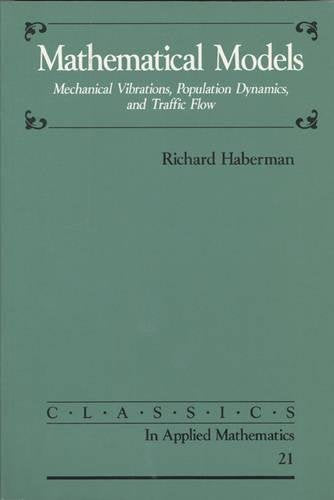
Title
Mathematical Models: Mechanical Vibrations, Population Dynamics, and Traffic Flow (Classics in Applied Mathematics, Series Numbe,Used
Sold by Ergodebooks, an authorized reseller.
Returns accepted within 30 days | support@ergodebooks.com
Shipping Information
- Free Standard Shipping — United States only
- Processing Time: 3–5 business days
- Estimated Delivery: 6–10 business days after dispatch
- Double-boxed, fully insured & discreetly packaged
- Tracking number sent via email once dispatched
Returns & Refund
Returns accepted within 30 days of delivery.
Damaged or Defective Item
Free return shipping + replacement or full refund
Wrong Item Received
Free return shipping + replacement or full refund
Change of Mind
Return shipping at customer's expense · 25% restocking fee applies
Payment Option

Mathematics is a grand subject in the way it can be applied to various problems in science and engineering. To use mathematics, one needs to understand the physical context. The author uses mathematical techniques along with observations and experiments to give an indepth look at models for mechanical vibrations, population dynamics, and traffic flow. Equal emphasis is placed on the mathematical formulation of the problem and the interpretation of the results. In the sections on mechanical vibrations and population dynamics, the author emphasizes the nonlinear aspects of ordinary differential equations and develops the concepts of equilibrium solutions and their stability. He introduces phase plane methods for the nonlinear pendulum and for predatorprey and competing species models.
⚠️ WARNING (California Proposition 65):
This product may contain chemicals known to the State of California to cause cancer, birth defects, or other reproductive harm.
For more information, please visit www.P65Warnings.ca.gov.
- Q: What topics are covered in 'Mathematical Models: Mechanical Vibrations, Population Dynamics, and Traffic Flow'? A: This book covers mechanical vibrations, population dynamics, and traffic flow, emphasizing the mathematical techniques and their physical contexts.
- Q: Who is the author of the book? A: The author of the book is Richard Haberman.
- Q: What is the condition of the used book available for purchase? A: The used book is listed in good condition.
- Q: How many pages does this book have? A: The book has a total of 422 pages.
- Q: What type of binding does this book have? A: The book is available in paperback binding.
- Q: When was 'Mathematical Models: Mechanical Vibrations, Population Dynamics, and Traffic Flow' published? A: The book was published in February 1998.
- Q: Does the book focus on nonlinear aspects of ordinary differential equations? A: Yes, the book emphasizes the nonlinear aspects of ordinary differential equations, particularly in mechanical vibrations and population dynamics.
- Q: Is this book suitable for beginners in mathematics? A: While the book provides in-depth explanations, it may be more suitable for those with a foundational understanding of mathematics due to its advanced topics.
- Q: What is the primary audience for this book? A: The primary audience includes students and professionals interested in applied mathematics within the fields of science and engineering.
- Q: Are there any special features of this book? A: The book includes mathematical formulations along with interpretations of results, providing a comprehensive understanding of the models discussed.