
Title
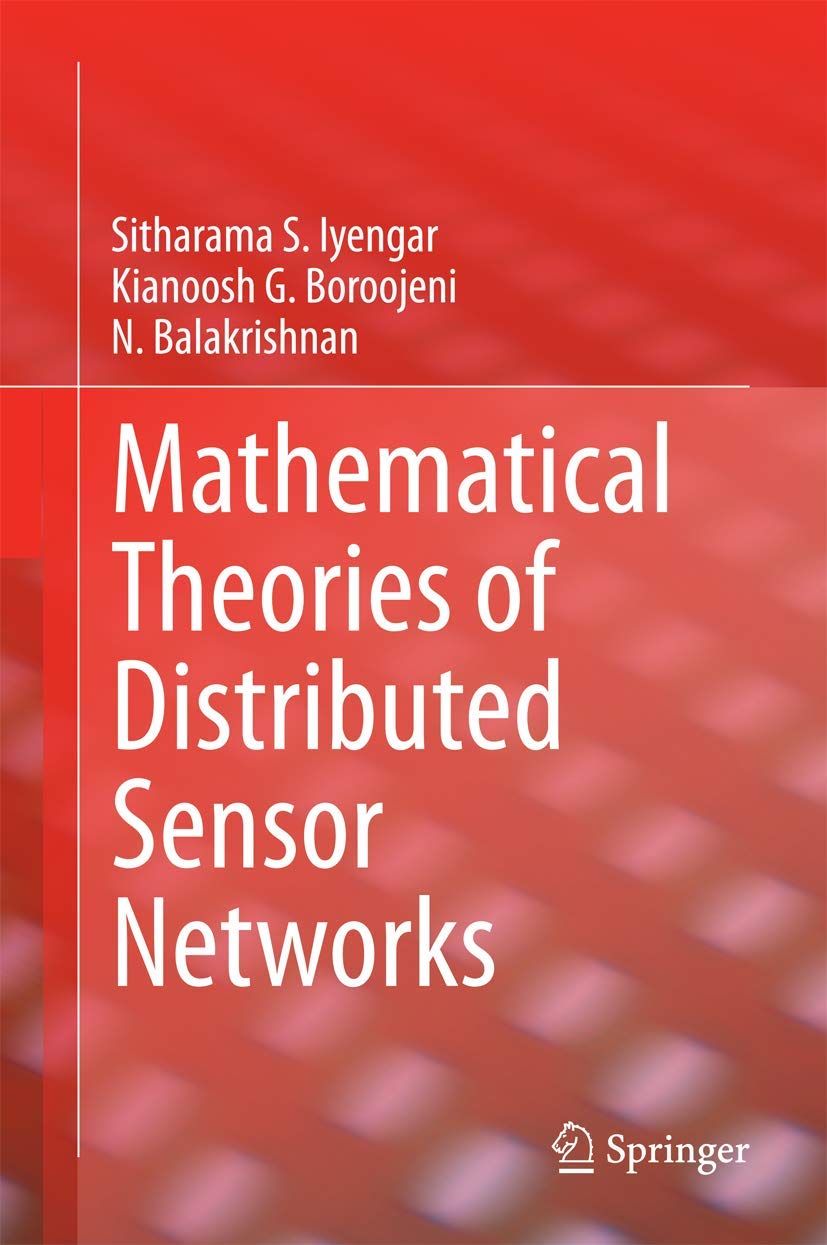
Mathematical Theories of Distributed Sensor Networks,Used
Sold by Ergodebooks, an authorized reseller.
Returns accepted within 30 days | support@ergodebooks.com
Shipping Information
- Free Standard Shipping — United States only
- Processing Time: 3–5 business days
- Estimated Delivery: 6–10 business days after dispatch
- Double-boxed, fully insured & discreetly packaged
- Tracking number sent via email once dispatched
Returns & Refund
Returns accepted within 30 days of delivery.
Damaged or Defective Item
Free return shipping + replacement or full refund
Wrong Item Received
Free return shipping + replacement or full refund
Change of Mind
Return shipping at customer's expense · 25% restocking fee applies
Payment Option

This book provides a Mathematical Theory of Distributed Sensor Networks. It introduces the Mathematical & Computational Structure by discussing what they are, their applications and how they differ from traditional systems. It also explains how mathematics are utilized to provide efficient techniques implementing effective coverage, deployment, transmission, data processing, signal processing, and data protection within distributed sensor networks. Finally, it discusses some important challenges facing mathematics to get more incite to the multidisciplinary area of distributed sensor networks. This book will help design engineers to set up WSNbased applications providing better use of resources while optimizing processing costs. This book is highly useful for graduate students starting their first steps in research to apprehend new approaches and understand the mathematics behind them and face promising challenges. This book aims at presenting a formal framework allowing to show how mathematical theories can be used to provide distributed sensor modeling and to solve important problems such as coverage hole detection and repair. This book aims at presenting the current state of the art in formal issues related to sensor networking. It can be used as a handbook for different classes at the graduate level and the undergraduate level. It is self contained and comprehensive, presenting a complete picture of the discipline of optical network engineering including modeling functions, controlling quality of service, allocation resources, monitoring traffic, protecting infrastructure, and conducting planning. This book addresses a large set of theoretical aspects. It is designed for specialists in ad hoc and wireless sensor networks and does not include discusses on very promising areas such as homotopy, computational geometry, and wavelet transforms.
⚠️ WARNING (California Proposition 65):
This product may contain chemicals known to the State of California to cause cancer, birth defects, or other reproductive harm.
For more information, please visit www.P65Warnings.ca.gov.