
Title
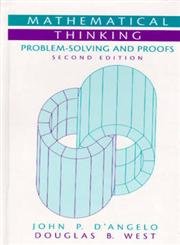
Mathematical Thinking: ProblemSolving and Proofs (2nd Edition),Used
Sold by Ergodebooks, an authorized reseller.
Returns accepted within 30 days | support@ergodebooks.com
Shipping Information
- Free Standard Shipping — United States only
- Processing Time: 3–5 business days
- Estimated Delivery: 6–10 business days after dispatch
- Double-boxed, fully insured & discreetly packaged
- Tracking number sent via email once dispatched
Returns & Refund
Returns accepted within 30 days of delivery.
Damaged or Defective Item
Free return shipping + replacement or full refund
Wrong Item Received
Free return shipping + replacement or full refund
Change of Mind
Return shipping at customer's expense · 25% restocking fee applies
Payment Option

This survey of both discrete and continuous mathematics focuses on the logical thinking skills necessary to understand and communicate fundamental ideas and proofs in mathematics, rather than on rote symbolic manipulation. Coverage begins with the fundamentals of mathematical language and proof techniques (such as induction); then applies them to easilyunderstood questions in elementary number theory and counting; then develops additional techniques of proofs via fundamental topics in discrete and continuous mathematics. Topics are addressed in the context of familiar objects; easilyunderstood, engaging examples; and over 700 stimulating exercises and problems, ranging from simple applications to subtle problems requiring ingenuity. ELEMENTARY CONCEPTS. Numbers, Sets and Functions. Language and Proofs. Properties of Functions. Induction. PROPERTIES OF NUMBERS. Counting and Cardinality. Divisibility. Modular Arithmetic. The Rational Numbers. DISCRETE MATHEMATICS. Combinatorial Reasoning. Two Principles of Counting. Graph Theory. Recurrence Relations. CONTINUOUS MATHEMATICS. The Real Numbers. Sequences and Series. Continuity. Differentiation. Integration. The Complex Numbers. For anyone interested in learning how to understand and write mathematical proofs, or a reference for college professors and high school teachers of mathematics.
⚠️ WARNING (California Proposition 65):
This product may contain chemicals known to the State of California to cause cancer, birth defects, or other reproductive harm.
For more information, please visit www.P65Warnings.ca.gov.
- Q: What topics are covered in 'Mathematical Thinking: Problem-Solving and Proofs'? A: This book covers a variety of topics in both discrete and continuous mathematics, including mathematical language, proof techniques like induction, elementary number theory, counting, combinatorial reasoning, graph theory, sequences, series, differentiation, and integration.
- Q: Who is the author of this textbook? A: The book is authored by John P. D'Angelo.
- Q: What is the edition and publication date of this book? A: This is the 2nd edition of 'Mathematical Thinking: Problem-Solving and Proofs', published on December 27, 1999.
- Q: Is this book suitable for self-study? A: Yes, the book is designed to help individuals learn how to understand and write mathematical proofs, making it suitable for self-study as well as for use in academic settings.
- Q: How many pages does the book have? A: The book contains 412 pages.
- Q: What is the condition of the book? A: The item condition is listed as 'Acceptable', which means it may have some wear but is still usable.
- Q: What type of binding does this book have? A: The book is bound in hardcover, providing durability for regular use.
- Q: Can this book help with teaching mathematics? A: Yes, it serves as a valuable reference for college professors and high school teachers, providing insights into teaching mathematical concepts and proof techniques.
- Q: What are some of the key features of this textbook? A: The book emphasizes logical thinking skills, includes engaging examples, and offers over 700 exercises ranging from simple to complex problems.
- Q: Is there a focus on practical applications in this book? A: Yes, the book addresses mathematical topics in the context of familiar objects and includes practical examples to enhance understanding.