
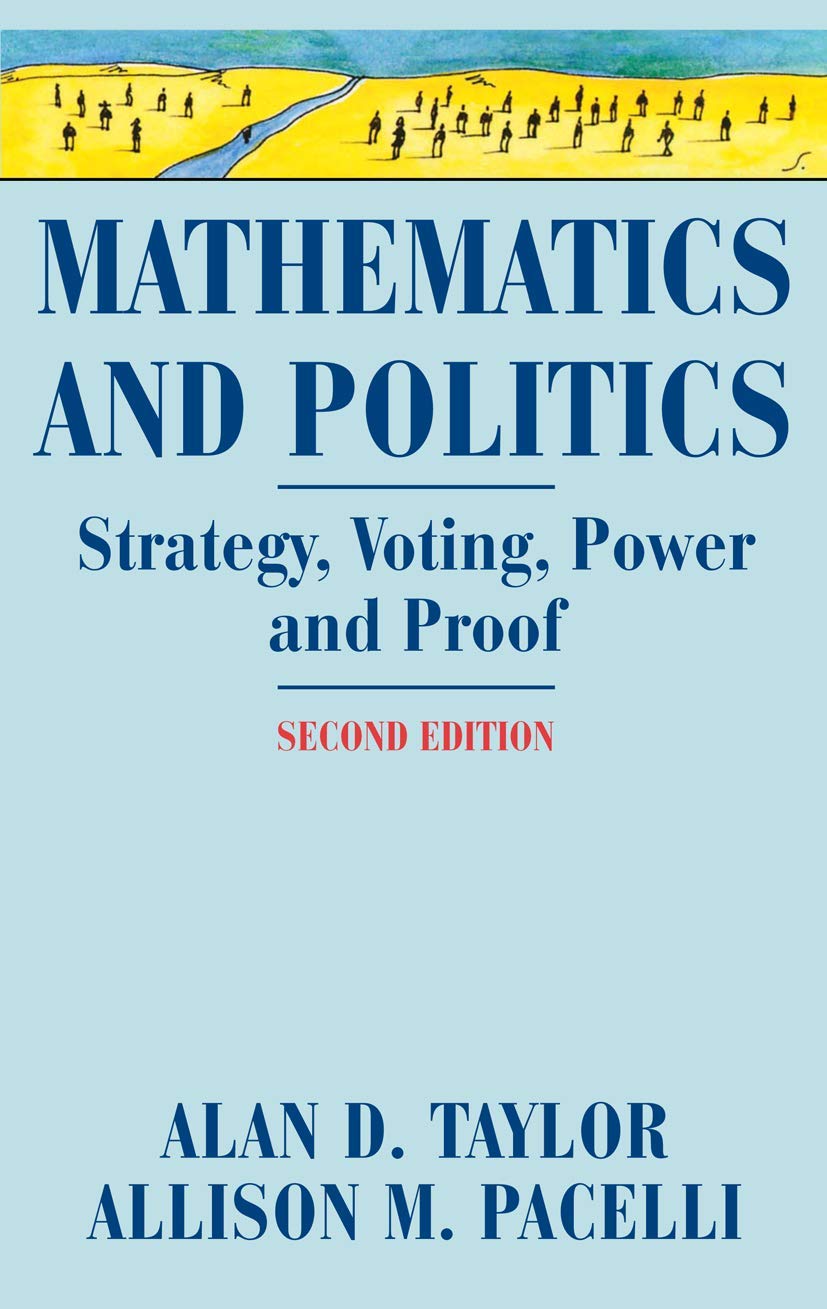
Title
Mathematics and Politics: Strategy, Voting, Power, and Proof,New
Sold by Ergodebooks, an authorized reseller.
Returns accepted within 30 days | support@ergodebooks.com
Shipping Information
- Free Standard Shipping — United States only
- Processing Time: 3–5 business days
- Estimated Delivery: 6–10 business days after dispatch
- Double-boxed, fully insured & discreetly packaged
- Tracking number sent via email once dispatched
Returns & Refund
Returns accepted within 30 days of delivery.
Damaged or Defective Item
Free return shipping + replacement or full refund
Wrong Item Received
Free return shipping + replacement or full refund
Change of Mind
Return shipping at customer's expense · 25% restocking fee applies
Payment Option

Why would anyone bid $3. 25 in an auction where the prize is a single dollar bill? Can one game explain the apparent irrationality behind both the arms race of the 1980s and the libretto of Puccinis opera Tosca? How can one calculation suggest the president has 4 percent of the power in the United States federal system while another s gests that he or she controls 77 percent? Is democracy (in the sense of re?ecting the will of the people) impossible? Questionslikethesequitesurprisinglyprovideaveryniceforumfor some fundamental mathematical activities: symbolic representation and manipulation, modeltheoretic analysis, quantitative represen tionandcalculation,anddeductionasembodiedinthepresentationof mathematical proof as convincing argument. We believe that an ex sure to aspects of mathematics such as these should be an integral part of a liberal arts education. Our hope is that this book will serve as a text for freshmansophomore level courses, aimed primarily at students in the humanities and social sciences, that will provide this sort of exposure. A number of colleges and universities already have interdisciplinary freshman seminars where this could take place. Most mathematics texts for nonscience majors try to show that mathematics can be applied to many different disciplines. A students viii PREFACE interest in a particular application, however, often depends on his or hergeneralinterestintheareainwhichtheapplicationistakingplace. Our experience at Union College and Williams College has been that there is a real advantage in having students enter the course knowing that virtually all the applications will focus on a single disciplinein this case, political science.
⚠️ WARNING (California Proposition 65):
This product may contain chemicals known to the State of California to cause cancer, birth defects, or other reproductive harm.
For more information, please visit www.P65Warnings.ca.gov.
- Q: What are the dimensions of the book? A: The book measures seven point twenty-four inches in length, one point zero eight inches in width, and ten point forty-three inches in height.
- Q: How many pages does this book contain? A: This book contains three hundred and eighty pages, providing a comprehensive exploration of mathematics in relation to politics.
- Q: What is the binding type of this book? A: The book is bound in hardcover, ensuring durability and a professional appearance.
- Q: What topics does this book cover? A: The book covers topics such as strategy, voting, power, and mathematical proof in the context of politics.
- Q: Is this book suitable for beginners? A: Yes, this book is suitable for beginners, particularly those in the humanities and social sciences.
- Q: What type of courses is this book designed for? A: This book is designed for freshman-sophomore level courses, focusing on liberal arts education.
- Q: How should this book be used in educational settings? A: This book can be used in interdisciplinary freshman seminars to expose students to mathematical concepts.
- Q: Is there a specific audience for this book? A: Yes, the primary audience includes students studying humanities and social sciences.
- Q: What is the author's background? A: The author, Alan D. Taylor, is known for his work in mathematics and its applications to social sciences.
- Q: What if I receive a damaged book? A: If you receive a damaged book, you should contact the seller for return or exchange options.
- Q: Is there a warranty on this book? A: Typically, books do not come with warranties, but you can check the seller's return policy.
- Q: Can I find this book in a digital format? A: Availability in digital format may vary; check with the publisher or seller for eBook options.
- Q: How should I store this book? A: Store this hardcover book upright on a shelf to maintain its shape and protect it from damage.
- Q: What is the return policy for this book? A: The return policy can vary by seller; please review the specific terms before purchasing.
- Q: Does this book include exercises or examples? A: Yes, the book includes exercises and examples to help illustrate mathematical concepts in a political context.