If you have any questions, you are always welcome to contact us. We'll get back to you as soon as possible, withing 24 hours on weekdays.
Customer service
All questions about your order, return and delivery must be sent to our customer service team by e-mail at yourstore@yourdomain.com
Sale & Press
If you are interested in selling our products, need more information about our brand or wish to make a collaboration, please contact us at press@yourdomain.com
Help
If you have any questions, you are always welcome to contact us. We'll get back to you as soon as possible, withing 24 hours on weekdays.
Customer service
All questions about your order, return and delivery must be sent to our customer service team by e-mail at yourstore@yourdomain.com
Sale & Press
If you are interested in selling our products, need more information about our brand or wish to make a collaboration, please contact us at press@yourdomain.com
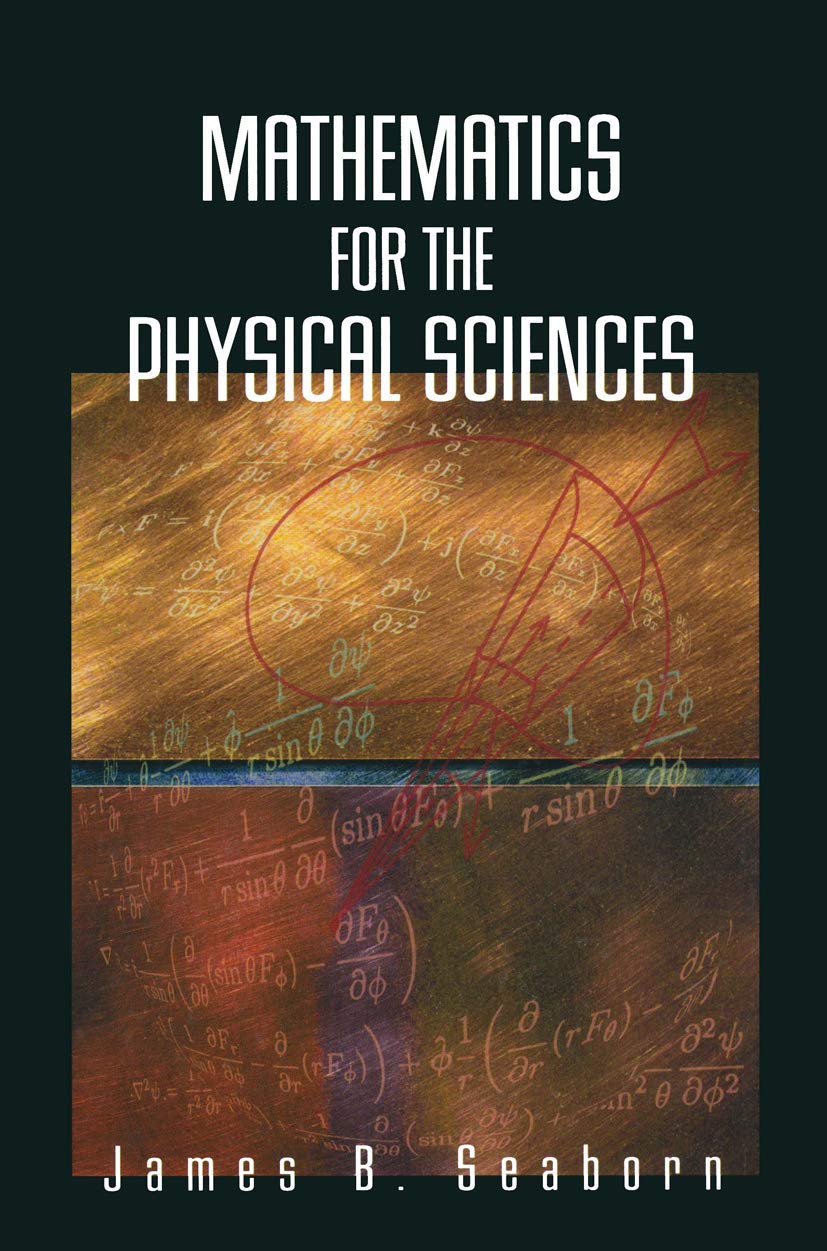
This book is intended to provide a mathematical bridge from a general physics course to intermediatelevel courses in classical mechanics, electricity and mag netism, and quantum mechanics. The book begins with a short review of a few topics that should be familiar to the student from a general physics course. These examples will be used throughout the rest of the book to provide physical con texts for introducing the mathematical applications. The next two chapters are devoted to making the student familiar with vector operations in algebra and cal culus. Students will have already become acquainted with vectors in the general physics course. The notion of magnetic flux provides a physical connection with the integral theorems of vector calculus. A very short chapter on complex num bers is sufficient to supply the needed background for the minor role played by complex numbers in the remainder of the text. Mathematical applications in in termediate and advanced undergraduate courses in physics are often in the form of ordinary or partial differential equations. Ordinary differential equations are introduced in Chapter 5. The ubiquitous simple harmonic oscillator is used to il lustrate the series method of solving an ordinary, linear, secondorder differential equation. The onedimensional, timedependent SchrOdinger equation provides an illus tration for solving a partial differential equation by the method of separation of variables in Chapter 6.
⚠️ WARNING (California Proposition 65):
This product may contain chemicals known to the State of California to cause cancer,
birth defects, or other reproductive harm.
For MAP (Minimum Advertised Price) violations and Intellectual Property (IP) or Trademark concerns, please contact:
support@ergodebooks.com
⚠️ California Proposition 65 Warning: Some products sold on this website may expose you to chemicals known to the State of California to cause cancer, birth defects, or other reproductive harm. For more information, visit www.P65Warnings.ca.gov.