
Title
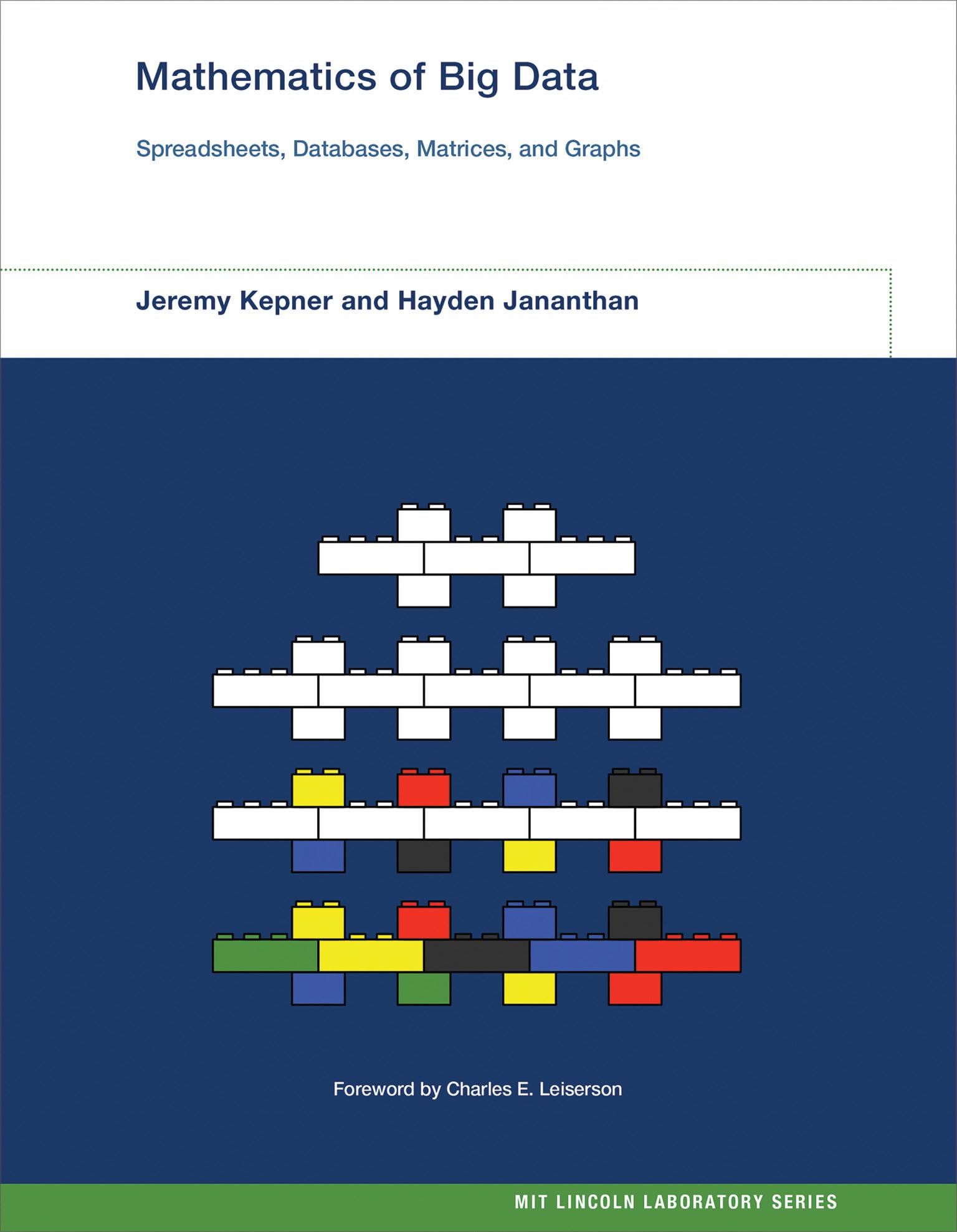
Mathematics Of Big Data: Spreadsheets, Databases, Matrices, And Graphs (Mit Lincoln Laboratory Series)
Sold by Ergodebooks, an authorized reseller.
Returns accepted within 30 days | support@ergodebooks.com
Shipping Information
- Free Standard Shipping — United States only
- Processing Time: 3–5 business days
- Estimated Delivery: 6–10 business days after dispatch
- Double-boxed, fully insured & discreetly packaged
- Tracking number sent via email once dispatched
Returns & Refund
Returns accepted within 30 days of delivery.
Damaged or Defective Item
Free return shipping + replacement or full refund
Wrong Item Received
Free return shipping + replacement or full refund
Change of Mind
Return shipping at customer's expense · 25% restocking fee applies
Payment Option

The First Book To Present The Common Mathematical Foundations Of Big Data Analysis Across A Range Of Applications And Technologies.Today, The Volume, Velocity, And Variety Of Data Are Increasing Rapidly Across A Range Of Fields, Including Internet Search, Healthcare, Finance, Social Media, Wireless Devices, And Cybersecurity. Indeed, These Data Are Growing At A Rate Beyond Our Capacity To Analyze Them. The Toolsincluding Spreadsheets, Databases, Matrices, And Graphsdeveloped To Address This Challenge All Reflect The Need To Store And Operate On Data As Whole Sets Rather Than As Individual Elements. This Book Presents The Common Mathematical Foundations Of These Data Sets That Apply Across Many Applications And Technologies. Associative Arrays Unify And Simplify Data, Allowing Readers To Look Past The Differences Among The Various Tools And Leverage Their Mathematical Similarities In Order To Solve The Hardest Big Data Challenges.The Book First Introduces The Concept Of The Associative Array In Practical Terms, Presents The Associative Array Manipulation System D4M (Dynamic Distributed Dimensional Data Model), And Describes The Application Of Associative Arrays To Graph Analysis And Machine Learning. It Provides A Mathematically Rigorous Definition Of Associative Arrays And Describes The Properties Of Associative Arrays That Arise From This Definition. Finally, The Book Shows How Concepts Of Linearity Can Be Extended To Encompass Associative Arrays. Mathematics Of Big Data Can Be Used As A Textbook Or Reference By Engineers, Scientists, Mathematicians, Computer Scientists, And Software Engineers Who Analyze Big Data.
⚠️ WARNING (California Proposition 65):
This product may contain chemicals known to the State of California to cause cancer, birth defects, or other reproductive harm.
For more information, please visit www.P65Warnings.ca.gov.
- Q: What is the page count of this book? A: This book has four hundred forty-eight pages. It offers extensive content covering the mathematical foundations of big data analysis.
- Q: What are the dimensions of this book? A: The book measures nine point twenty-one inches in length, seven point zero one inches in width, and one point two inches in height.
- Q: What type of binding does this book have? A: This book is hardcover bound. This ensures durability and a professional appearance for readers and libraries.
- Q: Who is the author of this book? A: The author of this book is Jeremy Kepner. He is known for his expertise in big data mathematics and analysis.
- Q: What is the primary focus of this book? A: This book focuses on the mathematical foundations of big data analysis. It covers various applications and technologies relevant to this field.
- Q: Is this book suitable for beginners? A: Yes, this book can be suitable for beginners. It provides a clear introduction to complex topics, making it accessible for those new to big data.
- Q: Is this book appropriate for advanced readers? A: Yes, advanced readers will find value in the rigorous mathematical definitions presented. It serves as a reference for experienced professionals as well.
- Q: Can this book be used as a textbook? A: Yes, this book can be used as a textbook. It's designed to be educational and informative for students in engineering and computer science.
- Q: What topics are covered in this book? A: Topics include associative arrays, graph analysis, and machine learning. These areas are crucial for understanding big data challenges.
- Q: How should I care for this book? A: To care for this book, store it upright in a dry place. Avoid exposing it to direct sunlight to prevent fading and wear.
- Q: Is this book safe for children? A: This book is not specifically aimed at children. It is intended for an audience of engineers, scientists, and computer scientists.
- Q: What if the book arrives damaged? A: If the book arrives damaged, you should contact the retailer for a return or exchange. Most retailers have policies in place for such situations.
- Q: Does this book contain illustrations or graphs? A: Yes, the book contains graphs and diagrams. These visual aids help clarify complex mathematical concepts discussed throughout the text.
- Q: Is there a glossary or index in this book? A: Yes, there is an index included. This helps readers easily locate specific topics and terms in the book.
- Q: What is the publication date of this book? A: The publication date of this book is not specified in the provided details. However, it is part of the MIT Lincoln Laboratory Series.