If you have any questions, you are always welcome to contact us. We'll get back to you as soon as possible, withing 24 hours on weekdays.
Customer service
All questions about your order, return and delivery must be sent to our customer service team by e-mail at yourstore@yourdomain.com
Sale & Press
If you are interested in selling our products, need more information about our brand or wish to make a collaboration, please contact us at press@yourdomain.com
Help
If you have any questions, you are always welcome to contact us. We'll get back to you as soon as possible, withing 24 hours on weekdays.
Customer service
All questions about your order, return and delivery must be sent to our customer service team by e-mail at yourstore@yourdomain.com
Sale & Press
If you are interested in selling our products, need more information about our brand or wish to make a collaboration, please contact us at press@yourdomain.com
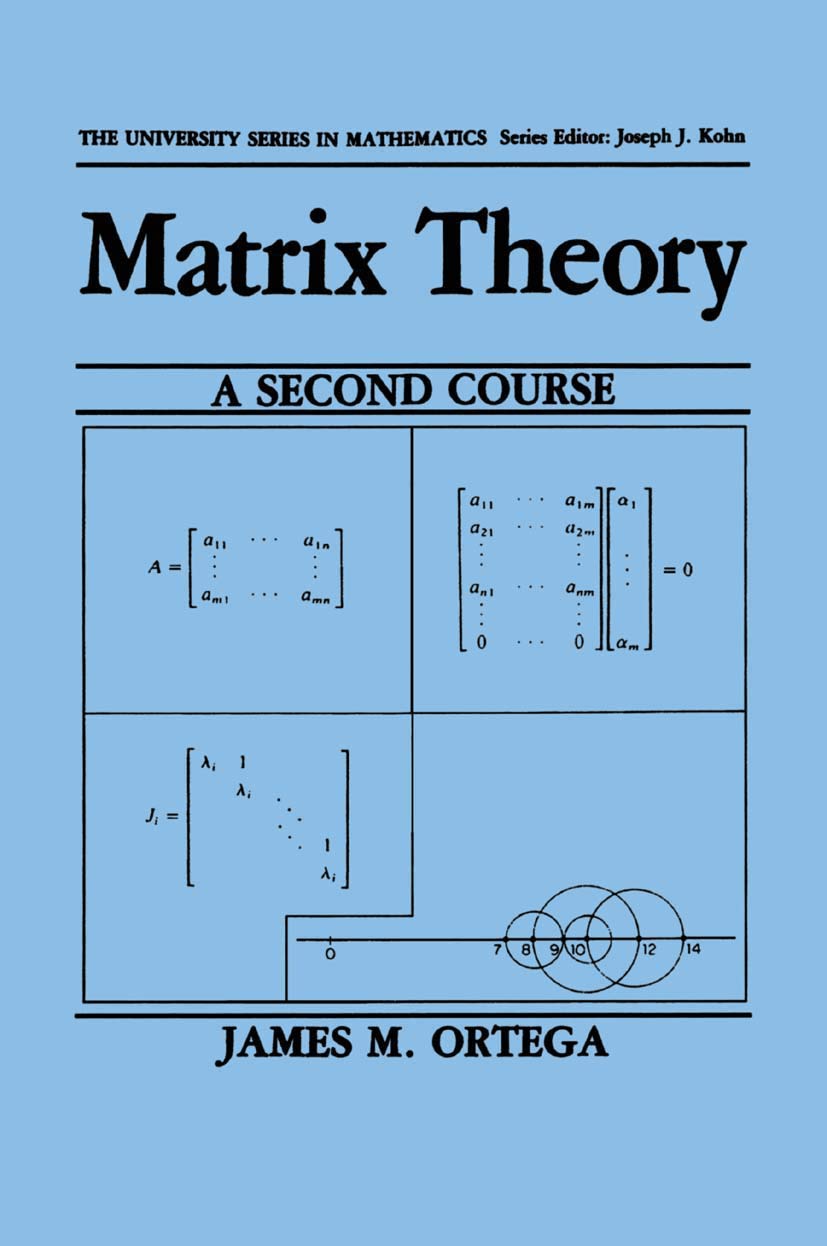
Linear algebra and matrix theory are essentially synonymous terms for an area of mathematics that has become one of the most useful and pervasive tools in a wide range of disciplines. It is also a subject of great mathematical beauty. In consequence of both of these facts, linear algebra has increasingly been brought into lower levels of the curriculum, either in conjunction with the calculus or separate from it but at the same level. A large and still growing number of textbooks has been written to satisfy this need, aimed at students at the junior, sophomore, or even freshman levels. Thus, most students now obtaining a bachelor's degree in the sciences or engineering have had some exposure to linear algebra. But rarely, even when solid courses are taken at the junior or senior levels, do these students have an adequate working knowledge of the subject to be useful in graduate work or in research and development activities in government and industry. In particular, most elementary courses stop at the point of canonical forms, so that while the student may have 'seen' the Jordan and other canonical forms, there is usually little appreciation of their usefulness. And there is almost never time in the elementary courses to deal with more specialized topics like nonnegative matrices, inertia theorems, and so on. In consequence, many graduate courses in mathematics, applied mathe matics, or applications develop certain parts of matrix theory as needed.
⚠️ WARNING (California Proposition 65):
This product may contain chemicals known to the State of California to cause cancer,
birth defects, or other reproductive harm.
For MAP (Minimum Advertised Price) violations and Intellectual Property (IP) or Trademark concerns, please contact:
support@ergodebooks.com
⚠️ California Proposition 65 Warning: Some products sold on this website may expose you to chemicals known to the State of California to cause cancer, birth defects, or other reproductive harm. For more information, visit www.P65Warnings.ca.gov.