If you have any questions, you are always welcome to contact us. We'll get back to you as soon as possible, withing 24 hours on weekdays.
Customer service
All questions about your order, return and delivery must be sent to our customer service team by e-mail at yourstore@yourdomain.com
Sale & Press
If you are interested in selling our products, need more information about our brand or wish to make a collaboration, please contact us at press@yourdomain.com
Help
If you have any questions, you are always welcome to contact us. We'll get back to you as soon as possible, withing 24 hours on weekdays.
Customer service
All questions about your order, return and delivery must be sent to our customer service team by e-mail at yourstore@yourdomain.com
Sale & Press
If you are interested in selling our products, need more information about our brand or wish to make a collaboration, please contact us at press@yourdomain.com
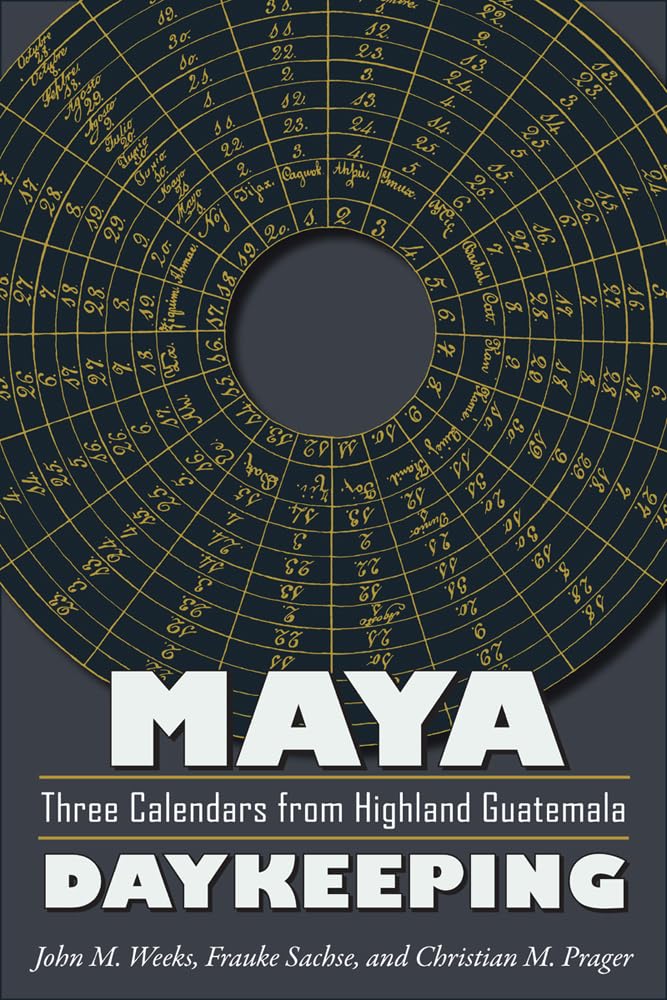
In Maya Daykeeping, three divinatory calendars from highland Guatemala examples of a Mayan literary tradition that includes the Popul Vuh, Annals of the Cakchiquels, and the Titles of the Lords of Totonicapan dating to 1685, 1722, and 1855, are transcribed in K'iche or Kaqchikel sidebyside with English translations. Calendars such as these continue to be the basis for prognostication, determining everything from the time for planting and harvest to foreshadowing illness and death. Good, bad, and mixed fates can all be found in these examples of the solar calendar and the 260day divinatory calendar.The use of such calendars is mentioned in historical and ethnographic works, but very few examples are known to exist. Each of the three calendars transcribed and translated by John M. Weeks, Frauke Sachse, and Christian M. Prager and housed at the University of Pennsylvania Museum of Archaeology and Anthropology is unique in structure and content. Moreover, except for an unpublished study of the 1722 calendar by Rudolf Schuller and Oliver La Farge (1934), these littleknown works appear to have escaped the attention of most scholars. Introductory essays contextualize each document in time and space, and a series of appendixes present previously unpublished calendrical notes assembled in the early twentieth century.Providing considerable information on the divinatory use of calendars in colonial highland Maya society previously unavailable without a visit to the University of Pennsylvania's archives, Maya Daykeeping is an invaluable primary resource for Maya scholars. Mesoamerican Worlds Series
⚠️ WARNING (California Proposition 65):
This product may contain chemicals known to the State of California to cause cancer,
birth defects, or other reproductive harm.
For MAP (Minimum Advertised Price) violations and Intellectual Property (IP) or Trademark concerns, please contact:
support@ergodebooks.com
⚠️ California Proposition 65 Warning: Some products sold on this website may expose you to chemicals known to the State of California to cause cancer, birth defects, or other reproductive harm. For more information, visit www.P65Warnings.ca.gov.