If you have any questions, you are always welcome to contact us. We'll get back to you as soon as possible, withing 24 hours on weekdays.
Customer service
All questions about your order, return and delivery must be sent to our customer service team by e-mail at yourstore@yourdomain.com
Sale & Press
If you are interested in selling our products, need more information about our brand or wish to make a collaboration, please contact us at press@yourdomain.com
Help
If you have any questions, you are always welcome to contact us. We'll get back to you as soon as possible, withing 24 hours on weekdays.
Customer service
All questions about your order, return and delivery must be sent to our customer service team by e-mail at yourstore@yourdomain.com
Sale & Press
If you are interested in selling our products, need more information about our brand or wish to make a collaboration, please contact us at press@yourdomain.com
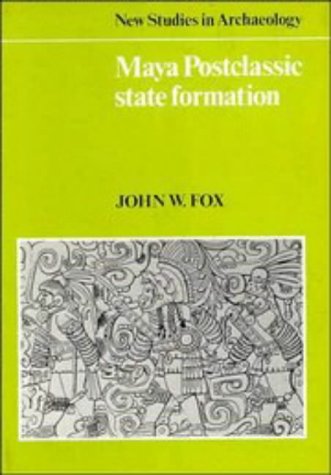
John Fox here offers a fresh and persuasive view of the crucial ClassicPostclassic transition that determined the shape of the later Maya state. Drawing this data from ethnographic analogy and native chronicles as well as archaeology, he identifies segmentary lineage organisation as the key to understanding both the political organisation and the longdistance migrations observed among the Quiche Maya of Guatemala and Mexico. The first part of the book traces the origins of the Quiche, Itza and Xiu to the homeland on the Mexican Gulf coast where they acquired their potent Toltec mythology and identifies early segmentary lineages that developed as a result of social forces in the frontier zone. Dr Fox then matches the known anthropological characteristics of segmentary lineages against the Mayan kinship relationships described in documents and deduced from the spatial patterning within Quiche towns and cities. His conclusion, that the inherently fissile nature of segmentary lineages caused the leapfrogging migrations of up to 500km observed amongst the Maya, offers a convincing solution to a problem that has long puzzled scholars.
⚠️ WARNING (California Proposition 65):
This product may contain chemicals known to the State of California to cause cancer,
birth defects, or other reproductive harm.
For MAP (Minimum Advertised Price) violations and Intellectual Property (IP) or Trademark concerns, please contact:
support@ergodebooks.com
⚠️ California Proposition 65 Warning: Some products sold on this website may expose you to chemicals known to the State of California to cause cancer, birth defects, or other reproductive harm. For more information, visit www.P65Warnings.ca.gov.