

Title
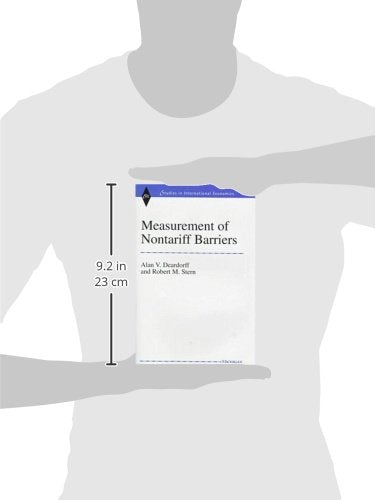
Measurement of Nontariff Barriers (Studies In International Economics),Used
Sold by Ergodebooks, an authorized reseller.
Returns accepted within 30 days | support@ergodebooks.com
Shipping Information
- Free Standard Shipping — United States only
- Processing Time: 3–5 business days
- Estimated Delivery: 6–10 business days after dispatch
- Double-boxed, fully insured & discreetly packaged
- Tracking number sent via email once dispatched
Returns & Refund
Returns accepted within 30 days of delivery.
Damaged or Defective Item
Free return shipping + replacement or full refund
Wrong Item Received
Free return shipping + replacement or full refund
Change of Mind
Return shipping at customer's expense · 25% restocking fee applies
Payment Option

As tariffs on imports of manufactures have been reduced as a result of multilateral trade negotiations, interest in the extent to which existing nontariff barriers may distort and restrict international trade is growing. Accurate and reliable measures are needed in order to address the issues involving the use and impacts of nontariff barriers. This study assesses currently available methods for quantifying such barriers and makes recommendations as to those methods that can be most effectively employed. The authors focus both on the conceptual issues arising in the measurement of the different types of nontariff barriers and on the applied research that has been carried out in studies prepared by country members of the OECD Pilot Group and others seeking to quantify the barriers.Nontariff barriers include quotas, variable levies, voluntary export restraints, government procurement regulations, domestic subsidies, and antidumping and countervailing duty measures. The authors discuss the many different methods available for measuring the effects of these and other nontariff barriers. Illustrative results are presented for industrial OECD countries, including Australia, Canada, Germany, Norway, the European Union, the United Kingdom, and the United States. Finally, the authors offer guideline principles and recommend procedures for measuring different types of nontariff barriers.Economists, political scientists, government officials, and lawyers involved in international trade will find this an invaluable resource for understanding and measuring NTBs.Alan V. Deardorff and Robert M. Stern are Professors of Economics and Public Policy, University of Michigan.
⚠️ WARNING (California Proposition 65):
This product may contain chemicals known to the State of California to cause cancer, birth defects, or other reproductive harm.
For more information, please visit www.P65Warnings.ca.gov.