If you have any questions, you are always welcome to contact us. We'll get back to you as soon as possible, withing 24 hours on weekdays.
Customer service
All questions about your order, return and delivery must be sent to our customer service team by e-mail at yourstore@yourdomain.com
Sale & Press
If you are interested in selling our products, need more information about our brand or wish to make a collaboration, please contact us at press@yourdomain.com
Help
If you have any questions, you are always welcome to contact us. We'll get back to you as soon as possible, withing 24 hours on weekdays.
Customer service
All questions about your order, return and delivery must be sent to our customer service team by e-mail at yourstore@yourdomain.com
Sale & Press
If you are interested in selling our products, need more information about our brand or wish to make a collaboration, please contact us at press@yourdomain.com
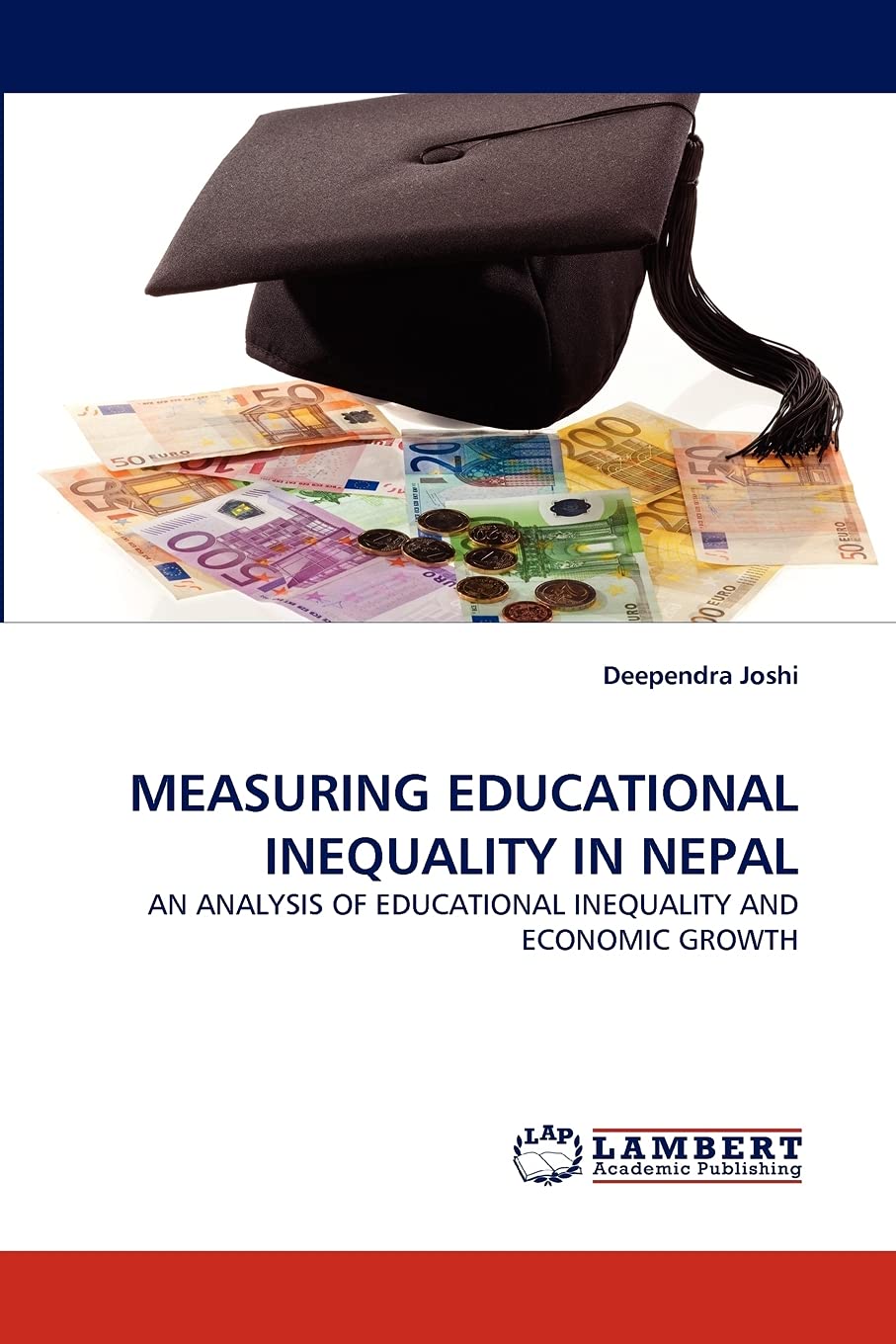
Nepal's targets for economic growth are often ?wishful thinking' due to a number of reasons including persistent poverty and educational inequality among others. Many countries including Nepal are committed to providing equal access to education to reduce the educational attainment gaps between various groups for attaining the committed goals of Universal Primary Education (UPE) of Millennium Development Goals (MDGs) and the Goals of Education for All (EFA). In order to attain these goals, a strategic effort with more effective interventions is required for further equitable distribution, which is ultimately required for balanced economic growth. This dissertation has measured educational inequality by calculating Gini coefficient using the dataset of three major household surveys. The findings in terms of educational inequality is then analyzed with the GDP per capita (PPP US$) to assess the relationship between educational inequality and economic growth.
⚠️ WARNING (California Proposition 65):
This product may contain chemicals known to the State of California to cause cancer,
birth defects, or other reproductive harm.
For MAP (Minimum Advertised Price) violations and Intellectual Property (IP) or Trademark concerns, please contact:
support@ergodebooks.com
⚠️ California Proposition 65 Warning: Some products sold on this website may expose you to chemicals known to the State of California to cause cancer, birth defects, or other reproductive harm. For more information, visit www.P65Warnings.ca.gov.