If you have any questions, you are always welcome to contact us. We'll get back to you as soon as possible, withing 24 hours on weekdays.
Customer service
All questions about your order, return and delivery must be sent to our customer service team by e-mail at yourstore@yourdomain.com
Sale & Press
If you are interested in selling our products, need more information about our brand or wish to make a collaboration, please contact us at press@yourdomain.com
Help
If you have any questions, you are always welcome to contact us. We'll get back to you as soon as possible, withing 24 hours on weekdays.
Customer service
All questions about your order, return and delivery must be sent to our customer service team by e-mail at yourstore@yourdomain.com
Sale & Press
If you are interested in selling our products, need more information about our brand or wish to make a collaboration, please contact us at press@yourdomain.com
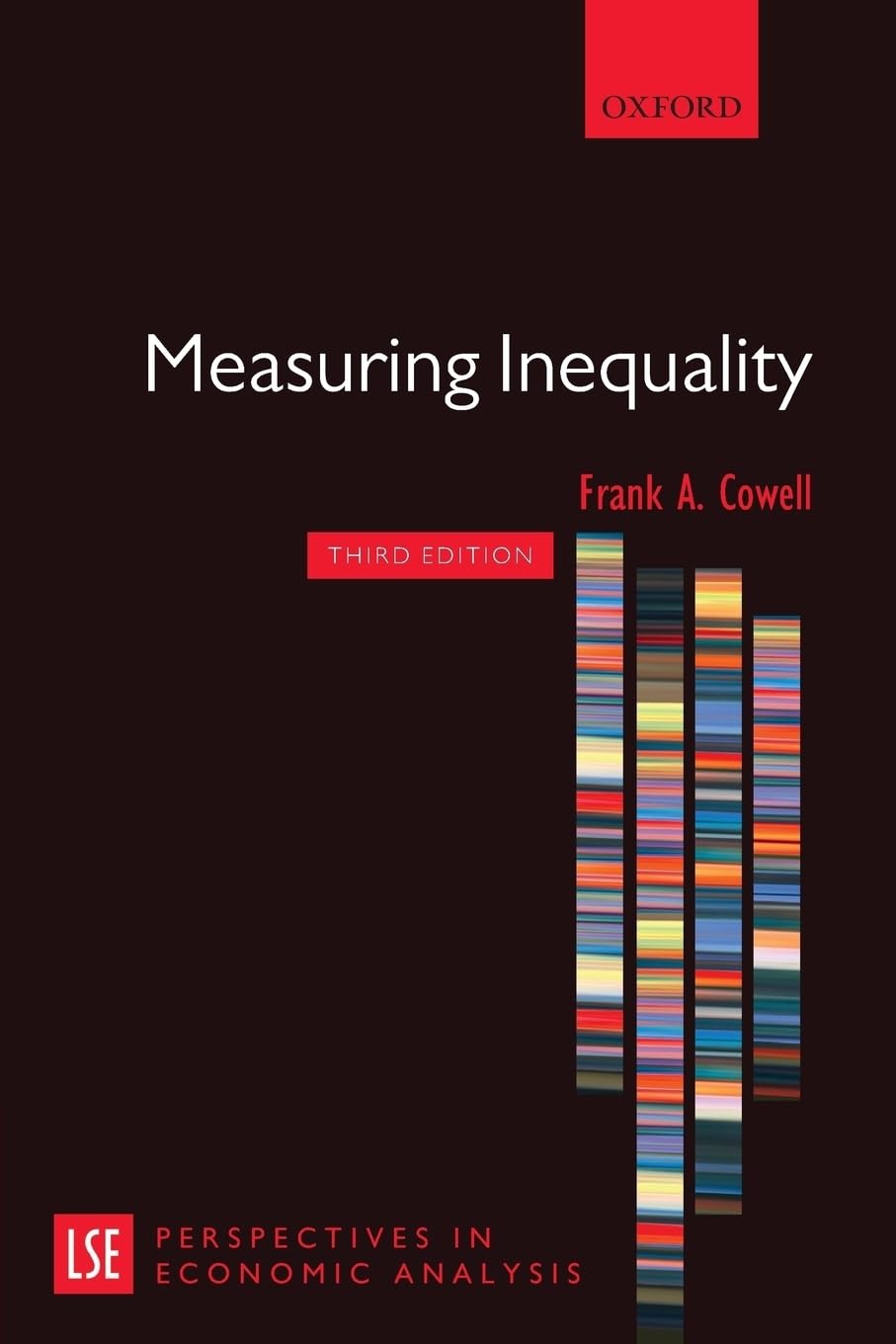
What do we mean by inequality comparisons? If the rich just get richer and the poor get poorer, the answer might seem easy. But what if the income distribution changes in a complicated way? Can we use mathematical or statistical techniques to simplify the comparison problem in a way that has economic meaning? What does it mean to measure inequality? Is it similar to National Income? Or a price index? Is it enough just to work out the Gini coefficient?Measuring Inequality tackles these questions and examines the underlying principles of inequality measurement and its relation to welfare economics, distributional analysis, and information theory. The book covers modern theoretical developments in inequality analysis, as well as showing how the way we think about inequality today has been shaped by classic contributions in economics and related disciplines. Formal results and detailed literature discussion are provided in two appendices. The principal points are illustrated in the main text, using examples from US and UK data, as well as other data sources, and associated web materials provide handson learning.Measuring Inequality is designed to appeal to both undergraduate and postgraduate students, and academic economists. Its emphasis on practical application means that it will also be useful to policy analysts and advisors.
⚠️ WARNING (California Proposition 65):
This product may contain chemicals known to the State of California to cause cancer,
birth defects, or other reproductive harm.
For MAP (Minimum Advertised Price) violations and Intellectual Property (IP) or Trademark concerns, please contact:
support@ergodebooks.com
⚠️ California Proposition 65 Warning: Some products sold on this website may expose you to chemicals known to the State of California to cause cancer, birth defects, or other reproductive harm. For more information, visit www.P65Warnings.ca.gov.