
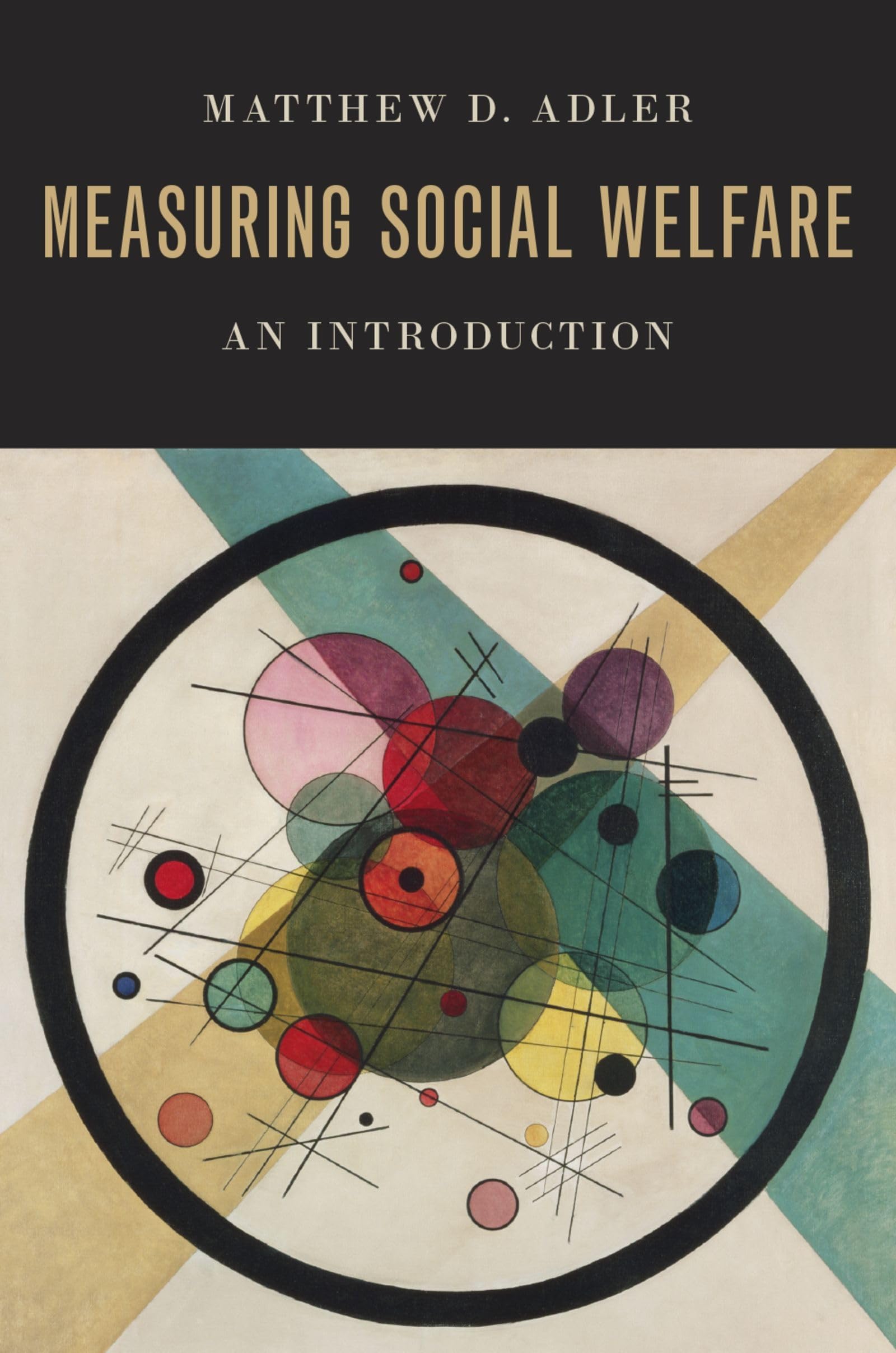
Title
Measuring Social Welfare: An Introduction,Used
Sold by Ergodebooks, an authorized reseller.
Returns accepted within 30 days | support@ergodebooks.com
Shipping Information
- Free Standard Shipping — United States only
- Processing Time: 3–5 business days
- Estimated Delivery: 6–10 business days after dispatch
- Double-boxed, fully insured & discreetly packaged
- Tracking number sent via email once dispatched
Returns & Refund
Returns accepted within 30 days of delivery.
Damaged or Defective Item
Free return shipping + replacement or full refund
Wrong Item Received
Free return shipping + replacement or full refund
Change of Mind
Return shipping at customer's expense · 25% restocking fee applies
Payment Option

Disputes over government policies rage in a number of areas. From taxation to climate change, from public finance to risk regulation, and from health care to infrastructure planning, advocates debate how policies affect multiple dimensions of individual wellbeing, how these effects balance against each other, and how tradeoffs between overall wellbeing and inequality should be resolved.How to measure and balance wellbeing gains and losses is a vexed issue. Matthew D. Adler advances the debate by introducing the social welfare function (SWF) framework and demonstrating how it can be used as a powerful tool for evaluating governmental policies. The framework originates in welfare economics and in philosophical scholarship regarding individual wellbeing, ethics, and distributive justice. It has three core components: a wellbeing measure, which translates each of the possible policy outcomes into an array of interpersonally comparable wellbeing numbers, quantifying how well off each person in the population would be in that outcome; a rule for ranking outcomes thus described ; and an uncertainty module, which orders policies understood as probability distributions over outcomes. The SWF framework is a significant improvement compared to costbenefit analysis (CBA), which quantifies policy impacts in dollars, is thereby biased towards the rich, and is insensitive to the distribution of these monetized impacts. The SWF framework, by contrast, uses an unbiased measure of wellbeing and allows the policymaker to consider both efficiency (total wellbeing) and equity (the distribution of wellbeing).Because the SWF framework is a fully generic methodology for policy assessment, Adler also discusses how it can be implemented to inform government policies. He illustrates it through a detailed case study of risk regulation, contrasting the implications of results of SWF and CBA. This book provides an accessible, yet rigorous overview of the SWF approach that can inform policymakers and students.
⚠️ WARNING (California Proposition 65):
This product may contain chemicals known to the State of California to cause cancer, birth defects, or other reproductive harm.
For more information, please visit www.P65Warnings.ca.gov.