If you have any questions, you are always welcome to contact us. We'll get back to you as soon as possible, withing 24 hours on weekdays.
Customer service
All questions about your order, return and delivery must be sent to our customer service team by e-mail at yourstore@yourdomain.com
Sale & Press
If you are interested in selling our products, need more information about our brand or wish to make a collaboration, please contact us at press@yourdomain.com
Help
If you have any questions, you are always welcome to contact us. We'll get back to you as soon as possible, withing 24 hours on weekdays.
Customer service
All questions about your order, return and delivery must be sent to our customer service team by e-mail at yourstore@yourdomain.com
Sale & Press
If you are interested in selling our products, need more information about our brand or wish to make a collaboration, please contact us at press@yourdomain.com
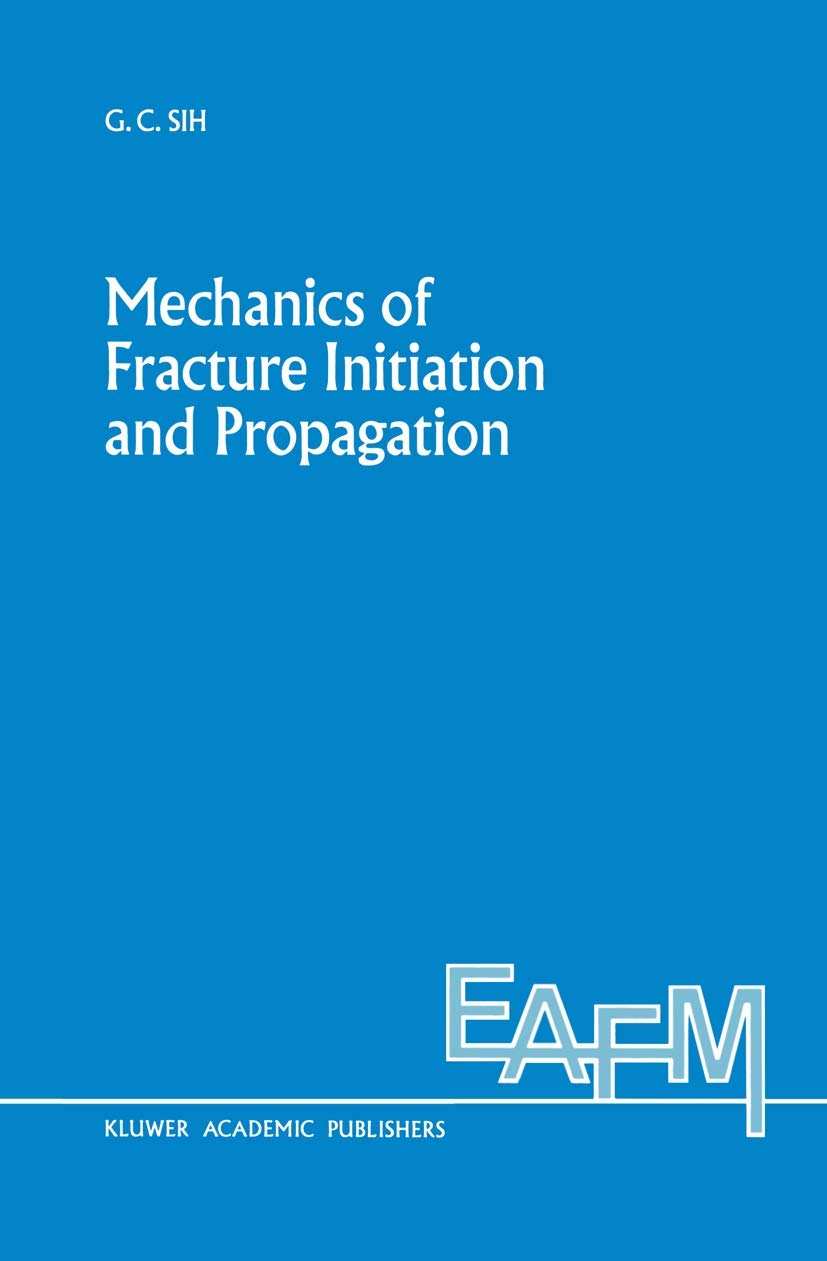
The assessment of crack initiation and/or propagation has been the subject of many past discussions on fracture mechanics. Depending on how the chosen failure criterion is combined with the solution of a particular theory of continuum mechanics, the outcome could vary over a wide range. Mod elling of the material damage process could be elusive if the scale level of observation is left undefined. The specification of physical dimension alone is not sufficient because time and temperature also play an intimate role. It is only when the latter two variables are fixed that failure predictions can be simplified. The sudden fracture of material with a preexisting crack is a case in point. Barring changes in the local temperature,* the energy released to create a unit surface area of an existing crack can be obtained by considering the change in elastic energy of the system before and after crack extension. Such a quantity has been referred to as the critical energy release rate, G e, or stress intensity factor, K Ie. Other parameters, such as the crack opening displacement (COD), pathindependent Jintegral, etc. , have been proposed; their relation to the fracture process is also based on the energy release concept. These oneparameter approaches, however, are unable simultaneously to account for the failure process of crack initiation, propagation and onset of rapid fracture. A review on the use of G, K I, COD, J, etc. , has been made by Sih [1,2].
⚠️ WARNING (California Proposition 65):
This product may contain chemicals known to the State of California to cause cancer,
birth defects, or other reproductive harm.
For MAP (Minimum Advertised Price) violations and Intellectual Property (IP) or Trademark concerns, please contact:
support@ergodebooks.com
⚠️ California Proposition 65 Warning: Some products sold on this website may expose you to chemicals known to the State of California to cause cancer, birth defects, or other reproductive harm. For more information, visit www.P65Warnings.ca.gov.