
Title
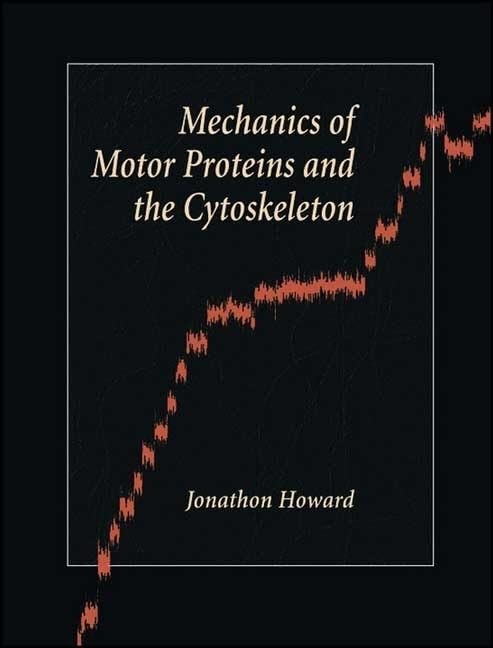
Mechanics of Motor Proteins and the Cytoskeleton,Used
Sold by Ergodebooks, an authorized reseller.
Returns accepted within 30 days | support@ergodebooks.com
Shipping Information
- Free Standard Shipping — United States only
- Processing Time: 3–5 business days
- Estimated Delivery: 6–10 business days after dispatch
- Double-boxed, fully insured & discreetly packaged
- Tracking number sent via email once dispatched
Returns & Refund
Returns accepted within 30 days of delivery.
Damaged or Defective Item
Free return shipping + replacement or full refund
Wrong Item Received
Free return shipping + replacement or full refund
Change of Mind
Return shipping at customer's expense · 25% restocking fee applies
Payment Option

Motor proteins are molecular machines that convert chemical energy from ATP hydrolysis into mechanical work, which powers cell motility. Over the last ten years, singlemolecule techniques and structural studies have led to rapid progess in understanding how these biological motors operate. How do they move? How do they generate force? How much fuel do they consume, and with what efficiency? Mechanics of Motor Proteins and the Cytoskeleton brings these new findings together.This book is for biology, physics, and engineering students who want to learn about the principles of protein mechanics and how it applies to the morphology and motility of cells. Understanding how motors and the cytoskeleton operate requires mechanical concepts such as force, elasticity, damping, and work. Introductory physics textbooks address these concepts, yet they are concerned primarily with macroscopic systems, whose motions are qualitatively different from the highly damped, diffusive motion of individual molecules.Mechanics of Motor Proteins and the Cytoskeleton provides a physical foundation for molecular mechanics. Part I explains how small particles like proteins respond to mechanical, thermal, and chemical forces, Part II focuses on cytoskeletal filaments, and Part III focuses on motor proteins. The treatments are unified in the respect that they are organized around principles rather than proteins: chapters are centered on topics such as structure, chemistry, and mechanics, and different filaments or motors are discussed together.The book assumes a rudimentary knowledge of cell biology as well as freshman physics, though all concepts are introduced from first principles, and numerous boxed examples and figures aid the nonmathematical reader. For the mathematically inclined, detailed proofs of important results are included in the Appendix.
⚠️ WARNING (California Proposition 65):
This product may contain chemicals known to the State of California to cause cancer, birth defects, or other reproductive harm.
For more information, please visit www.P65Warnings.ca.gov.