
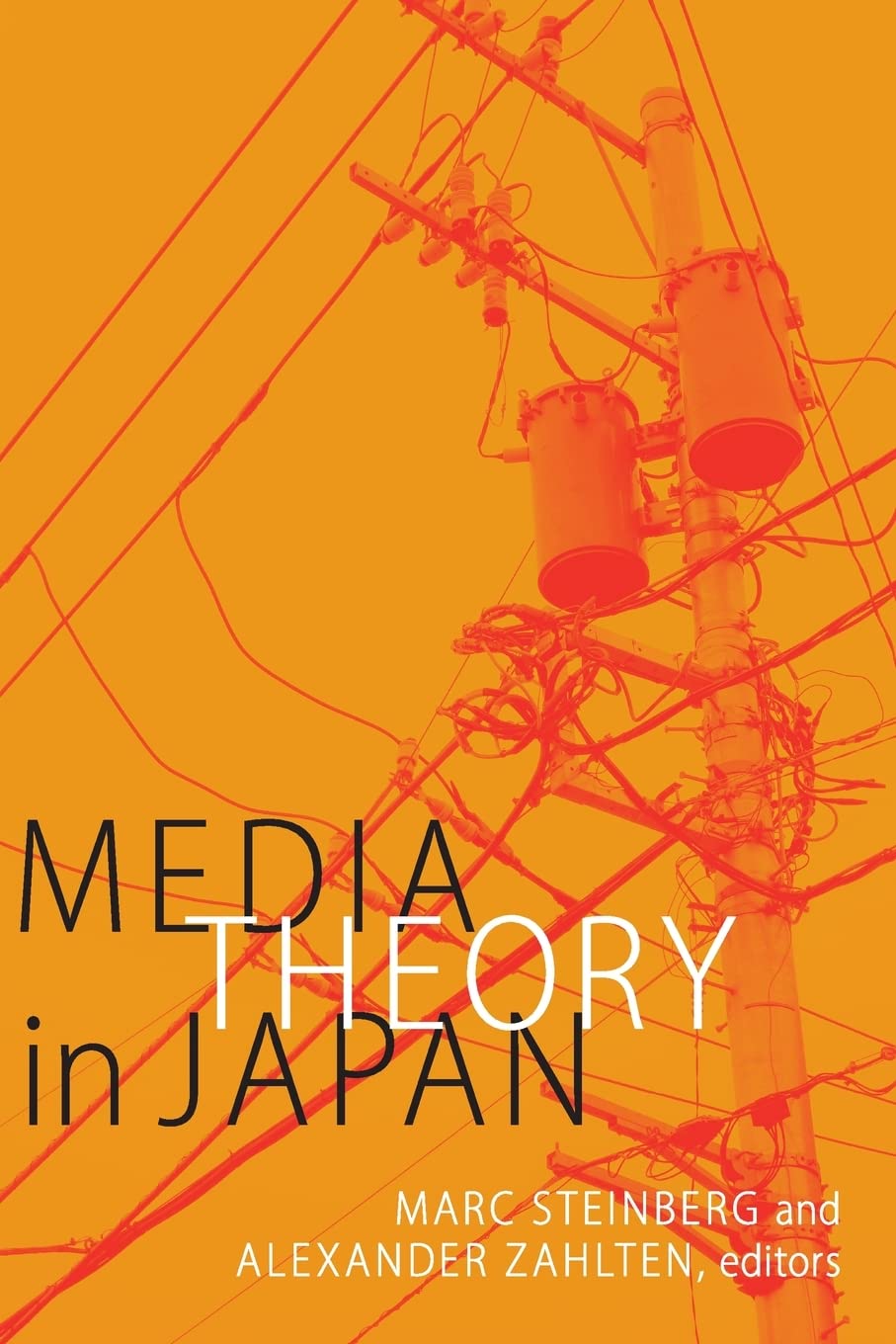
Title
Media Theory In Japan,New
Sold by Ergodebooks, an authorized reseller.
Returns accepted within 30 days | support@ergodebooks.com
Shipping Information
- Free Standard Shipping — United States only
- Processing Time: 3–5 business days
- Estimated Delivery: 6–10 business days after dispatch
- Double-boxed, fully insured & discreetly packaged
- Tracking number sent via email once dispatched
Returns & Refund
Returns accepted within 30 days of delivery.
Damaged or Defective Item
Free return shipping + replacement or full refund
Wrong Item Received
Free return shipping + replacement or full refund
Change of Mind
Return shipping at customer's expense · 25% restocking fee applies
Payment Option

Providing An Overview Of Japanese Media Theory From The 1910S To The Present, This Volume Introduces Englishlanguage Readers To Japan'S Rich Body Of Theoretical And Conceptual Work On Media For The First Time. The Essays Address A Wide Range Of Topics, Including The Work Of Foundational Japanese Thinkers; Japanese Theories Of Mediation And The Philosophy Of Media; The Connections Between Early Japanese Television And Consumer Culture; And Architecture'S Intersection With Communications Theory. Tracing The Theoretical Frameworks And Paradigms That Stem From Japan'S Media Ecology, The Contributors Decenter Eurocentric Media Theory And Demonstrate The Value Of The Japanese Context To Reassessing The Parameters And Definition Of Media Theory Itself. Taken Together, These Interdisciplinary Essays Expand Media Theory To Encompass Philosophy, Feminist Critique, Literary Theory, Marketing Discourse, And Art; Provide A Counterbalance To The Persisting Universalist Impulse Of Media Studies; And Emphasize The Need To Consider Media Theory Situationally.Contributors. Yuriko Furuhata, Aaron Gerow, Mark Hansen, Marilyn Ivy, Takeshi Kadobayashi, Keisuke Kitano, Akihiro Kitada, Thomas Looser, Anne Mcknight, Ryoko Misono, Akira Mizuta Lippit, Miryam Sas, Fabian Schfer, Marc Steinberg, Tomiko Yoda, Alexander Zahlten
⚠️ WARNING (California Proposition 65):
This product may contain chemicals known to the State of California to cause cancer, birth defects, or other reproductive harm.
For more information, please visit www.P65Warnings.ca.gov.
- Q: What is the page count of 'Media Theory in Japan'? A: This book has four hundred forty pages. It provides a comprehensive overview of Japanese media theory.
- Q: What is the binding type of this book? A: The binding type is paperback. This makes it flexible and easy to handle for readers.
- Q: What are the dimensions of 'Media Theory in Japan'? A: The dimensions are six point two six inches in length, one point two six inches in width, and nine point two five inches in height. These measurements make it a convenient size for reading.
- Q: How do I read 'Media Theory in Japan'? A: You can read it like any standard book. It is suitable for anyone interested in media theory, particularly in a Japanese context.
- Q: Is this book suitable for academic study? A: Yes, it is suitable for academic study. The essays provide in-depth analysis and interdisciplinary perspectives on media theory.
- Q: What is the reading level for 'Media Theory in Japan'? A: The reading level is appropriate for college students and above. It explores complex theories and concepts, making it ideal for advanced readers.
- Q: How do I keep 'Media Theory in Japan' in good condition? A: Store it in a dry place away from direct sunlight. Avoid bending the spine to maintain its structural integrity.
- Q: Can I clean the book if it gets dirty? A: Yes, you can clean it gently with a dry cloth. Avoid using water or chemicals that could damage the pages.
- Q: Is 'Media Theory in Japan' safe for all readers? A: Yes, it is safe for all readers. The book does not contain explicit content, making it suitable for a general audience.
- Q: What topics are covered in 'Media Theory in Japan'? A: The book covers a range of topics including Japanese theories of mediation, consumer culture, and the intersection of architecture and communications theory.
- Q: Who are the contributors to this book? A: Contributors include notable scholars like Yuriko Furuhata, Aaron Gerow, and Akira Mizuta Lippit. Their diverse backgrounds enhance the book's interdisciplinary approach.
- Q: What is the primary focus of 'Media Theory in Japan'? A: The primary focus is to introduce English-language readers to Japanese media theory. It aims to decenter Eurocentric perspectives in media studies.
- Q: Does this book include illustrations or images? A: No, the book does not include illustrations or images. It focuses on theoretical essays and textual analysis.
- Q: What makes this book stand out in media studies? A: It stands out by emphasizing the Japanese context in media theory, providing a counterbalance to universalist approaches in the field.
- Q: Is this book part of a series or a standalone? A: It is a standalone volume. However, it contributes to ongoing discussions in media studies and theory.