
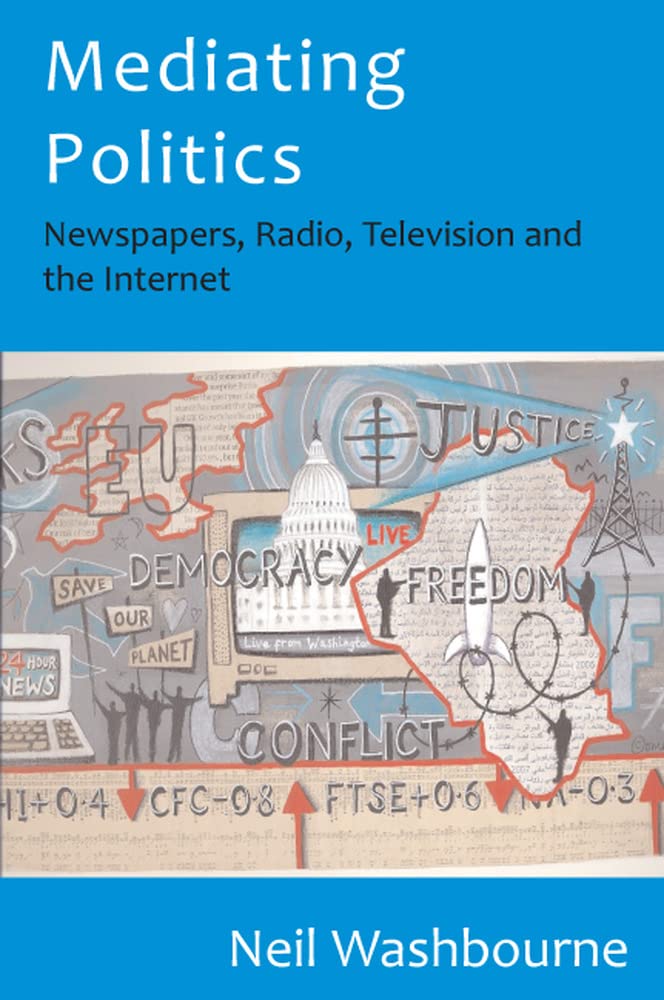
Title
Mediating Politics,Used
Sold by Ergodebooks, an authorized reseller.
Returns accepted within 30 days | support@ergodebooks.com
Shipping Information
- Free Standard Shipping — United States only
- Processing Time: 3–5 business days
- Estimated Delivery: 6–10 business days after dispatch
- Double-boxed, fully insured & discreetly packaged
- Tracking number sent via email once dispatched
Returns & Refund
Returns accepted within 30 days of delivery.
Damaged or Defective Item
Free return shipping + replacement or full refund
Wrong Item Received
Free return shipping + replacement or full refund
Change of Mind
Return shipping at customer's expense · 25% restocking fee applies
Payment Option

For anyone interested in the relationship between politics and mass media, this is a key book. Neil Washbourne combines a compendious knowledge of modern forms of communication with an astute and sophisticated analysis of contemporary politics. Mediating Politics is theoretically subtle and empirically detailed, offering a new perspective on a vital topic.'Professor John Street, University of East Anglia, UK'In the vast field that political communication has become Neil Washbourne's book stands out... Admirable and helpful work for both students and scholars new to the topic.' Professor Liesbet van Zoonen, Erasmus University, Rotterdam How is politics reported in the media? How does the relationship between the media and political organizations affect the political messages that are conveyed? How do members of the public access and make sense of political messages?This book critically analyses the complex relationship between media and politics, beginning with a discussion of what is meant by the mediating of politics. The author outlines the ways in which political messages are formulated, broadcast and received, as well as examining the ways in which the media and political organisations are linked to one another.The author also analyses the relationship between the media and: Globalisation Deregulation of the media Apathy of audiences Illustrated throughout with case studies from the US, UK and from across the world, the book also explores: Celebrity politicians How different national media systems encourage (or discourage) political engagement How young people engage with the media and politics How the Internet has affected the organization of politics and news media Mediating Politics is key reading for media, communication, cultural and political studies students.
⚠️ WARNING (California Proposition 65):
This product may contain chemicals known to the State of California to cause cancer, birth defects, or other reproductive harm.
For more information, please visit www.P65Warnings.ca.gov.
- Q: How many pages does 'Mediating Politics' have? A: This book has two hundred pages. It's a comprehensive read that covers various aspects of political communication.
- Q: What is the binding type of 'Mediating Politics'? A: The binding type is paperback. This makes it lightweight and easy to handle for reading.
- Q: What are the dimensions of 'Mediating Politics'? A: The dimensions are six inches in length, zero point four seven inches in width, and nine point one inches in height. These measurements make it a portable book.
- Q: Who is the author of 'Mediating Politics'? A: The author is Neil Washbourne. He provides a detailed analysis of the intersection between media and politics.
- Q: What genre does 'Mediating Politics' belong to? A: The genre is Journalism and Nonfiction. It focuses on real-world issues related to political communication.
- Q: What is the main focus of 'Mediating Politics'? A: The main focus is on the relationship between media and politics. It critically examines how political messages are formulated and received.
- Q: Is 'Mediating Politics' suitable for beginners in political studies? A: Yes, it is suitable for beginners. The book offers a nuanced introduction to the complexities of political communication.
- Q: Can students benefit from reading 'Mediating Politics'? A: Yes, students can benefit significantly. It provides detailed case studies and empirical analysis relevant to their studies.
- Q: What age group is 'Mediating Politics' appropriate for? A: The book is appropriate for adults and students. It addresses themes that are most relevant for higher education.
- Q: How should I store 'Mediating Politics' for best preservation? A: Store it in a cool, dry place away from direct sunlight. This will help maintain the book's condition over time.
- Q: What is the best way to clean 'Mediating Politics'? A: To clean it, simply wipe the cover with a soft, dry cloth. Avoid using water or cleaning solutions.
- Q: Are there any safety concerns with 'Mediating Politics'? A: No, there are no safety concerns. It is a scholarly book focused on political communication.
- Q: What should I do if 'Mediating Politics' arrives damaged? A: If it arrives damaged, contact the retailer for a return or exchange. Most retailers have policies in place for such situations.
- Q: How does 'Mediating Politics' compare to other political communication books? A: It stands out due to its empirical detail and theoretical subtlety. It offers unique insights into media's role in politics.
- Q: Is 'Mediating Politics' a good resource for research? A: Yes, it is an excellent resource for research. It includes various case studies that enhance its academic value.
- Q: Does 'Mediating Politics' discuss the impact of the Internet on politics? A: Yes, it discusses how the Internet affects political organization and news media. This is a key focus of the analysis.