
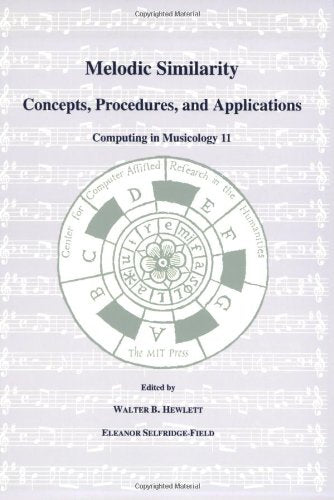
Title

Melodic Similarity: Concepts, Procedures, And Applications
Sold by Ergodebooks, an authorized reseller.
Returns accepted within 30 days | support@ergodebooks.com
Shipping Information
- Free Standard Shipping — United States only
- Processing Time: 3–5 business days
- Estimated Delivery: 6–10 business days after dispatch
- Double-boxed, fully insured & discreetly packaged
- Tracking number sent via email once dispatched
Returns & Refund
Returns accepted within 30 days of delivery.
Damaged or Defective Item
Free return shipping + replacement or full refund
Wrong Item Received
Free return shipping + replacement or full refund
Change of Mind
Return shipping at customer's expense · 25% restocking fee applies
Payment Option

This Volume Covers A Wide Range Of Approaches To Fundamental Questions About Music, Such As: What Is Similarity In Music? How Do We Recognize It? How Can We Program Computers To Recognize It? Topics Include Concepts And Procedures, Tools And Applications, Human Melodic Judgments, And Online Tools For Melodic Searching. The Contributors Draw On Theoretical Approaches And Practical Results From Computer Science And Network Models, Folkmusic Archives And Bibliographical Collaborations, Algorithmic Composition, Classicalmusic History, Ethnomusicology And Social Psychology, And Case Law In Claims Of Popular Music Plagiarism.Contributors : David Bainbridge, David Cope, Tim Crawford, Charles Cronin, Ewa Dahlig, Dominik Hrnel, John Howard, Costas S. Iliopoulos, Andreas Kornstdt, Rodger J. Mcnab, Nigel Nettheim, Donncha Maidn, Rajeev Raman, Helmut Schaffrath, Eleanor Selfridgefield, Lloyd A. Smith, Ian H. Witten, Masato Yako.Computing In Musicology 11
⚠️ WARNING (California Proposition 65):
This product may contain chemicals known to the State of California to cause cancer, birth defects, or other reproductive harm.
For more information, please visit www.P65Warnings.ca.gov.
- Q: How many pages does this book have? A: This book has two hundred forty-four pages. It provides a comprehensive overview of melodic similarity in music.
- Q: What is the binding type of this book? A: The binding type is paperback. This makes it lightweight and easy to handle for readers.
- Q: What are the dimensions of this book? A: The dimensions are seven point zero one inches in length, zero point seventy-five inches in width, and ten point two five inches in height. These measurements make it a convenient size for reading.
- Q: How do I use this book effectively? A: You can read this book to learn about concepts and applications in melodic similarity. It’s suitable for both casual readers and serious students of music.
- Q: Is this book suitable for beginners in musicology? A: Yes, this book can be suitable for beginners. It covers fundamental questions about music, making it accessible for new learners.
- Q: Can this book be used in a classroom setting? A: Yes, it can be effectively used in classroom settings. The diverse topics and contributors provide a wide range of perspectives for discussion.
- Q: How should I store this book to keep it in good condition? A: Store this book upright on a shelf to maintain its shape. Keep it away from direct sunlight to prevent fading.
- Q: Is there any special cleaning required for this book? A: No special cleaning is required. Simply dust the cover occasionally and keep it in a dry place to avoid damage.
- Q: What if my book arrives damaged? A: If your book arrives damaged, you should contact the seller for a return or exchange. Most sellers have a return policy for such issues.
- Q: What is the return policy for this book? A: The return policy may vary by seller. Generally, you can return it within a specified period if it is in original condition.
- Q: How does this book compare to other musicology texts? A: This book offers unique insights into melodic similarity, making it distinct from other texts that may focus on broader music theory.
- Q: Is this book recommended for advanced music students? A: Yes, advanced music students can benefit from this book. It presents in-depth analysis and applications relevant to their studies.
- Q: Are there any prerequisites for understanding this book? A: No specific prerequisites are required. However, a basic understanding of music theory may enhance comprehension.
- Q: Who are the contributors to this book? A: Contributors include notable figures such as David Bainbridge, David Cope, and Tim Crawford, among others. Their diverse expertise enriches the content.
- Q: What are the main topics covered in this book? A: Main topics include concepts of similarity, human melodic judgments, and applications in computer music recognition. It covers both theoretical and practical aspects.