
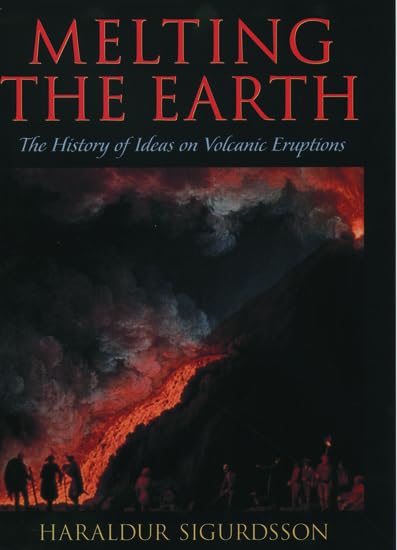
Title
Melting the Earth: The History of Ideas on Volcanic Eruptions,Used
Sold by Ergodebooks, an authorized reseller.
Returns accepted within 30 days | support@ergodebooks.com
Shipping Information
- Free Standard Shipping — United States only
- Processing Time: 3–5 business days
- Estimated Delivery: 6–10 business days after dispatch
- Double-boxed, fully insured & discreetly packaged
- Tracking number sent via email once dispatched
Returns & Refund
Returns accepted within 30 days of delivery.
Damaged or Defective Item
Free return shipping + replacement or full refund
Wrong Item Received
Free return shipping + replacement or full refund
Change of Mind
Return shipping at customer's expense · 25% restocking fee applies
Payment Option

From prehistoric times to the fiery destruction of Pompeii in 79 A.D. and the more recent pyrotechnics of Mt. St. Helens, volcanic eruptions have aroused fear, inspired myths and religious worship, and prompted heated philosophical and scientific debate. Melting the Earth chronicles humankind's attempt to understand this terrifying phenomenon and provides a fascinating look at how our conception of volcanoes has changed as knowledge of the earth's internal processes has deepened over the centuries.A practicing volcanologist and native of Iceland, where volcanoes are frequently active, Haraldur Sigurdsson considers how philosophers and scientists have attempted to answer the question: Why do volcanoes erupt? He takes us through the ideas of the ancient Greekswho proposed that volcanoes resulted from the venting of subterranean windsand the internal combustion theories of Roman times, and notes how thinking about volcanoes took a backward, symbolic turn with the rise of Christian conceptions of Hell, a direction that would not be reversed until the Renaissance. He chronicles the 18thcentury conflict between the Neptunists, who believed that volcanic rocks originated from oceanic accretions, and the Plutonists, who argued for the existence of a molten planetary core, and traces how volcanology moved from "divine science" and "armchair geology" to empirical field study with the rise of 19thcentury naturalism. Finally, Sigurdsson describes how 19th and 20thcentury research in thermodynamics, petrology, geochemistry and plate tectonics contribute to the current understanding of volcanic activity.Drawing liberally from classical sources and firsthand accounts, this chronicle is not only a colorful history of volcanology, but an engrossing chapter in the development of scientific thought.
⚠️ WARNING (California Proposition 65):
This product may contain chemicals known to the State of California to cause cancer, birth defects, or other reproductive harm.
For more information, please visit www.P65Warnings.ca.gov.