
Title
Memory Against Culture: Arguments And Reminders,Used
Sold by Ergodebooks, an authorized reseller.
Returns accepted within 30 days | support@ergodebooks.com
Shipping Information
- Free Standard Shipping — United States only
- Processing Time: 3–5 business days
- Estimated Delivery: 6–10 business days after dispatch
- Double-boxed, fully insured & discreetly packaged
- Tracking number sent via email once dispatched
Returns & Refund
Returns accepted within 30 days of delivery.
Damaged or Defective Item
Free return shipping + replacement or full refund
Wrong Item Received
Free return shipping + replacement or full refund
Change of Mind
Return shipping at customer's expense · 25% restocking fee applies
Payment Option

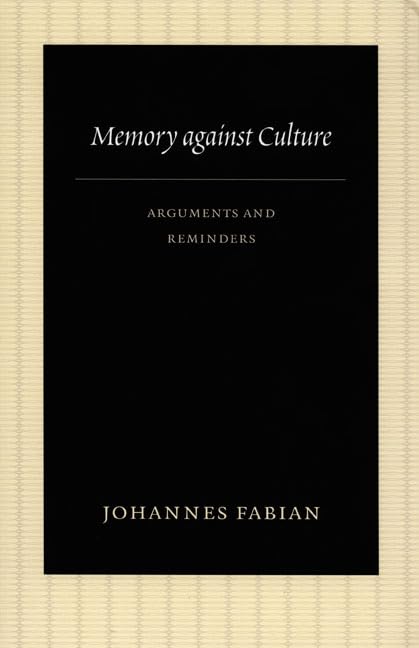
In Memory against Culture, the renowned anthropologist Johannes Fabian assesses the contemporary practice of anthropology and its emerging shape as a global discipline. In twelve essays ranging from theoretical reflections to reexaminations of past ethnographic work, Fabian addresses central theoretical debates within the discipline and throughout the social sciencesabout language and time, history and memory, and ethnography and recognition. Together the essays illuminate Fabians pluralist vision of an anthropology that always makes the other present by opening itself to conversational and transnational practices, refusing epistemological claims that privilege any one voice, language, or point of view.Fabian returns to his landmark book Time and the Other to consider how the role of the other in anthropological inquiry has been transformed over the past two decades. He explores the place of linguistics in contemporary languagecentered anthropology, and he ponders how studies of material culture imbue objects with otherness. Meditating on the place of memory and forgetting in ethnography, he draws from his own ethnographic work in the Congo to ask why Africa, the site of so much early anthropological study, continues to be forgotten in the wake of colonization. Arguing for the importance of remembering Africa, Fabian focuses on the relationship between thought and memory in the Swahili language. In so doing, he suggests new methods for investigating memory practices across cultures. Turning to the practice of ethnography, he examines the role of the Internet and the place of field notes and other memoranda in ethnographic writing. At once wideranging and incisive, Memory against Culture is a significant reflection on the state of the field by one of its most thoughtful and engaged practitioners.
⚠️ WARNING (California Proposition 65):
This product may contain chemicals known to the State of California to cause cancer, birth defects, or other reproductive harm.
For more information, please visit www.P65Warnings.ca.gov.