If you have any questions, you are always welcome to contact us. We'll get back to you as soon as possible, withing 24 hours on weekdays.
Customer service
All questions about your order, return and delivery must be sent to our customer service team by e-mail at yourstore@yourdomain.com
Sale & Press
If you are interested in selling our products, need more information about our brand or wish to make a collaboration, please contact us at press@yourdomain.com
Help
If you have any questions, you are always welcome to contact us. We'll get back to you as soon as possible, withing 24 hours on weekdays.
Customer service
All questions about your order, return and delivery must be sent to our customer service team by e-mail at yourstore@yourdomain.com
Sale & Press
If you are interested in selling our products, need more information about our brand or wish to make a collaboration, please contact us at press@yourdomain.com
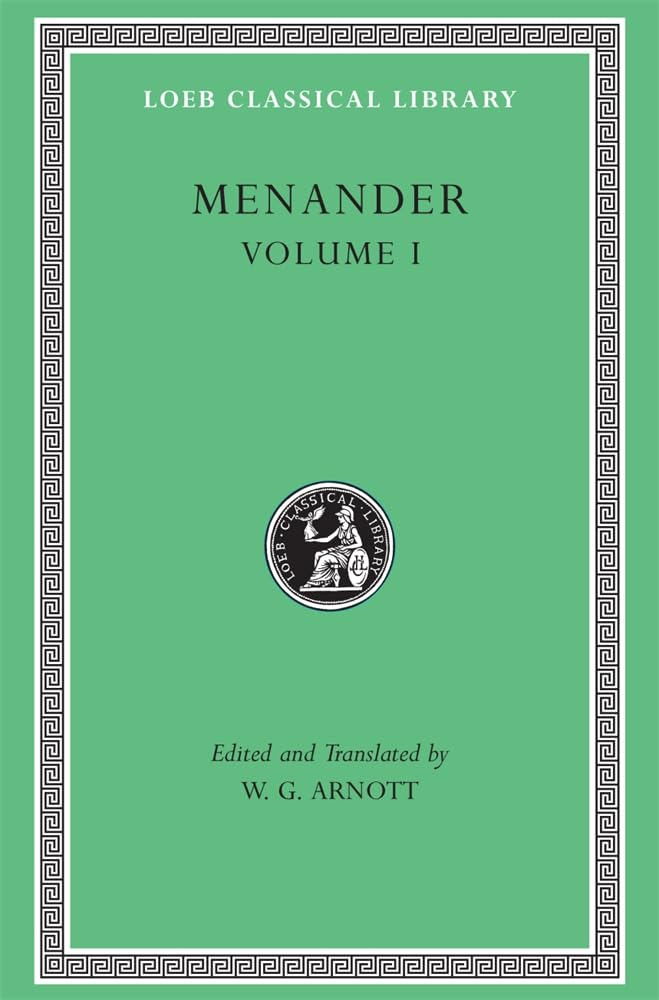
The master of New Comedy.Menander (?344/3292/1 BC) of Athens, the leading playwright of the New Comedy, wrote more than 100 plays. Many of his comedies were adapted by Roman dramatists. By the middle ages, however, his works were lost. Then, at the end of the nineteenth century, papyrus texts, preserved from antiquity by the dry heat of Egypt, began to be discovered. These have yielded so far one play virtually complete (Dyskolos), large continuous portions of four more (Aspis, Epitrepontes, Perikeiromene, Samia), and sizable chunks of many others. Menander remains a paradox: artificial plots based on unlikely but conventional coincidences, enlivened by individualized characters, realistic situations, and at times deeply moving dialogue.Volume I of Geoffrey Arnotts threevolume edition of Menander contains six plays, including Dyskolos (The Peevish Fellow), which won first prize in Athens in 317 BC, and Dis Exapaton (Twice a Swindler), the original of Plautus Two Bacchises. Ten plays are in Volume II, among them the recently published fragments of Misoumenos (The Man She Hated), which sympathetically presents the flawed relationship of a soldier and a captive girl; and the surviving half of Perikeiromene (The Girl with Her Hair Cut Short), a comedy of mistaken identity and lovers quarrel. Volume III begins with Samia (The Woman from Samos), which has come down to us nearly complete. Here too are the very substantial extant portions of Sikyonioi (The Sicyonians) and Phasma (The Apparition), as well as Synaristosai (Women Lunching Together), on which Plautus Cistellaria was based.
⚠️ WARNING (California Proposition 65):
This product may contain chemicals known to the State of California to cause cancer,
birth defects, or other reproductive harm.
For MAP (Minimum Advertised Price) violations and Intellectual Property (IP) or Trademark concerns, please contact:
support@ergodebooks.com
⚠️ California Proposition 65 Warning: Some products sold on this website may expose you to chemicals known to the State of California to cause cancer, birth defects, or other reproductive harm. For more information, visit www.P65Warnings.ca.gov.