
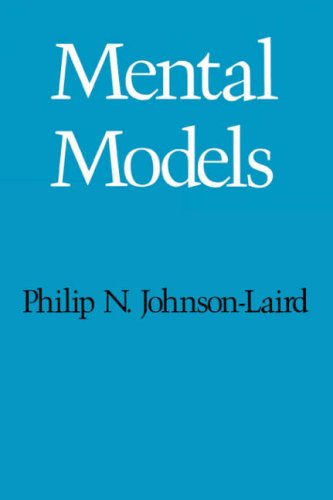
Title
Mental Models: Towards A Cognitive Science Of Language, Inference, And Consciousness (Cognitive Science Series)
Sold by Ergodebooks, an authorized reseller.
Returns accepted within 30 days | support@ergodebooks.com
Shipping Information
- Free Standard Shipping — United States only
- Processing Time: 3–5 business days
- Estimated Delivery: 6–10 business days after dispatch
- Double-boxed, fully insured & discreetly packaged
- Tracking number sent via email once dispatched
Returns & Refund
Returns accepted within 30 days of delivery.
Damaged or Defective Item
Free return shipping + replacement or full refund
Wrong Item Received
Free return shipping + replacement or full refund
Change of Mind
Return shipping at customer's expense · 25% restocking fee applies
Payment Option

Mental Models Offers Nothing Less Than A Unified Theory Of The Major Properties Of Mind: Comprehension, Inference, And Consciousness. In Spirited And Graceful Prose, Johnsonlaird Argues That We Apprehend The World By Building Inner Mental Replicas Of The Relations Among Objects And Events That Concern Us. The Mind Is Essentially A Modelbuilding Device That Can Itself Be Modeled On A Digital Computer. This Book Provides Both A Blueprint For Building Such A Model And Numerous Important Illustrations Of How To Do It.In Several Key Areas Of Cognition, Johnsonlaird Shows How An Explanation Based On Mental Modeling Is Clearly Superior To Previous Theory. For Example, He Argues Compellingly That Deductive Reasoning Does Not Take Place By Tacitly Applying The Rules Of Logic, But By Mentally Manipulating Models Of The States Of Affairs From Which Inferences Are Drawn. Similarly, Linguistic Comprehension Is Best Understood Not As A Matter Of Applying Inference Rules To Propositions Derived From Sentences, But Rather As The Mind'S Effort To Construct And Update A Model Of The Situation Described By A Text Or A Discourse. Most Provocative, Perhaps, Is Johnsonlaird'S Theory Of Consciousness: The Mind'S Necessarily Incomplete Model Of Itself Allows Only A Partial Control Over The Many Unconscious And Parallel Processes Of Cognition.This An Extraordinarily Rich Book, Providing A Coherent Account Of Much Recent Experimental Work In Cognitive Psychology, Along With Lucid Explanations Of Relevant Theory In Linguistics, Computer Science, And Philosophy Not Since Miller, Galanter, And Pribram'S Classic Plans And The Structure Of Behavior Has A Book In Cognitive Science Combined Such Sweep, Style, And Good Sense. Like Its Distinguished Predecessor, Mental Models May Well Serve To Fix A Point Of View For A Generation.
⚠️ WARNING (California Proposition 65):
This product may contain chemicals known to the State of California to cause cancer, birth defects, or other reproductive harm.
For more information, please visit www.P65Warnings.ca.gov.
- Q: What is the page count of this book? A: This book has five hundred thirteen pages. It offers an extensive examination of cognitive science and mental models.
- Q: What is the binding type of 'Mental Models'? A: The binding type is paperback. This makes it lightweight and easy to handle for readers.
- Q: Who is the author of 'Mental Models'? A: The author is P. N. Johnson-Laird. He is a noted figure in cognitive psychology and linguistics.
- Q: How do I read 'Mental Models' effectively? A: To read this book effectively, engage with the concepts and take notes. The text is dense with ideas and theories.
- Q: Is 'Mental Models' suitable for beginners in psychology? A: Yes, it is suitable for beginners. The author presents complex ideas in a clear and engaging manner.
- Q: What themes are explored in 'Mental Models'? A: Themes include comprehension, inference, and consciousness. The book provides a unified theory of these cognitive processes.
- Q: How do I keep this book in good condition? A: Store it in a cool, dry place, and avoid exposing it to direct sunlight. This will help preserve the quality of the pages.
- Q: Are there any specific care instructions for this book? A: No specific care instructions are needed. Just handle it gently to avoid wear and tear.
- Q: Can I return 'Mental Models' if I'm not satisfied? A: Yes, you can return it if unsatisfied, subject to the retailer's return policy. Check the specific return conditions.
- Q: What if the book arrives damaged? A: If the book arrives damaged, contact customer service for assistance with returns or replacements.
- Q: How does 'Mental Models' compare to other cognitive science books? A: This book is comprehensive and well-written, making it a strong choice among cognitive science literature.
- Q: Is this book appropriate for advanced psychology students? A: Yes, it is appropriate for advanced students. The depth of analysis will benefit those with a background in the field.
- Q: What makes 'Mental Models' stand out in cognitive science? A: Its unified theory of mind properties and clear writing style make it a significant contribution to cognitive science.
- Q: Should I read this book if I'm interested in consciousness? A: Yes, if you're interested in consciousness, this book offers valuable insights and theories on the topic.
- Q: Does this book provide practical applications of mental models? A: Yes, it includes illustrations and examples of how to apply mental modeling in various cognitive contexts.
- Q: Is there a glossary or index in 'Mental Models'? A: Yes, there is an index that helps locate key concepts and topics within the book.