
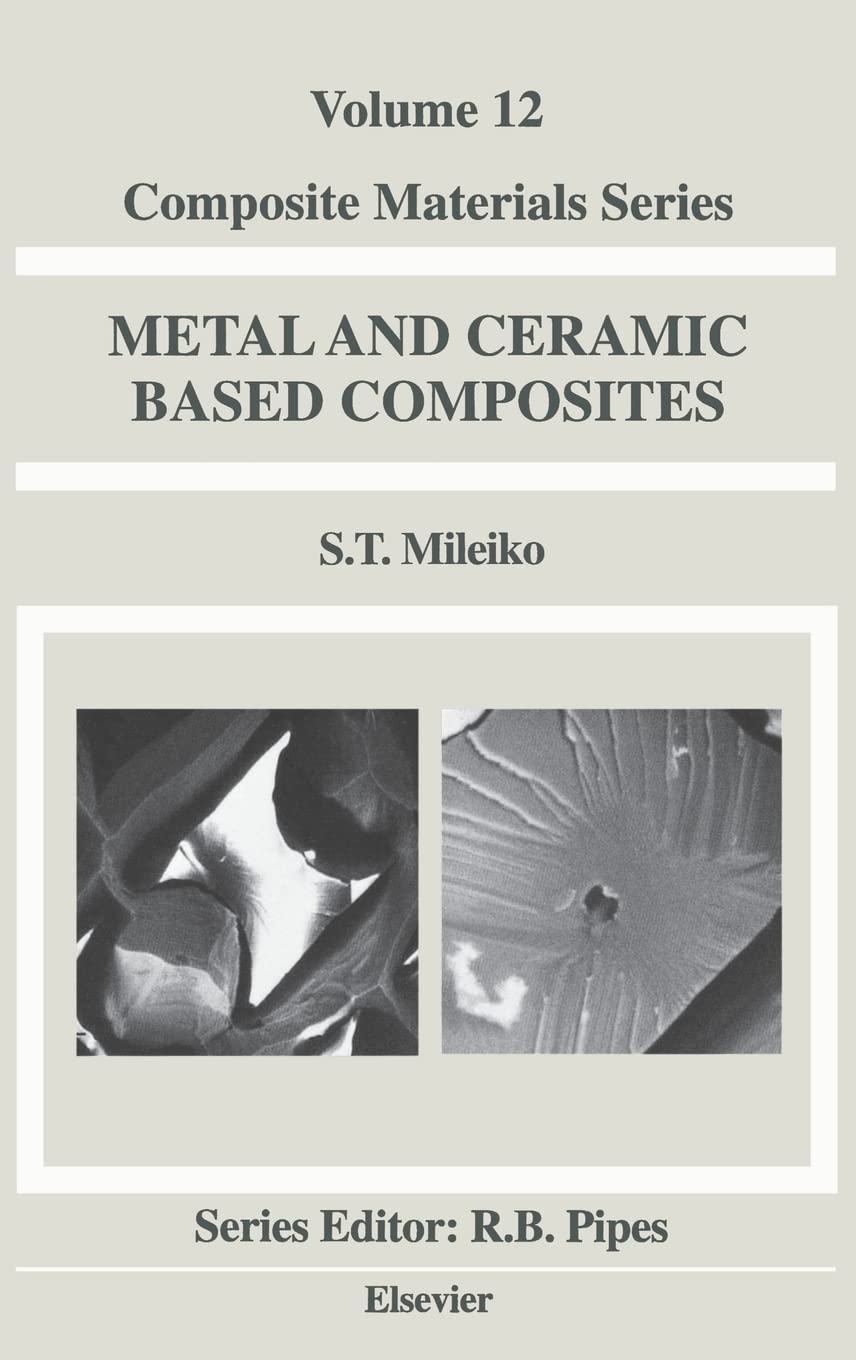
Title
Metal And Ceramic Based Composites (Volume 12) (Composite Materials Series, Volume 12)
Sold by Ergodebooks, an authorized reseller.
Returns accepted within 30 days | support@ergodebooks.com
Shipping Information
- Free Standard Shipping — United States only
- Processing Time: 3–5 business days
- Estimated Delivery: 6–10 business days after dispatch
- Double-boxed, fully insured & discreetly packaged
- Tracking number sent via email once dispatched
Returns & Refund
Returns accepted within 30 days of delivery.
Damaged or Defective Item
Free return shipping + replacement or full refund
Wrong Item Received
Free return shipping + replacement or full refund
Change of Mind
Return shipping at customer's expense · 25% restocking fee applies
Payment Option

Modern scientific and technological fields are frequently of an interdisciplinary nature, and the field of fibrous composites is no exception. Unlike fibrereinforced plastics, the family of metal and ceramicbased composites is still quite a new group of materials with a large variety of mechanical and physical properties. Up until now it has been difficult to produce these materials as the necessary technical information has not been well documented.The main purpose of this book is to link together fabrication, structure and properties chains, so as to clarify which structure provides the necessary properties, and how one can attain the correct composite structure. To this end, the book not only contains topics of a purely technical nature, but also a description of the failure mechanics of metal and ceramicmatrix composites, as this is the key to understanding the structureproperties segment of the chain mentioned.The book is divided into three parts. Part I presents a general view of composites with the accent on metal and ceramicmatrix composites. It also contains a brief description of modern fibres and composites and can be considered, at least for beginners, as a starting point for further study. Part II looks at the composite microstructures considered to be either optimal or reasonable in resisting a particular loading. Finally Part II describes a variety of mechanical, physical, and chemical potential for organizing these microstructures. Experimental data on technologies, material structures, and material properties are used throughout the book to support theoretical conclusions or to obtain important physical parameters.
⚠️ WARNING (California Proposition 65):
This product may contain chemicals known to the State of California to cause cancer, birth defects, or other reproductive harm.
For more information, please visit www.P65Warnings.ca.gov.