
Title
Metallic And Molecular Interactions In Nanometer Layers, Pores And Particles: New Findings At The Yoctolitre Level (Nanoscience,,Used
Sold by Ergodebooks, an authorized reseller.
Returns accepted within 30 days | support@ergodebooks.com
Shipping Information
- Free Standard Shipping — United States only
- Processing Time: 3–5 business days
- Estimated Delivery: 6–10 business days after dispatch
- Double-boxed, fully insured & discreetly packaged
- Tracking number sent via email once dispatched
Returns & Refund
Returns accepted within 30 days of delivery.
Damaged or Defective Item
Free return shipping + replacement or full refund
Wrong Item Received
Free return shipping + replacement or full refund
Change of Mind
Return shipping at customer's expense · 25% restocking fee applies
Payment Option

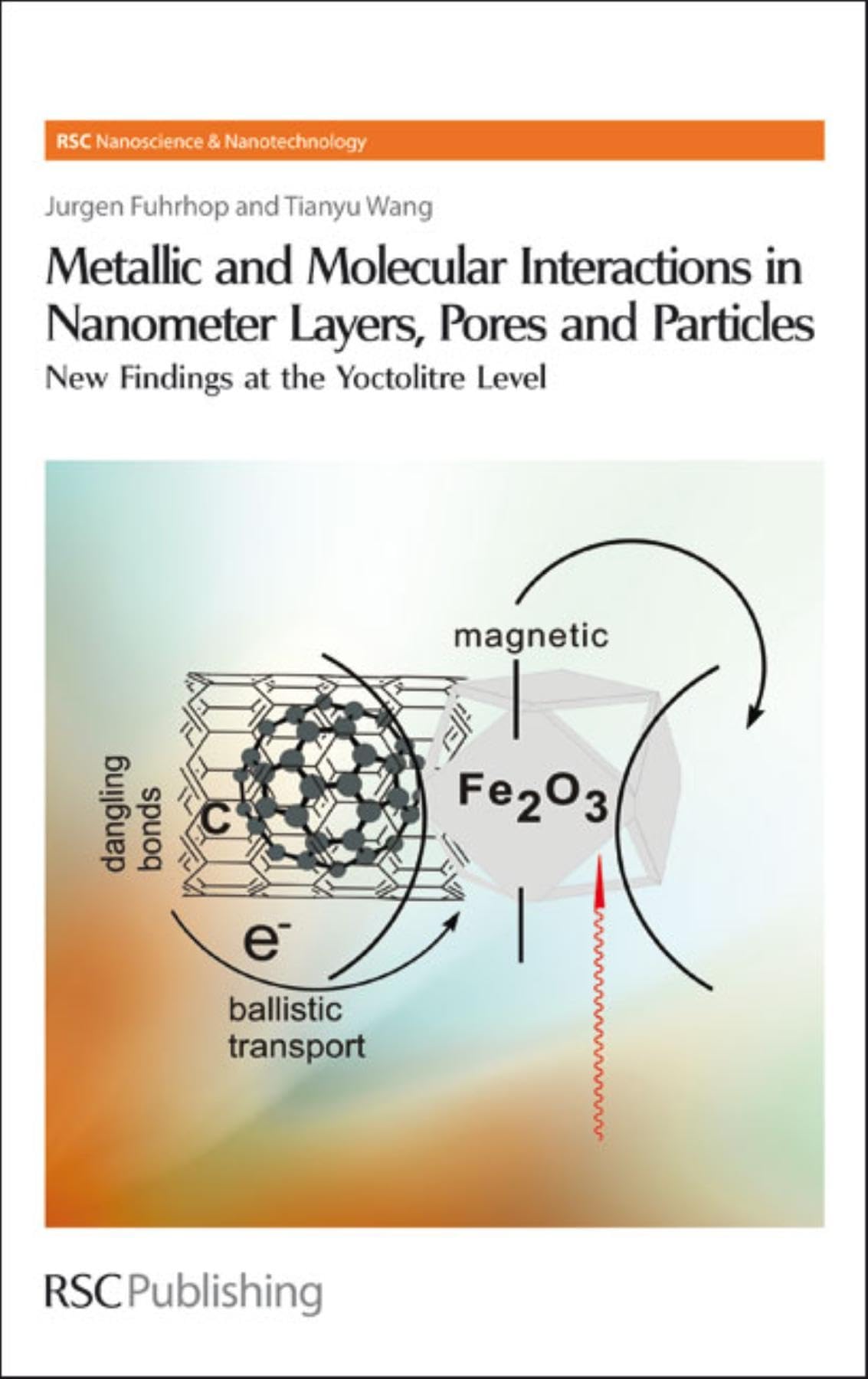
Excerpt. Reprinted by permission. All rights reserved. Metallic and Molecular Interactions in Nanometer Layers, Pores and ParticlesNew Findings at the Yoctolitre LevelBy Jrgen Fuhrhop, Tianyu WangThe Royal Society of ChemistryCopyright 2010 Jrgen Fuhrhop and Tianyu WangAll rights reserved.ISBN: 9780854041664ContentsChapter 1 Atoms, Molecules, Electrons, Light and Heat in Nanometre Confinement, 1, Chapter 2 Organic Carbon, 52, Chapter 3 Main Group Elements, 160, Chapter 4 Iron, 245, Chapter 5 Transition Metals, 299, Subject Index, 403, CHAPTER 1Atoms, Molecules, Electrons, Light and Heat in Nanometre Confinement1.1 IntroductionThe chemistry within yoctolitre (1024L) holes or on the surface of particles with a yoctolitre volume is generally called 'nanochemistry' because each dimension of these holes and particles measures a nanometre (nm): 1 yL = 1 nm. In volumes of up to 1000 yL, e.g. 10 10 10 nm, all distances between atoms and molecules on the particles or in the holes are within a few nanometres, which allows them to interact with each other and with ions and molecules that approach the surface. Holes left by missing single atoms, molecules or ions in yoctowell walls, and in the centres or surfaces of nanoparticles or nanocrystals, can easily migrate through the whole species.Yoctolitre dimensions are practical for the estimation of constituent numbers and models based on them: 1 yL can contain ~100 metal atoms, 50 molecules of metal oxide (MO), 33 molecules of water or 25 molecules of metal dioxide (MO2). Nanometre concepts are more appropriate if [111] surfaces have to be compared with [100] surfaces and where vectors, angles, and tenths of an ngstrm become important.The first special property of nanochemistry in or on yoctolitresized wells, pores, spheres or crystals depends on the fact that a large percentage of the atoms that form the holes or particles are surface atoms. Quite often the electrons on the hole or nanoparticle surfaces do not bind anything, but represent 'dangling bonds' with special activities. The second dominating fact is the relevance of spacedependent physical properties of molecules, which play hardly any role in bulk inorganic and organic chemistry. For example, glucose becomes waterinsoluble in hydrophobic yoctowells, because the molecules have a hydrophobic edge, which sticks to the wall, and metallic Ag(0) nanocrystals seem to forget about their metallic electron cloud and fluoresce like covalent molecules, for reasons yet unknown.The translation of stereochemistry into spin interactions of electrons and different kinds of magnetism, the chemical stabilization of electronhole pairs in order to create luminescence of all colours by the variation of electric potentials, the change in metal crystal lattices on the surface of nanocrystals that renders them catalytically active or fluorescent, and the fixation of watersoluble carbohydrate edge amphiphiles in hydrophobic, waterfilled yoctowells are subjects of current research, and chemists interested in the development of new properties should become familiar with them. Research in this field requires access to modern techniques such as rapid crystallization of vapour, laser ablation under water, preparation of atomically smooth surfaces, atomic force microscopy, electron transmission microscopy and electron scanning microscopy, among others.Subjects covered in this book are, in order of increasing complexity: selfcleaning surfaces of nanometre roughness quantum dots (QDs), which provide everlasting colours and discrete energy levels instead of bands soft and hard magnetic particles for computers and other engineering uses minimization of functional AFM tips localization of many different single molecules in a very small aqueous space decomposition of chlororganic compounds in soils coupling of NMR signals with magnetic field steering fixation of proteins, DNA and cell surfaces on nanoparticles in water routine
⚠️ WARNING (California Proposition 65):
This product may contain chemicals known to the State of California to cause cancer, birth defects, or other reproductive harm.
For more information, please visit www.P65Warnings.ca.gov.