
Title

Metaphor in Context (Bradford Books),Used
Sold by Ergodebooks, an authorized reseller.
Returns accepted within 30 days | support@ergodebooks.com
Shipping Information
- Free Standard Shipping — United States only
- Processing Time: 3–5 business days
- Estimated Delivery: 6–10 business days after dispatch
- Double-boxed, fully insured & discreetly packaged
- Tracking number sent via email once dispatched
Returns & Refund
Returns accepted within 30 days of delivery.
Damaged or Defective Item
Free return shipping + replacement or full refund
Wrong Item Received
Free return shipping + replacement or full refund
Change of Mind
Return shipping at customer's expense · 25% restocking fee applies
Payment Option

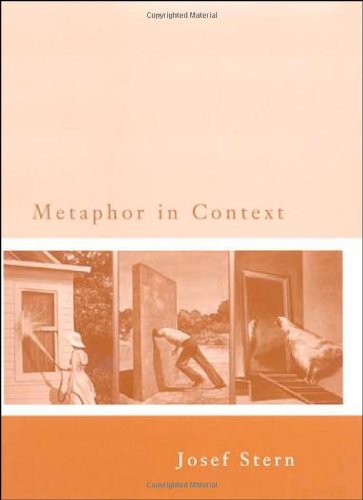
The many philosophers, linguists, and cognitive scientists writing on metaphor over the past two decades have generally taken for granted that metaphor lies outside, if not in opposition to, received conceptions of semantics and grammar. Assuming that metaphor cannot be explained by or within semantics, they claim that metaphor has little, if anything, to teach us about semantic theory. In this book Josef Stern challenges these assumptions. He is concerned primarily with the question: Given the received conception of the form and goals of semantic theory, does metaphorical interpretation, in whole or part, fall within its scope? Specifically, he asks, what (if anything) does a speakerhearer know as part of her semantic competence when she knows the interpretation of a metaphor?According to Stern, the answer to these questions lies in the systematic contextdependence of metaphorical interpretation. Drawing on a deep analogy between demonstratives, indexicals, and metaphors, Stern develops a formal theory of metaphorical meaning that underlies a speaker's ability to interpret a metaphor. With his semantics, he also addresses a variety of philosophical and linguistic issues raised by metaphor. These include the interpretive structure of complex extended metaphors, the cognitive significance of metaphors and their literal paraphrasability, the pictorial character of metaphors, the role of similarity and exemplification in metaphorical interpretation, metaphornetworks, dead metaphors, the relation of metaphors to other figures, and the dependence of metaphors on literal meanings. Unlike most metaphor theorists, however, who take these problems to be "sui generis" to metaphor, Stern subsumes them under the same rubric as other semantic facts that hold for nonmetaphorical language.
⚠️ WARNING (California Proposition 65):
This product may contain chemicals known to the State of California to cause cancer, birth defects, or other reproductive harm.
For more information, please visit www.P65Warnings.ca.gov.