
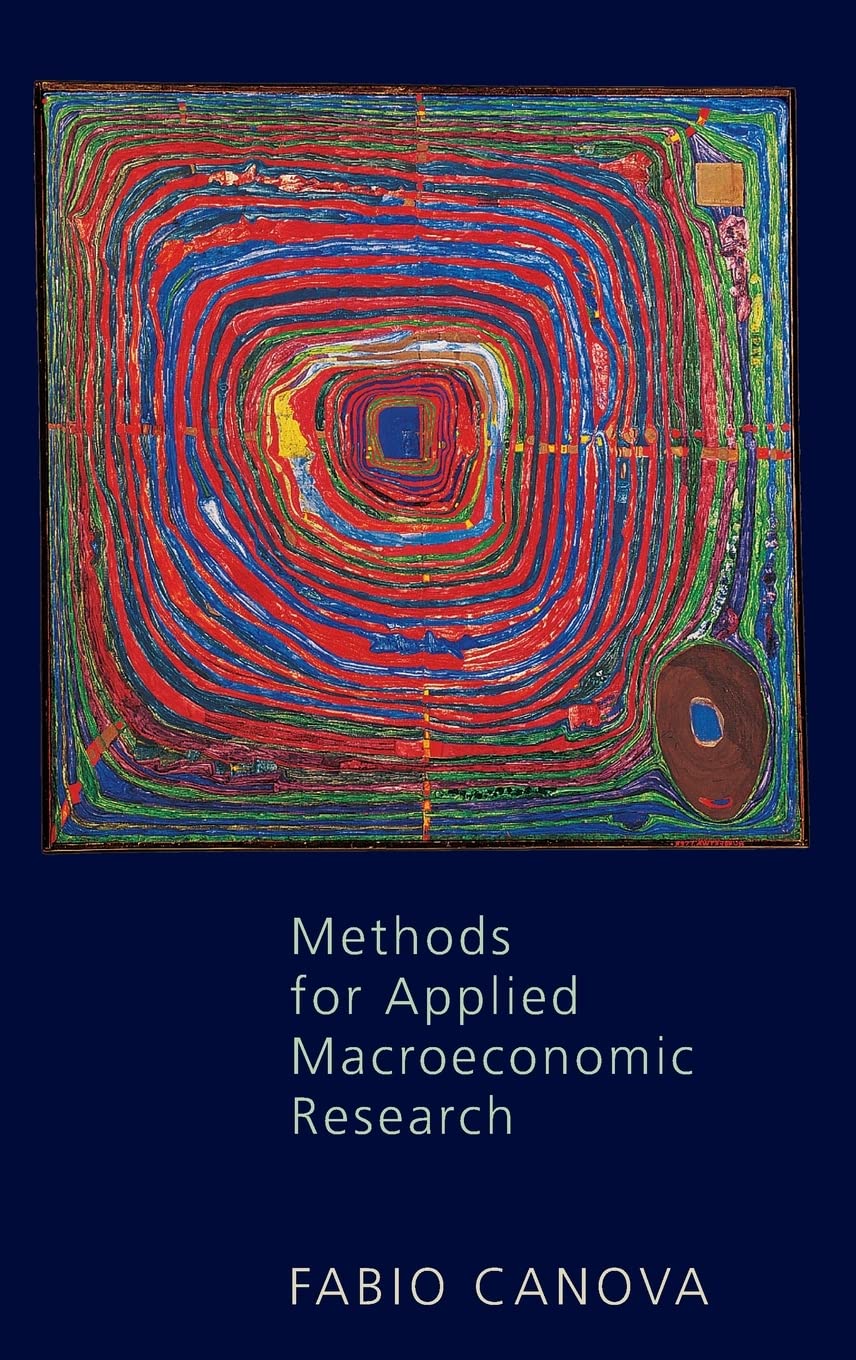
Title
Methods For Applied Macroeconomic Research,New
Sold by Ergodebooks, an authorized reseller.
Returns accepted within 30 days | support@ergodebooks.com
Shipping Information
- Free Standard Shipping — United States only
- Processing Time: 3–5 business days
- Estimated Delivery: 6–10 business days after dispatch
- Double-boxed, fully insured & discreetly packaged
- Tracking number sent via email once dispatched
Returns & Refund
Returns accepted within 30 days of delivery.
Damaged or Defective Item
Free return shipping + replacement or full refund
Wrong Item Received
Free return shipping + replacement or full refund
Change of Mind
Return shipping at customer's expense · 25% restocking fee applies
Payment Option

The Last Twenty Years Have Witnessed Tremendous Advances In The Mathematical, Statistical, And Computational Tools Available To Applied Macroeconomists. This Rapidly Evolving Field Has Redefined How Researchers Test Models And Validate Theories. Yet Until Now There Has Been No Textbook That Unites The Latest Methods And Bridges The Divide Between Theoretical And Applied Work.Fabio Canova Brings Together Dynamic Equilibrium Theory, Data Analysis, And Advanced Econometric And Computational Methods To Provide The First Comprehensive Set Of Techniques For Use By Academic Economists As Well As Professional Macroeconomists In Banking And Finance, Industry, And Government. This Graduatelevel Textbook Is For Readers Knowledgeable In Modern Macroeconomic Theory, Econometrics, And Computational Programming Using Rats, Matlab, Or Gauss. Inevitably A Modern Treatment Of Such A Complex Topic Requires A Quantitative Perspective, A Solid Dynamic Theory Background, And The Development Of Empirical And Numerical Methodswhich Is Where Canova'S Book Differs From Typical Graduate Textbooks In Macroeconomics And Econometrics. Rather Than List A Series Of Estimators And Their Properties, Canova Starts From A Class Of Dsge Models, Finds An Approximate Linear Representation For The Decision Rules, And Describes Methods Needed To Estimate Their Parameters, Examining Their Fit To The Data. The Book Is Complete With Numerous Examples And Exercises.Today'S Economic Analysts Need A Strong Foundation In Both Theory And Application. Methods For Applied Macroeconomic Research Offers The Essential Tools For The Next Generation Of Macroeconomists.
⚠️ WARNING (California Proposition 65):
This product may contain chemicals known to the State of California to cause cancer, birth defects, or other reproductive harm.
For more information, please visit www.P65Warnings.ca.gov.
- Q: How many pages does this book have? A: This book has five hundred twelve pages. It provides a comprehensive overview of macroeconomic research methods.
- Q: What is the binding type of this book? A: The binding type is hardcover. This offers durability and a professional appearance for academic use.
- Q: What are the dimensions of this book? A: The dimensions are six point two six inches in length, one point two six inches in width, and nine point zero two inches in height. These measurements make it a suitable size for both reading and storage.
- Q: Who is the author of this book? A: The author is Fabio Canova. He is known for his contributions to the field of macroeconomics.
- Q: What is the main focus of this book? A: The main focus is on applied macroeconomic research methods. It bridges the gap between theoretical and practical applications.
- Q: Is this book suitable for beginners in macroeconomics? A: No, this book is not suitable for beginners. It is intended for readers with a solid understanding of modern macroeconomic theory and econometrics.
- Q: Can this book help in understanding dynamic equilibrium theory? A: Yes, it covers dynamic equilibrium theory in depth. The book integrates theory with practical data analysis.
- Q: How can I apply the methods learned in this book? A: You can apply the methods by utilizing the techniques for econometric modeling and data analysis in various economic contexts.
- Q: What tools are recommended for use with this book? A: The book recommends using RATS, MATLAB, or Gauss for computational programming. These tools enhance the application of the methods discussed.
- Q: Are there exercises included in the book? A: Yes, the book includes numerous examples and exercises. These are designed to reinforce the concepts and methods presented.
- Q: How do I keep this book in good condition? A: To keep the book in good condition, store it in a cool, dry place away from direct sunlight. Avoid bending the cover or pages.
- Q: Is this book appropriate for use in academic settings? A: Yes, this book is appropriate for academic settings. It serves as a valuable resource for graduate-level courses.
- Q: What makes this book different from typical macroeconomics textbooks? A: This book differs by integrating advanced econometric methods with dynamic equilibrium theory, rather than merely listing estimators.
- Q: How does this book support empirical and numerical methods? A: It supports empirical and numerical methods by providing a comprehensive set of techniques and practical applications.
- Q: Can I find theoretical frameworks in this book? A: Yes, it includes theoretical frameworks necessary for understanding applied macroeconomic research.
- Q: What level of understanding is required to read this book? A: A graduate-level understanding of macroeconomic theory and econometrics is required to fully grasp the content.