
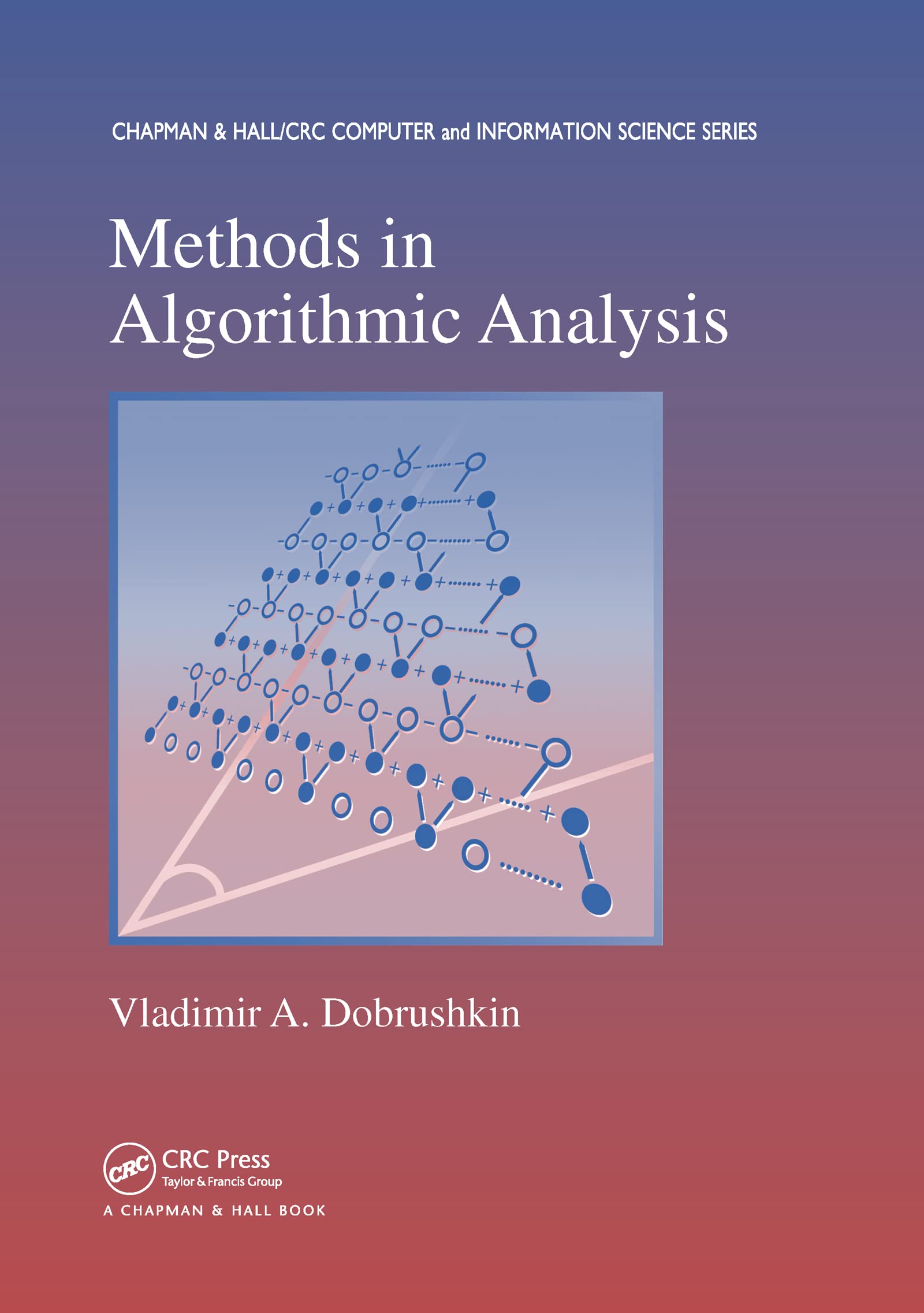
Title
Methods in Algorithmic Analysis (Chapman & Hall/CRC Computer and Information Science Series),Used
Sold by Ergodebooks, an authorized reseller.
Returns accepted within 30 days | support@ergodebooks.com
Shipping Information
- Free Standard Shipping — United States only
- Processing Time: 3–5 business days
- Estimated Delivery: 6–10 business days after dispatch
- Double-boxed, fully insured & discreetly packaged
- Tracking number sent via email once dispatched
Returns & Refund
Returns accepted within 30 days of delivery.
Damaged or Defective Item
Free return shipping + replacement or full refund
Wrong Item Received
Free return shipping + replacement or full refund
Change of Mind
Return shipping at customer's expense · 25% restocking fee applies
Payment Option

Explores the Impact of the Analysis of Algorithms on Many Areas within and beyond Computer ScienceA flexible, interactive teaching format enhanced by a large selection of examples and exercisesDeveloped from the authors own graduatelevel course, Methods in Algorithmic Analysis presents numerous theories, techniques, and methods used for analyzing algorithms. It exposes students to mathematical techniques and methods that are practical and relevant to theoretical aspects of computer science.After introducing basic mathematical and combinatorial methods, the text focuses on various aspects of probability, including finite sets, random variables, distributions, Bayes theorem, and Chebyshev inequality. It explores the role of recurrences in computer science, numerical analysis, engineering, and discrete mathematics applications. The author then describes the powerful tool of generating functions, which is demonstrated in enumeration problems, such as probabilistic algorithms, compositions and partitions of integers, and shuffling. He also discusses the symbolic method, the principle of inclusion and exclusion, and its applications. The book goes on to show how strings can be manipulated and counted, how the finite state machine and Markov chains can help solve probabilistic and combinatorial problems, how to derive asymptotic results, and how convergence and singularities play leading roles in deducing asymptotic information from generating functions. The final chapter presents the definitions and properties of the mathematical infrastructure needed to accommodate generating functions.Accompanied by more than 1,000 examples and exercises, this comprehensive, classroomtested text develops students understanding of the mathematical methodology behind the analysis of algorithms. It emphasizes the important relation between continuous (classical) mathematics and discrete mathematics, which is the basis of computer science.
⚠️ WARNING (California Proposition 65):
This product may contain chemicals known to the State of California to cause cancer, birth defects, or other reproductive harm.
For more information, please visit www.P65Warnings.ca.gov.