If you have any questions, you are always welcome to contact us. We'll get back to you as soon as possible, withing 24 hours on weekdays.
Customer service
All questions about your order, return and delivery must be sent to our customer service team by e-mail at yourstore@yourdomain.com
Sale & Press
If you are interested in selling our products, need more information about our brand or wish to make a collaboration, please contact us at press@yourdomain.com
Help
If you have any questions, you are always welcome to contact us. We'll get back to you as soon as possible, withing 24 hours on weekdays.
Customer service
All questions about your order, return and delivery must be sent to our customer service team by e-mail at yourstore@yourdomain.com
Sale & Press
If you are interested in selling our products, need more information about our brand or wish to make a collaboration, please contact us at press@yourdomain.com
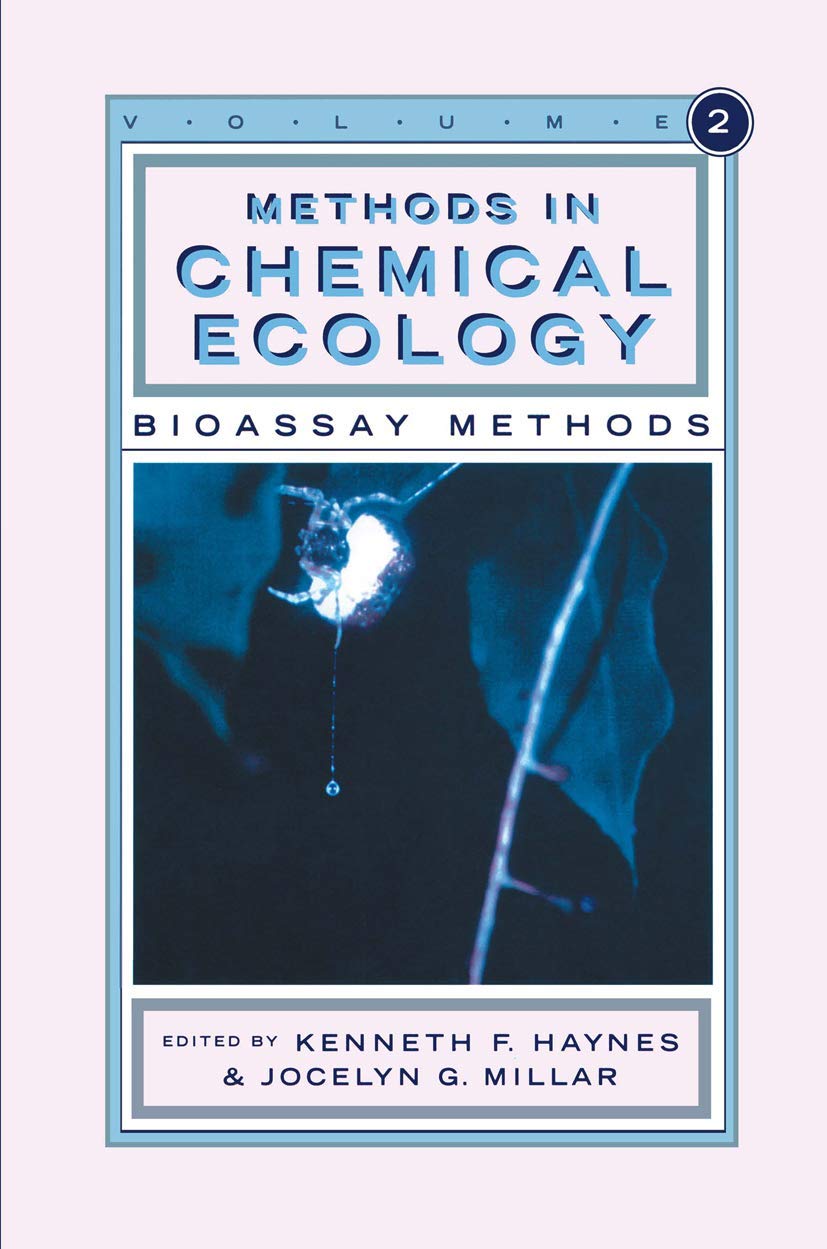
Identification of chemicals that affect the naturally occurring interactions be tween organisms requires sophisticated chemical techniques, such as those docu mented in volume 1, in combination with effective bioassays. Without an effective bioassay, the identification becomes akin to looking for a needle in a haystack, but without any idea of what a needle looks like. To a large extent serniochemical identifications must be driven by bioassays. The design of bioassays for use in chemical ecology is governed by the sometimes conflicting objectives of ecological relevance and the need for simplic ity. Bioassay design should be based on observations of the interactions between organisms in their natural context, a theme that appears throughout this volume. As a result, this volume is as much about ecology and behavior as it is about specific methods. It is impossible to design a relevant bioassay, whether it is simple or complex, without understanding at least the fundamentals of how chemical cues or signals mediate the interaction in nature. Thus, the development of bioassay methods must be driven by an understanding of ecology and a knowledge of the natural history of the organisms under study. Given such an understanding, it is often possible to design assays that are both ecologically relevant and easy to perform.
⚠️ WARNING (California Proposition 65):
This product may contain chemicals known to the State of California to cause cancer,
birth defects, or other reproductive harm.
For MAP (Minimum Advertised Price) violations and Intellectual Property (IP) or Trademark concerns, please contact:
support@ergodebooks.com
⚠️ California Proposition 65 Warning: Some products sold on this website may expose you to chemicals known to the State of California to cause cancer, birth defects, or other reproductive harm. For more information, visit www.P65Warnings.ca.gov.