If you have any questions, you are always welcome to contact us. We'll get back to you as soon as possible, withing 24 hours on weekdays.
Customer service
All questions about your order, return and delivery must be sent to our customer service team by e-mail at yourstore@yourdomain.com
Sale & Press
If you are interested in selling our products, need more information about our brand or wish to make a collaboration, please contact us at press@yourdomain.com
Help
If you have any questions, you are always welcome to contact us. We'll get back to you as soon as possible, withing 24 hours on weekdays.
Customer service
All questions about your order, return and delivery must be sent to our customer service team by e-mail at yourstore@yourdomain.com
Sale & Press
If you are interested in selling our products, need more information about our brand or wish to make a collaboration, please contact us at press@yourdomain.com
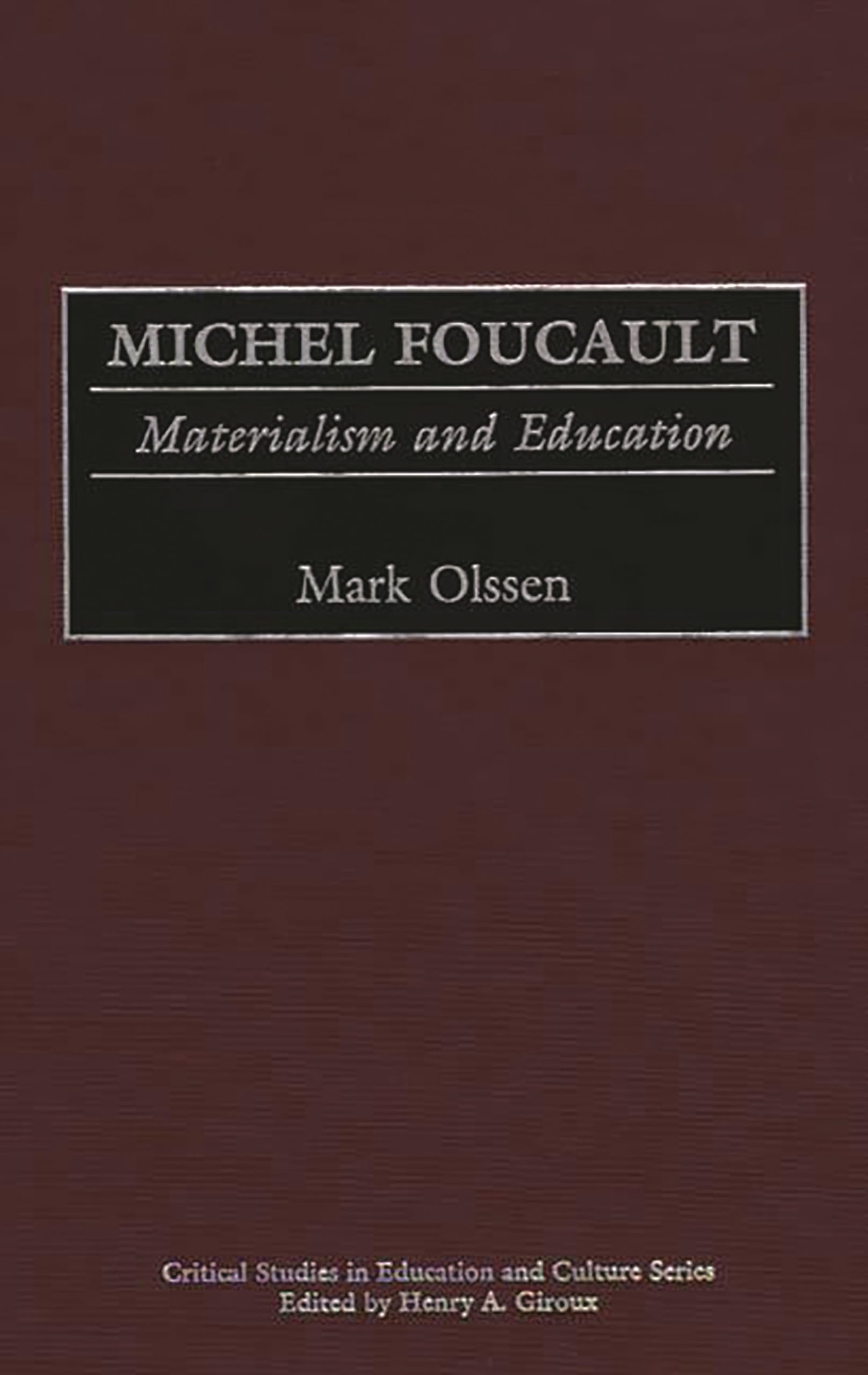
Although Foucault departs from Marxism, his own approach constitutes a form of consistent materialism which has theoretical implications for the analysis of social and educational discursive systems. In seeking to demonstrate a correct reading of Foucault, linguistic readings of his work, such as those of Christopher Norris (1993), which represent him as part of the linguistic turn in French philosophy, where language (or representation) henceforth defines the limits of thought, will be dispelled in the process of being corrected. Rather, Foucault will be represented, as Habermas (1987) has suggested, not merely as a historicist but at the same time as a nominalist, materialist, and empiricist.Because the distinctiveness of Foucault's approach can best be seen in contrast to other major philosophical systems and thinkers, considerable attention is given to examining Foucault's relationship to Marxism, as well as his relations to Kant, Gramsci, Habermas, and the Greeks. In relation to education, there is in Foucault's approach a double emphasis which constitutes an ordering principle for this work. On the one hand, attention is directed to discursive practices which perform an educative role in the constitution of subjects and of human forms of existence. On the other hand, forms of education are constituted and utilized for the purposes of collective ethical selfcreation, a theme Foucault emphasized in his later works. The book assesses some of the more interesting recent utilizations of Foucault in educational research.
⚠️ WARNING (California Proposition 65):
This product may contain chemicals known to the State of California to cause cancer,
birth defects, or other reproductive harm.
For MAP (Minimum Advertised Price) violations and Intellectual Property (IP) or Trademark concerns, please contact:
support@ergodebooks.com
⚠️ California Proposition 65 Warning: Some products sold on this website may expose you to chemicals known to the State of California to cause cancer, birth defects, or other reproductive harm. For more information, visit www.P65Warnings.ca.gov.