
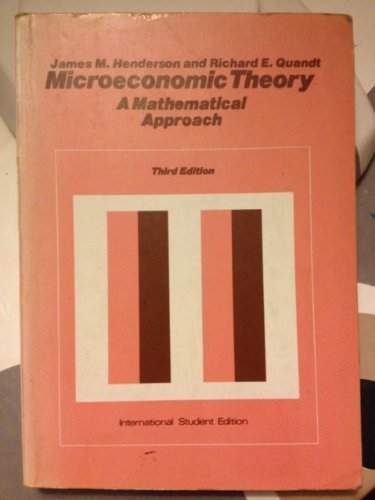
Title
Microeconomic Theory: A Mathematical Approach,Used
Sold by Ergodebooks, an authorized reseller.
Returns accepted within 30 days | support@ergodebooks.com
Shipping Information
- Free Standard Shipping — United States only
- Processing Time: 3–5 business days
- Estimated Delivery: 6–10 business days after dispatch
- Double-boxed, fully insured & discreetly packaged
- Tracking number sent via email once dispatched
Returns & Refund
Returns accepted within 30 days of delivery.
Damaged or Defective Item
Free return shipping + replacement or full refund
Wrong Item Received
Free return shipping + replacement or full refund
Change of Mind
Return shipping at customer's expense · 25% restocking fee applies
Payment Option

This Revision Of A Successful Text Is Intended For Undergraduate And Graduate Courses In Microeconomic Theory. Unusually Comprehensive In Coverage,It Offers A Rigorous Yet Accessible Presentation Of Microeconomic Theory. Mathematics Is Treated At A Uniform Level Throughout And Amply Integrated Into Each Chapter. Learning Aids Worked Examples,And Chapter Summaries,Problems,Suggested Readings,And Bibliographies.
⚠️ WARNING (California Proposition 65):
This product may contain chemicals known to the State of California to cause cancer, birth defects, or other reproductive harm.
For more information, please visit www.P65Warnings.ca.gov.
- Q: What is the page count of this book? A: This book has four hundred forty-eight pages. It provides a comprehensive overview of microeconomic theory suited for both undergraduate and graduate courses.
- Q: What are the dimensions of the book? A: The dimensions of this book are six point seventy-five inches by zero point seventy-five inches by nine point seventy-six inches. These measurements make it a compact hardcover suitable for easy handling.
- Q: What type of binding does this book have? A: This book is bound in hardcover. The hardcover binding contributes to its durability and longevity, making it a reliable resource for students.
- Q: Who is the author of this book? A: The author of this book is James Mitchell Henderson. He is known for his expertise in microeconomic theory and has crafted this text for educational purposes.
- Q: What subjects does this book cover? A: This book covers the subject of microeconomics. It is designed to provide a rigorous yet accessible understanding of microeconomic theory.
- Q: Is this book suitable for beginners? A: Yes, this book is suitable for beginners. It offers a comprehensive introduction to microeconomic theory, making it accessible for undergraduate students.
- Q: Can I use this book for graduate courses? A: Yes, this book is appropriate for graduate courses. Its thorough presentation of microeconomic concepts makes it a valuable resource for advanced studies.
- Q: Are there any learning aids in the book? A: Yes, the book includes learning aids such as worked examples, chapter summaries, problems, suggested readings, and bibliographies. These aids enhance the learning experience.
- Q: How do I use this book for studying? A: You can use this book by reading each chapter and completing the problems provided. The chapter summaries and learning aids will help reinforce your understanding of the material.
- Q: What age group is this book intended for? A: This book is intended for high school students and above. It is suitable for anyone looking to deepen their understanding of microeconomic theory.
- Q: How should I care for the book? A: To care for the book, keep it in a dry, cool place and avoid exposure to direct sunlight. This will help maintain its condition over time.
- Q: Is this book easy to read? A: Yes, the book is designed to be accessible. It balances rigorous mathematical treatment with clear explanations, making it understandable for readers at different levels.
- Q: What if the book arrives damaged? A: If the book arrives damaged, you should contact the retailer for a return or exchange. Most sellers have policies in place to address such issues.
- Q: Does this book include bibliographies? A: Yes, the book includes bibliographies. These references can guide further reading and study in the field of microeconomic theory.
- Q: What makes this book different from others on microeconomics? A: This book is unique due to its comprehensive coverage and integration of mathematics throughout the chapters. It provides an in-depth yet accessible approach to microeconomic concepts.
- Q: Who is the publisher of this book? A: The publisher of this book is McGraw-Hill Education. They are known for producing high-quality educational materials in various subjects.