
Title

Microscopic To Macroscopic: Atomic Environments To Mineral Thermodynamics (Reviews In Mineralogy & Geochemistry, 14),Used
Sold by Ergodebooks, an authorized reseller.
Returns accepted within 30 days | support@ergodebooks.com
Shipping Information
- Free Standard Shipping — United States only
- Processing Time: 3–5 business days
- Estimated Delivery: 6–10 business days after dispatch
- Double-boxed, fully insured & discreetly packaged
- Tracking number sent via email once dispatched
Returns & Refund
Returns accepted within 30 days of delivery.
Damaged or Defective Item
Free return shipping + replacement or full refund
Wrong Item Received
Free return shipping + replacement or full refund
Change of Mind
Return shipping at customer's expense · 25% restocking fee applies
Payment Option

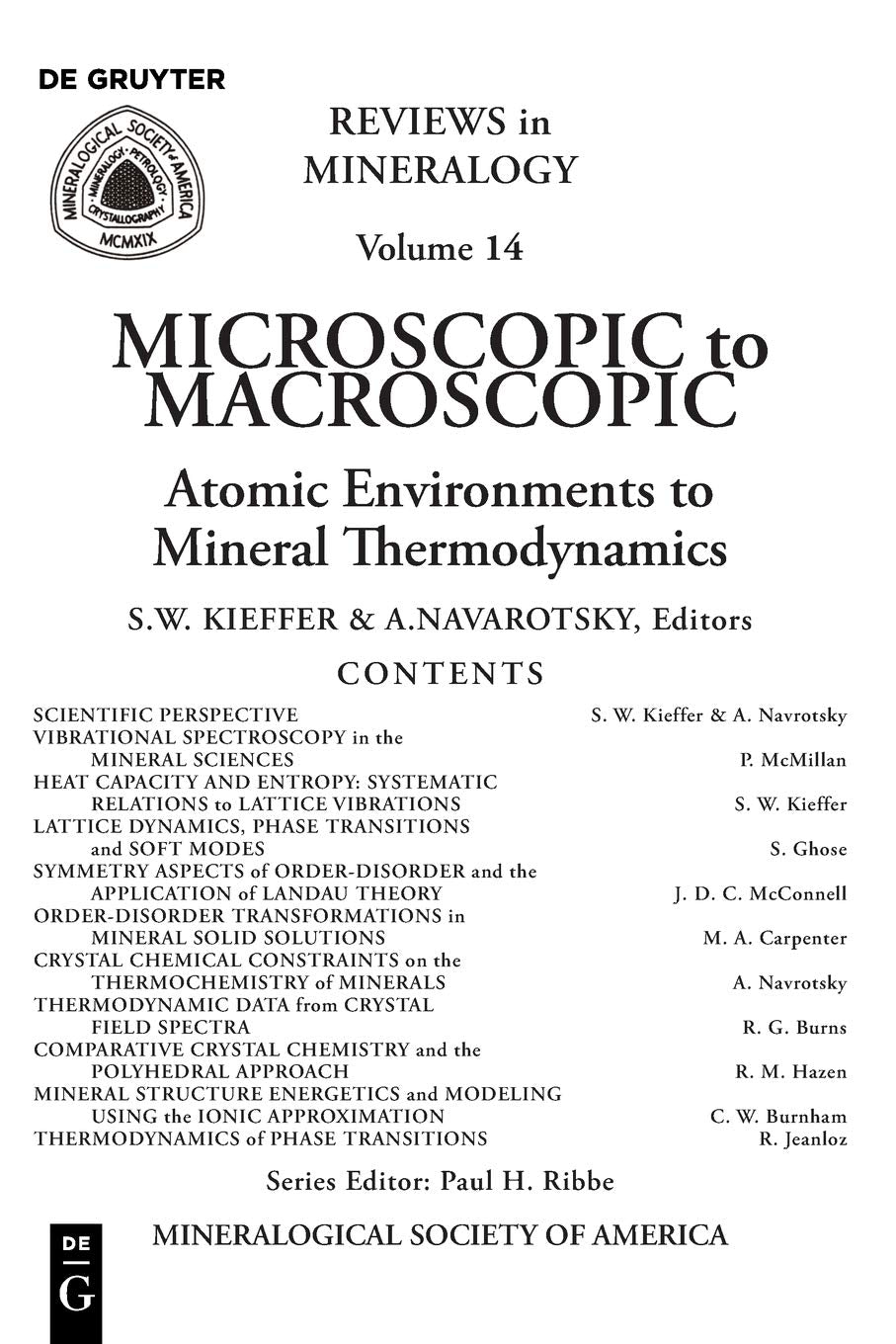
Volume 14 of Reviews in Mineralogy covers a short course about the relations among the microscopic structure of minerals and their macroscopic thermodynamic properties. Understanding the microtomacro relations provides a rigorous theoretical foundation for formulation of energy relations. With such a foundation, measured parameters can be understood, and extrapolation and prediction of thermodynamic properties beyond the range of measurement can be done with more confidence than if only empirical relations are used.The purpose of this course is to consider the microscopic factors that influence the free energy of minerals: atomic environments, bonding, and crystal structure. These factors influence the structural energy and the detailed nature of the lattice vibrations which are an important source of entropy and enthalpy at temperatures greater than 0 K. The same factors determine the relative energy of different phases, and thereby; the relative stability of different minerals. Configurational entropy terms arising from disorder also contribute to the energy and entropy. In transition metal compounds there are additional energy and entropy terms arising from the electronic configurations, leading to additional stabilizations, magnetic ordering, and, incidentally, color.Organized by Sue Kieffer and Alex Navrotsky, the course was presented by the ten authors of this book on the campus of Washington College in Chestertown, Maryland. This was the second of MSA's short courses to be given in conjunction with meetings of the American Geophysical Union.
⚠️ WARNING (California Proposition 65):
This product may contain chemicals known to the State of California to cause cancer, birth defects, or other reproductive harm.
For more information, please visit www.P65Warnings.ca.gov.