
Title
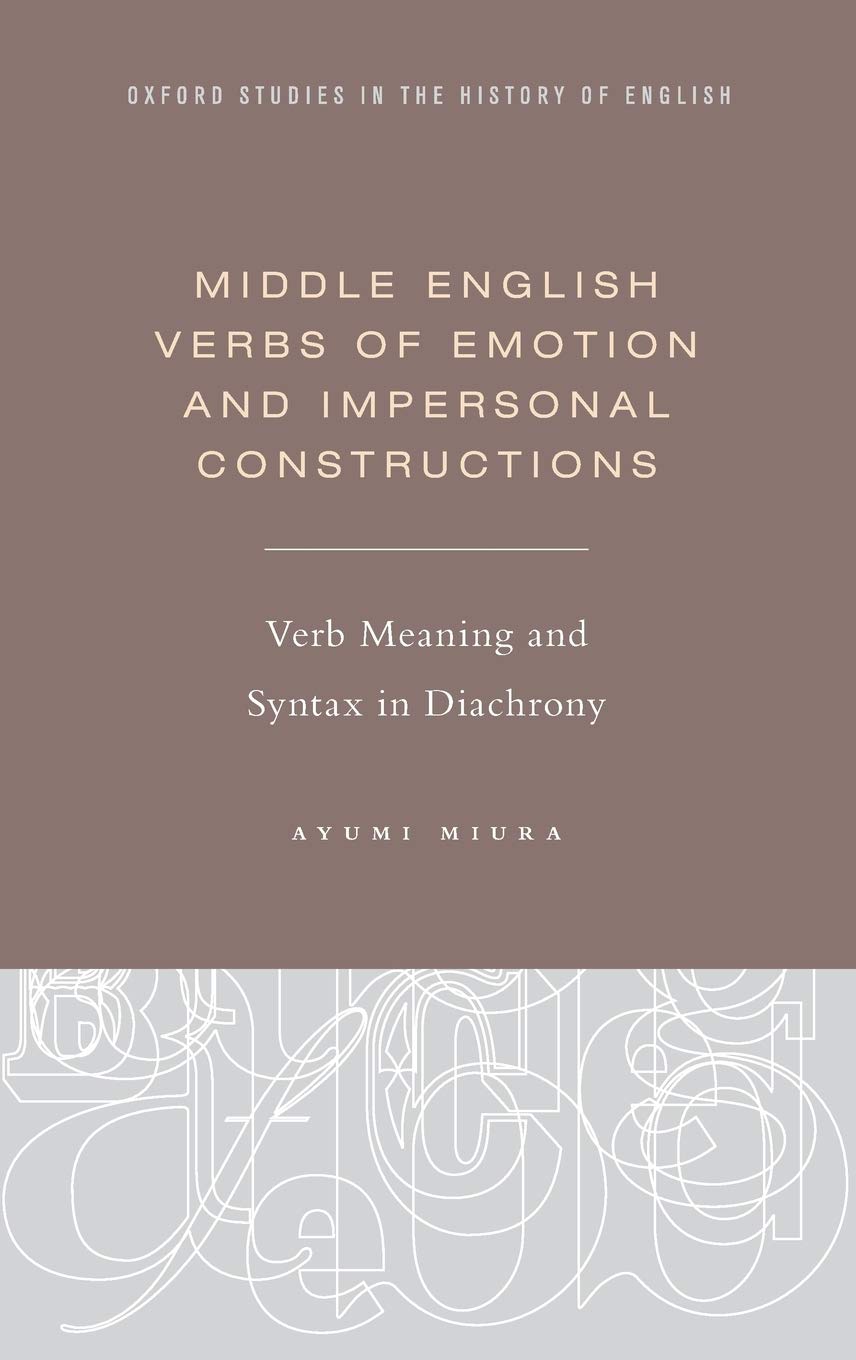
Middle English Verbs of Emotion and Impersonal Constructions: Verb Meaning and Syntax in Diachrony (Oxford Studies in the Histor,Used
Sold by Ergodebooks, an authorized reseller.
Returns accepted within 30 days | support@ergodebooks.com
Shipping Information
- Free Standard Shipping — United States only
- Processing Time: 3–5 business days
- Estimated Delivery: 6–10 business days after dispatch
- Double-boxed, fully insured & discreetly packaged
- Tracking number sent via email once dispatched
Returns & Refund
Returns accepted within 30 days of delivery.
Damaged or Defective Item
Free return shipping + replacement or full refund
Wrong Item Received
Free return shipping + replacement or full refund
Change of Mind
Return shipping at customer's expense · 25% restocking fee applies
Payment Option

Impersonal constructions in the history of English form a puzzling category, in that there has been uncertainty as to why some verbs are attested in such constructions while others are not, even though they look almost synonymous. In this book, Ayumi Miura tackles this underdiscussed question with special reference to verbs of emotion in Middle English. Through a careful study of the behaviour of impersonal and nearsynonymous nonimpersonal verbs, she identifies the factors that determined the presence, absence, and spread of impersonal usage with the verbs concerned. Miura utilizes modern linguistic approaches, including theories and methodologies adopted in the study of psychverbs in modern languages, which bear close relevance to impersonal verbs of emotion but have traditionally been researched separately. She also draws on categorizations in the Historical Thesaurus of the Oxford English Dictionary and harnesses the online Middle English Dictionary in a novel way, demonstrating that dictionary materials are in fact a valuable tool in the study of early English syntax and semantics.Miura concludes that a range of factors such as causation, transitivity, animacy of the target of emotion, and duration of the emotion influenced the choice of impersonal constructions with Middle English verbs of emotion. We can therefore make reasonable generalizations about when impersonal usage was licensed in these verbs. This careful analysis of the correlation between Middle English verbs of emotion and use or nonuse in impersonal constructions represents a new empirical and theoretical contribution to the busy research area of impersonal constructions in the history of English.
⚠️ WARNING (California Proposition 65):
This product may contain chemicals known to the State of California to cause cancer, birth defects, or other reproductive harm.
For more information, please visit www.P65Warnings.ca.gov.