
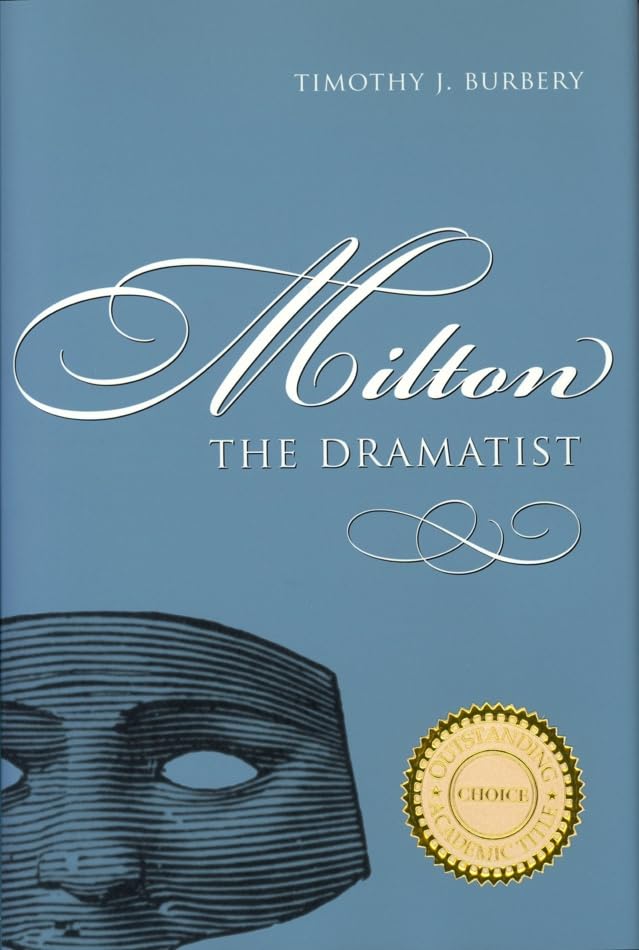
Title
Milton the Dramatist (Medieval & Renaissance Literary Studies),Used
Sold by Ergodebooks, an authorized reseller.
Returns accepted within 30 days | support@ergodebooks.com
Shipping Information
- Free Standard Shipping — United States only
- Processing Time: 3–5 business days
- Estimated Delivery: 6–10 business days after dispatch
- Double-boxed, fully insured & discreetly packaged
- Tracking number sent via email once dispatched
Returns & Refund
Returns accepted within 30 days of delivery.
Damaged or Defective Item
Free return shipping + replacement or full refund
Wrong Item Received
Free return shipping + replacement or full refund
Change of Mind
Return shipping at customer's expense · 25% restocking fee applies
Payment Option

This booklength study of Milton as a dramatist fills a longstanding gap in Milton scholarship. Combining authorcontextual criticism, historicized readerresponse theory, and new historicism, Timothy Burbery begins by answering common objections to the claim that the poet is a dramatist, including the putatively static natures of Comus and Samson Agonistes, Miltons egoism, and his Puritanism. Further, Burbery asserts, recent biographical evidence of Miltons consumption of drama, such as his fathers trusteeship of the Blackfriars Theater, suggests that the future poet viewed commercial plays and thus probably alludes to these experiences in his early poetry. Exposure to the public theater may also have influenced major episodes of his own dramas, including the debate between the Lady and Comus, and Dalilas stunning entrance in Samson.The study then examines Milton as a practitioner of drama by analyzing Arcades and the Ludlow masque. Having mastered the conventions of masque in the former work, Milton stretched himself in Comus by composing a work that was far more playlike than any court masque. It is possible that his success with these dramas encouraged Milton to regard himself as a budding dramatist in the 1630s, for late in that decade he began sketching out ideas for tragedies on biblical subjects including the Fall, Sodom, and Abraham and Isaac. This material, found in the Trinity Manuscript, shows him working through practical problems of staging and presentation, and sets the foundation for Paradise Lost and Samson Agonistes. While Samson was never intended for the stage, it nonetheless embeds numerous stage directions in its dialogue, including information about the characters appearances, gestures, and blocking. Awareness of these cues sheds light on some of the current critical debates, including the terrorist reading of the tragedy and Dalilas role. Burbery surveys the surprisingly extensive stage history of Samson, a history that tends to confirm its theatrical viability. Milton the Dramatist emphasizes Miltons dramatic achievements and thus restores a more equitable balance to our appreciation of his total literary achievement.
⚠️ WARNING (California Proposition 65):
This product may contain chemicals known to the State of California to cause cancer, birth defects, or other reproductive harm.
For more information, please visit www.P65Warnings.ca.gov.