
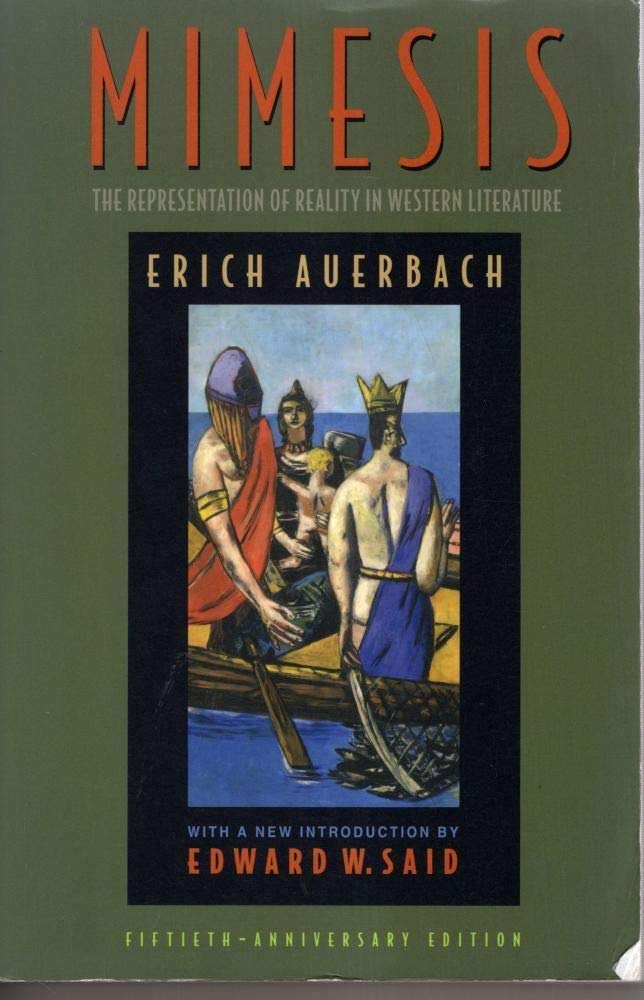
Title

Mimesis: The Representation Of Reality In Western Literature Fiftiethanniversary Edition
Sold by Ergodebooks, an authorized reseller.
Returns accepted within 30 days | support@ergodebooks.com
Shipping Information
- Free Standard Shipping — United States only
- Processing Time: 3–5 business days
- Estimated Delivery: 6–10 business days after dispatch
- Double-boxed, fully insured & discreetly packaged
- Tracking number sent via email once dispatched
Returns & Refund
Returns accepted within 30 days of delivery.
Damaged or Defective Item
Free return shipping + replacement or full refund
Wrong Item Received
Free return shipping + replacement or full refund
Change of Mind
Return shipping at customer's expense · 25% restocking fee applies
Payment Option

A Halfcentury After Its Translation Into English, Erich Auerbach'S Mimesis Still Stands As A Monumental Achievement In Literary Criticism. A Brilliant Display Of Erudition, Wit, And Wisdom, His Exploration Of How Great European Writers From Homer To Virginia Woolf Depicted Reality Has Taught Generations How To Read Western Literature. This New Expanded Edition Includes A Substantial Essay In Introduction By Edward Said As Well As An Essay, Never Before Translated Into English, In Which Auerbach Responds To His Critics.A German Jew, Auerbach Was Forced Out Of His Professorship At The University Of Marburg In 1935. He Left For Turkey, Where He Taught At The State University In Istanbul. There He Wrote Mimesis, Publishing It In German After The End Of The War. Displaced As He Was, Auerbach Produced A Work Of Great Erudition That Contains No Footnotes, Basing His Arguments Instead On Searching, Illuminating Readings Of Key Passages From His Primary Texts. His Aim Was To Show How From Antiquity To The Twentieth Century Literature Progressed Toward Ever More Naturalistic And Democratic Forms Of Representation. This Essentially Optimistic View Of European History Now Appears As A Defensiveand Impassionedresponse To The Inhumanity He Saw In The Third Reich. Ranging Over Works In Greek, Latin, Spanish, French, Italian, German, And English, Auerbach Used His Remarkable Skills In Philology And Comparative Literature To Refute Any Narrow Form Of Nationalism Or Chauvinism, In His Own Day And Ours.For Many Readers, Both Inside And Outside The Academy, Mimesis Is Among The Finest Works Of Literary Criticism Ever Written.
⚠️ WARNING (California Proposition 65):
This product may contain chemicals known to the State of California to cause cancer, birth defects, or other reproductive harm.
For more information, please visit www.P65Warnings.ca.gov.
- Q: What is the page count of this book? A: This book has six hundred sixteen pages. It provides an in-depth exploration of literary criticism across various genres.
- Q: What is the binding type of this book? A: The binding type is paperback. This makes it lightweight and easy to handle for readers.
- Q: What are the dimensions of this book? A: The book measures six point twenty-six inches in length, one point five inches in width, and nine point twenty-five inches in height. These dimensions make it a standard-sized paperback.
- Q: Who is the author of this book? A: The author is Erich Auerbach. He is renowned for his contributions to literary criticism and philology.
- Q: What is the main theme of this book? A: The main theme is the representation of reality in Western literature. Auerbach examines how various writers depict reality across different eras.
- Q: Is this book suitable for beginners in literary studies? A: Yes, this book is suitable for beginners. Auerbach's clear insights make complex literary concepts accessible to new readers.
- Q: How do I approach reading this book? A: You can approach reading this book by taking it chapter by chapter. It is beneficial to reflect on Auerbach's analyses of specific texts as you read.
- Q: Is there any recommended age for reading this book? A: This book is generally suitable for readers aged sixteen and older. Its themes and discussions are more relevant to those with a mature understanding of literature.
- Q: Can this book be used in academic settings? A: Yes, this book is widely used in academic settings. It is considered essential reading for literature and criticism courses.
- Q: How should I store this book to keep it in good condition? A: Store this book upright on a shelf in a cool, dry place. Avoid exposing it to direct sunlight to prevent fading.
- Q: What is the best way to clean this book? A: To clean this book, gently wipe the cover with a soft, dry cloth. Avoid using water or cleaning agents that could damage the material.
- Q: Is there a warranty or return policy for this book? A: Yes, there is a return policy. You can return the book within thirty days if it is in original condition.
- Q: What if the book arrives damaged? A: If the book arrives damaged, you should contact customer service for a replacement. Have your order details available for assistance.
- Q: Does this book include any essays by other authors? A: Yes, this edition includes a substantial introductory essay by Edward Said. It provides additional context to Auerbach's work.
- Q: Is this book available in other languages? A: Yes, this book has been translated into multiple languages. However, this specific edition is in English.
- Q: What distinguishes this edition from previous ones? A: This edition is distinguished by the inclusion of a previously untranslated essay by Auerbach. It offers fresh insights into his critical approach.