
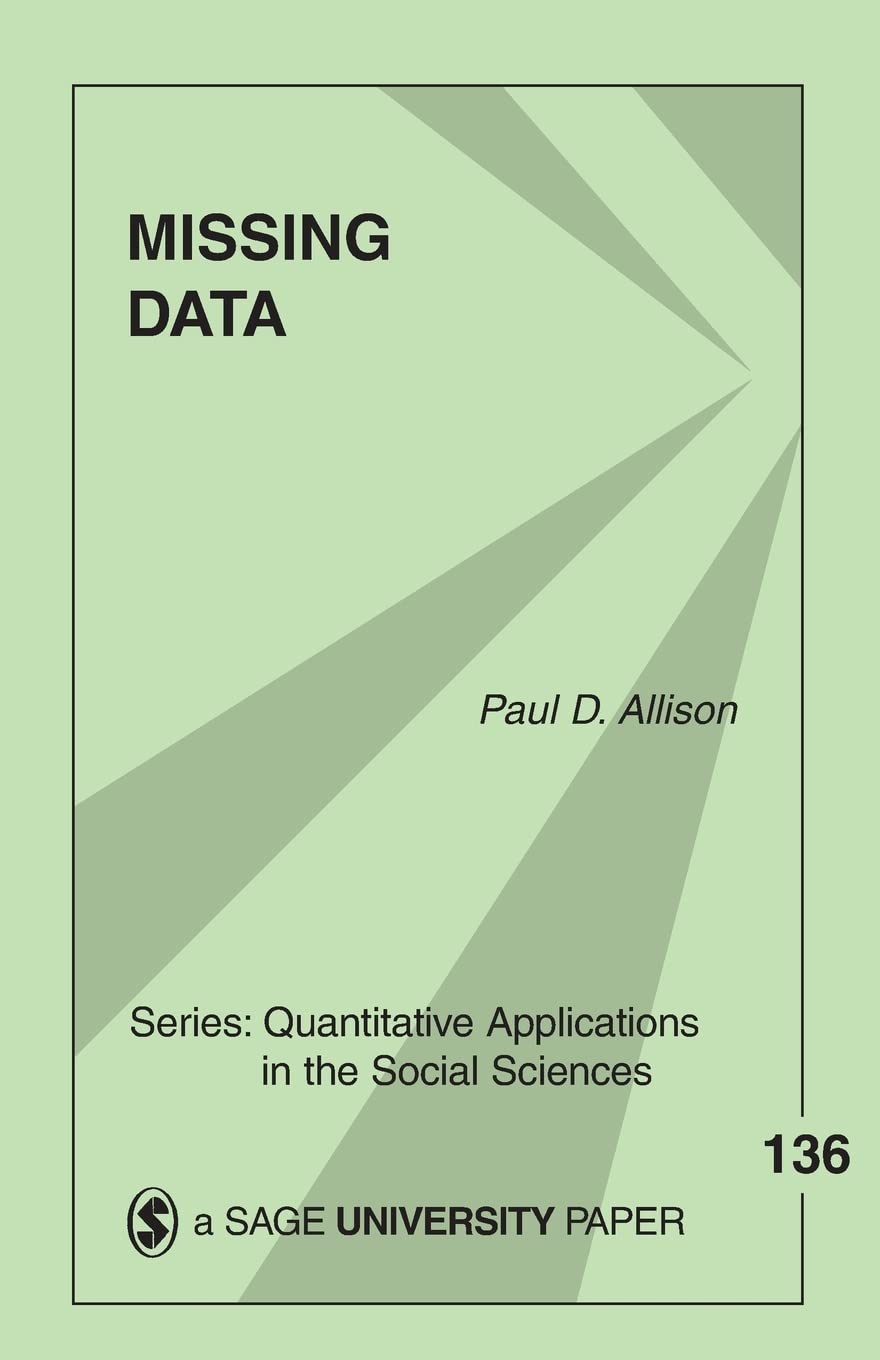
Title
Missing Data (Quantitative Applications In The Social Sciences)
Sold by Ergodebooks, an authorized reseller.
Returns accepted within 30 days | support@ergodebooks.com
Shipping Information
- Free Standard Shipping — United States only
- Processing Time: 3–5 business days
- Estimated Delivery: 6–10 business days after dispatch
- Double-boxed, fully insured & discreetly packaged
- Tracking number sent via email once dispatched
Returns & Refund
Returns accepted within 30 days of delivery.
Damaged or Defective Item
Free return shipping + replacement or full refund
Wrong Item Received
Free return shipping + replacement or full refund
Change of Mind
Return shipping at customer's expense · 25% restocking fee applies
Payment Option

Using Numerous Examples And Practical Tips, This Book Offers A Nontechnical Explanation Of The Standard Methods For Missing Data (Such As Listwise Or Casewise Deletion) As Well As Two Newer (And, Better) Methods, Maximum Likelihood And Multiple Imputation. Anyone Who Has Relied On Adhoc Methods That Are Statistically Inefficient Or Biased Will Find This Book A Welcome And Accessible Solution To Their Problems With Handling Missing Data.
⚠️ WARNING (California Proposition 65):
This product may contain chemicals known to the State of California to cause cancer, birth defects, or other reproductive harm.
For more information, please visit www.P65Warnings.ca.gov.
- Q: What is the page count of this book? A: This book has one hundred four pages. It provides a concise overview of missing data methods in social sciences.
- Q: What are the dimensions of this book? A: The dimensions of the book are five point five one inches in length, zero point two four inches in width, and eight point five inches in height.
- Q: What binding type does this book have? A: This book is bound in paperback. This makes it lightweight and easy to handle.
- Q: Who is the author of 'Missing Data'? A: The author is Paul D. Allison. He is known for his expertise in quantitative social science methods.
- Q: What subjects does this book cover? A: This book covers statistical methods for handling missing data. It is part of the Probability & Statistics genre.
- Q: How can I effectively use the methods in this book? A: You can apply the methods by following the practical tips and examples provided. The book guides you through both basic and advanced techniques.
- Q: Is this book suitable for beginners? A: Yes, this book is suitable for beginners. It offers nontechnical explanations that are easy to understand.
- Q: Who would benefit from reading this book? A: Researchers and practitioners dealing with missing data in social sciences will find this book beneficial. It addresses common problems and solutions.
- Q: Are there any specific techniques explained in this book? A: Yes, the book explains techniques like maximum likelihood and multiple imputation. These methods are more efficient than traditional approaches.
- Q: What is the target audience for this book? A: The target audience includes students and professionals in social sciences. It's designed for anyone needing to manage missing data.
- Q: How should I store this book? A: Store the book in a cool, dry place to prevent damage. Keep it away from direct sunlight to maintain its condition.
- Q: Can this book be damaged easily? A: Yes, like any paperback, it can be damaged if not handled carefully. Avoid bending the cover or pages.
- Q: What if the book arrives damaged? A: If the book arrives damaged, contact the seller for a return or replacement. Most sellers provide a clear return policy.
- Q: How do I maintain the quality of this book? A: To maintain quality, keep it clean and handle it gently. Avoid exposing it to moisture or extreme temperatures.
- Q: Is there a warranty for this book? A: No, books typically do not come with a warranty. However, check with the retailer for their specific return policies.
- Q: What if I need help with using the methods in this book? A: You can seek additional resources or consult with experts in statistics if you need help. Practical examples in the book can also guide you.