If you have any questions, you are always welcome to contact us. We'll get back to you as soon as possible, withing 24 hours on weekdays.
Customer service
All questions about your order, return and delivery must be sent to our customer service team by e-mail at yourstore@yourdomain.com
Sale & Press
If you are interested in selling our products, need more information about our brand or wish to make a collaboration, please contact us at press@yourdomain.com
Help
If you have any questions, you are always welcome to contact us. We'll get back to you as soon as possible, withing 24 hours on weekdays.
Customer service
All questions about your order, return and delivery must be sent to our customer service team by e-mail at yourstore@yourdomain.com
Sale & Press
If you are interested in selling our products, need more information about our brand or wish to make a collaboration, please contact us at press@yourdomain.com
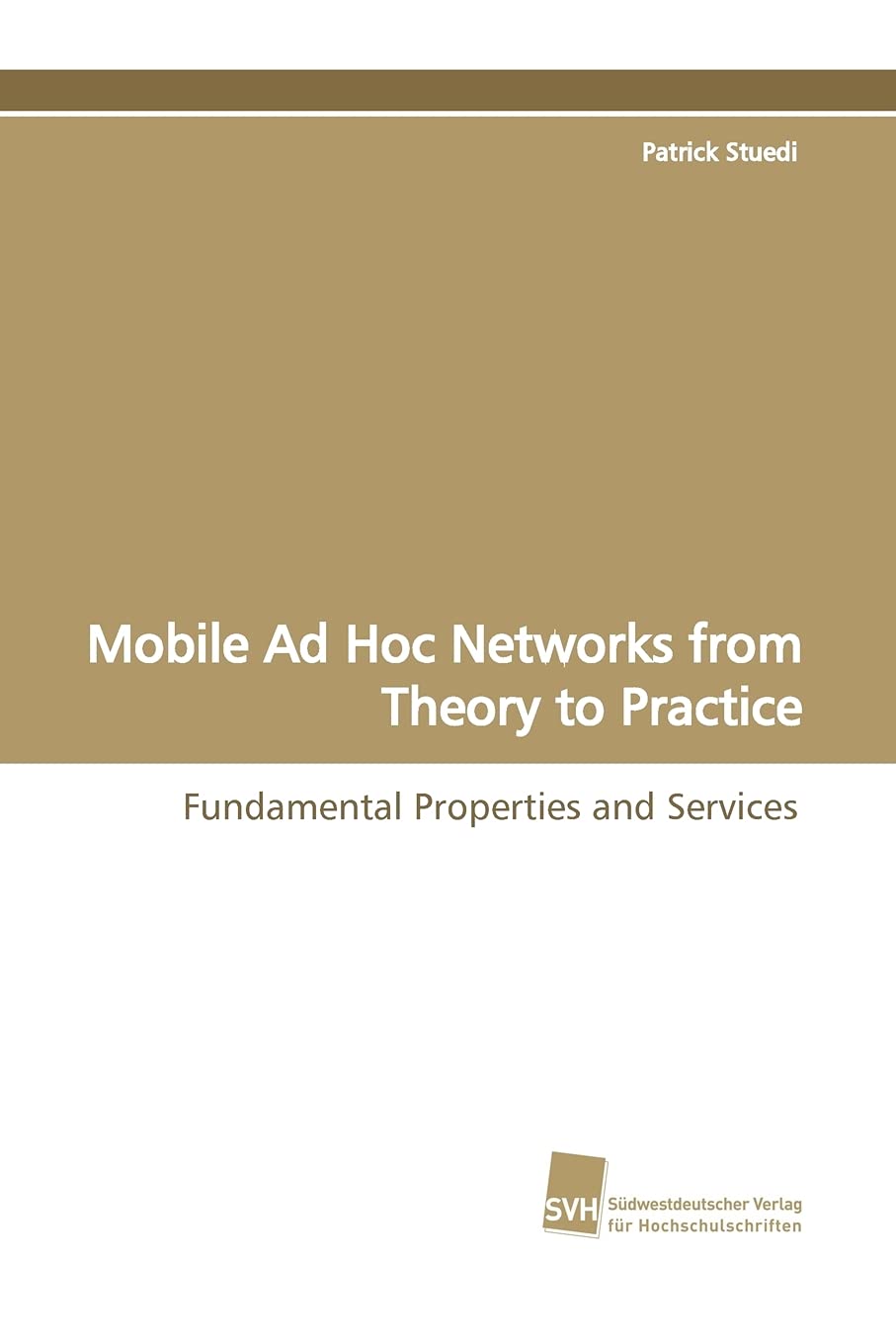
Mobile Ad Hoc Networks (MANETs) by definition operate without preestablished infrastructure. On the one hand side, this can be seen as an advantage since it makes them usable in situations where an infrastructure is not available, such as, e.g., in settings of emergency response. On the other hand, the lack of infrastructure poses difficult challenges to protocol design and software architecture for such networks. One example is wireless media access. In contrast to traditional wireless networks where nodes communicate through base stations, there is no dedicated network component to control the media access of the nodes in MANETs. This makes scheduling wireless transmissions complicated and affects the overall throughput capacity of the network. Another example are application level services. Many advanced applications on MANETs require basic services such as, e.g., DNS, SIP and SLP to operate. These services, however, typically rely on centralized components for storing the required networking information, components that are not available in MANETS. In this thesis, we study several problems occurring in MANETs at different places in the network stack.
⚠️ WARNING (California Proposition 65):
This product may contain chemicals known to the State of California to cause cancer,
birth defects, or other reproductive harm.
For MAP (Minimum Advertised Price) violations and Intellectual Property (IP) or Trademark concerns, please contact:
support@ergodebooks.com
⚠️ California Proposition 65 Warning: Some products sold on this website may expose you to chemicals known to the State of California to cause cancer, birth defects, or other reproductive harm. For more information, visit www.P65Warnings.ca.gov.